Dmytro CianBay · 24.11.2026 · 12 min read
Selling Products Online in Europe and the USA in 2027: What Merchants Need to Know
EU VAT and IOSS, US sales tax, import duties, shipping, returns and localization: what international merchants should plan and where WooCommerce fits.
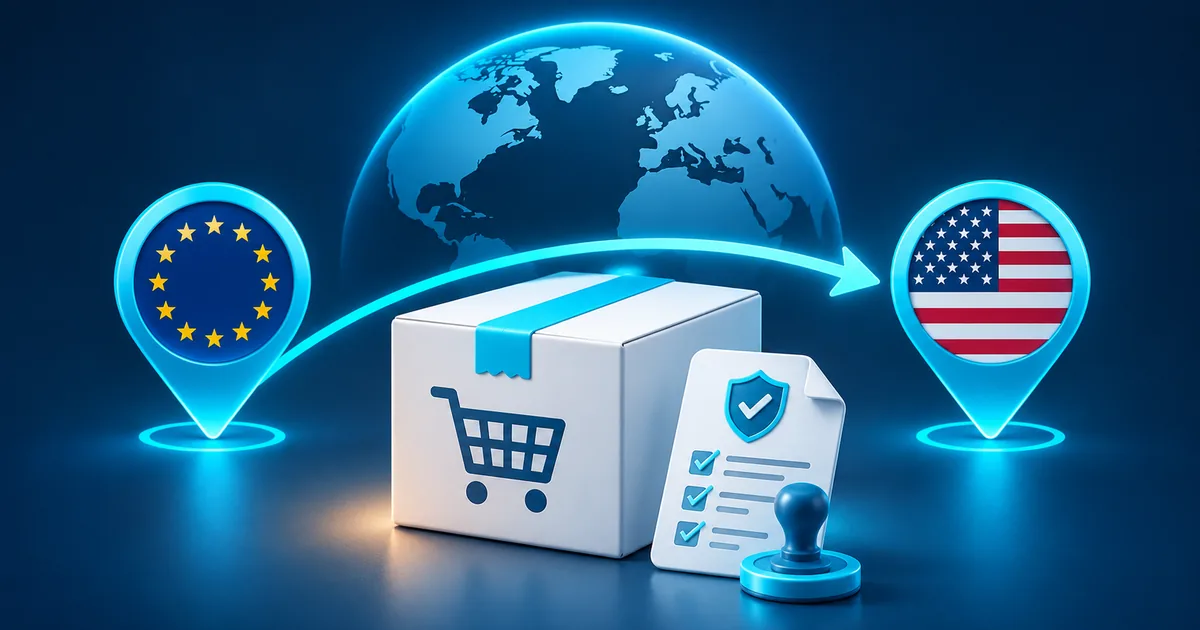
Selling a product to a customer in Paris or New York may look like the same transaction on a checkout screen. For the merchant, however, it can mean different import procedures, tax obligations, delivery promises and consumer expectations. The opportunity is real: one independent online store can reach buyers in several countries. The costly mistake is assuming that a translated product page and a currency switcher make the business internationally ready.
Selling online in Europe and the United States in 2027 is about designing a dependable commercial operation, not simply installing a shopping cart. This article explores what owners need to evaluate, why US and EU sales must be treated differently, and where WordPress and WooCommerce offer meaningful flexibility. It is a business analysis, not jurisdiction-specific tax or legal advice.
1. There are several international business models hiding behind one checkout
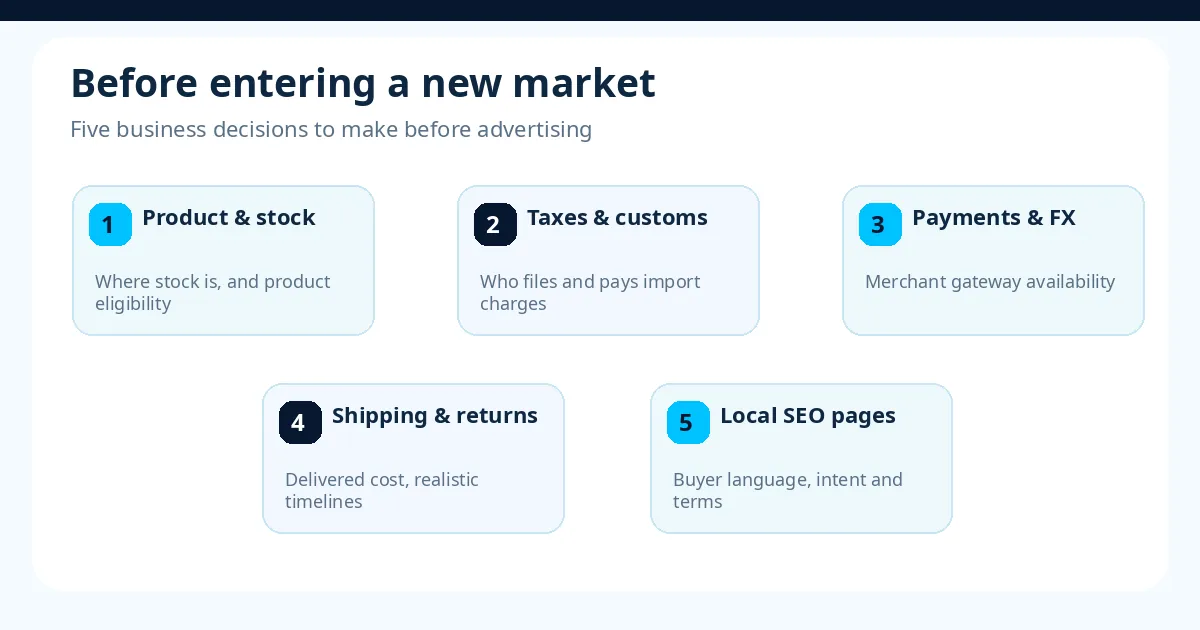
A merchant shipping from Poland to Germany is operating differently from a merchant shipping from Ukraine to Germany. A US company selling from a warehouse in New Jersey to customers in another state faces a third situation. The same product can have a different landed cost, tax treatment, delivery time and return route depending on where inventory is physically stored. A website cannot choose the commercially correct model on behalf of the company.
A practical market decision begins with product eligibility, inventory location, fulfilment partner, expected order value and profit per destination. Selling to twenty countries from day one is rarely a competitive advantage if delivery economics have never been tested. WooCommerce can organise country-specific selling and shipping zones, but the actual cross-border supply chain has to exist outside the plugin.
2. EU sales: distinguish intra-EU VAT rules from imported goods
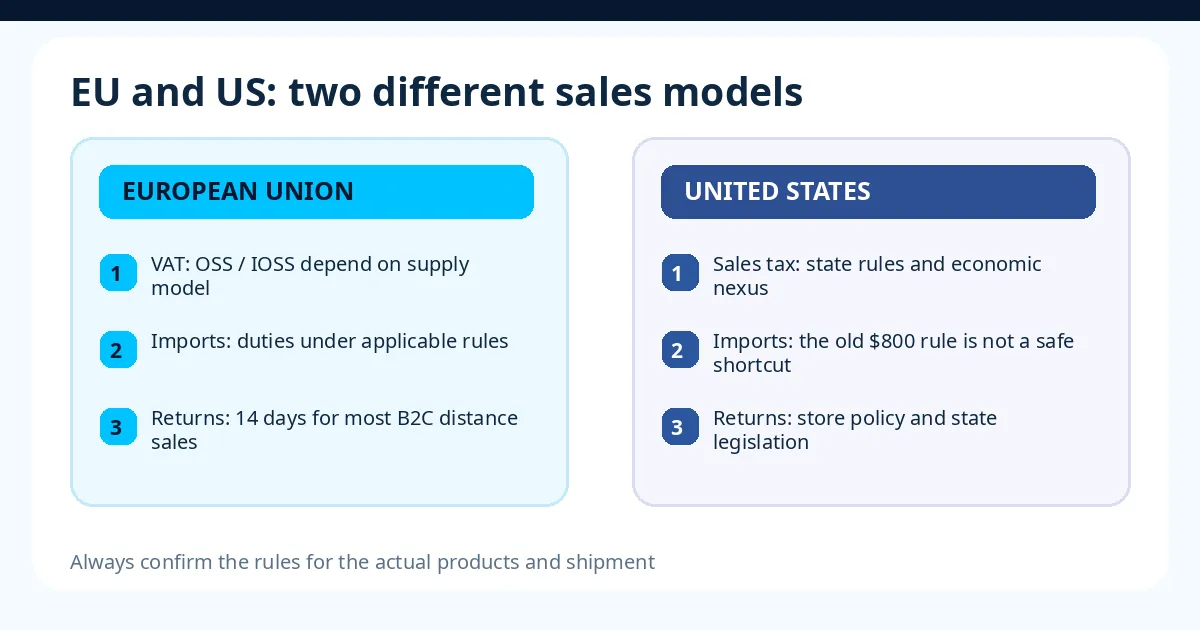
EU VAT applies within a common framework, yet there is no single simplistic checkout setting that solves all cross-border scenarios. When goods move between EU member states in qualifying B2C distance sales, the Union One Stop Shop, or OSS, can simplify reporting VAT due in other countries through a single member state of identification. A combined EU-wide €10,000 threshold exists under particular rules; it is not a universal tax-free allowance available to any overseas seller.
Imported goods follow a different route. The Import One Stop Shop, or IOSS, applies to specified distance sales of goods imported in consignments whose intrinsic value does not exceed €150. It facilitates collection of VAT in eligible circumstances; it does not erase customs formalities or make every shipment duty-free. A seller's establishment, inventory location and importer arrangements should determine the tax design before it is mirrored in WooCommerce prices.
3. The EU's 2026 low-value customs change matters for 2027 margins
From July 1, 2026, a temporary €3 customs duty per item applies in the defined low-value import arrangements for consignments up to €150. This is not a generic €3 charge per parcel, and it must not be confused with VAT. The regulation is a transitional measure associated with wider customs reform. Businesses offering inexpensive accessories, small gifts or multi-item orders should pay particularly close attention to how items are classified and charged.
Imagine a customer ordering several low-priced items from a warehouse outside the EU. If the merchant advertises a reassuring checkout total and the recipient later receives an unexpected payment request, the operational problem becomes a trust problem. Clear delivered-cost information protects conversion and customer support capacity. Proposed changes to the scope of IOSS discussed in November 2026 are not automatically effective rules; merchants must check the actual implementation status before pricing their 2027 catalogue.
4. US sales tax is a state-level decision, not a US-wide VAT rate
US sales tax varies by state and sometimes by local jurisdiction, product type and seller circumstances. Remote sellers may create an obligation to register and collect through physical or economic nexus. Thresholds are not uniform across states, and the relevance of marketplaces, inventory and fulfilment arrangements can change the analysis. A company should not rely on a single nationwide tax percentage just because most of its customers pay in dollars.
There is also an important distinction between sales tax collected on an order and import duties imposed when the goods cross the US border. They are separate issues. WooCommerce and supported tax services can calculate rates according to appropriate settings; they do not determine the underlying legal obligations of the seller. Store owners need a tax adviser familiar with the states and business model they actually serve.
5. US customs: the old $800 de minimis shortcut is no longer reliable
An outdated ecommerce article may still promise that goods entering the US under $800 avoid import duties. That is no longer a safe assumption. The United States suspended ordinary duty-free de minimis treatment for most low-value imports in 2025–2026, with rules and exceptions that depend on the merchandise and entry process. Import requirements must be checked against current US Customs and Border Protection guidance rather than a marketing slogan about small parcels.
A brand shipping physical goods from abroad must consider classification, origin, duty exposure, customs broker arrangements and who acts as importer of record. Some categories have additional regulatory controls, for example FDA-regulated merchandise. A good product can lose its pricing advantage if the customer is surprised by charges at delivery. A trusted store explains who pays and what happens if a package is stopped or returned by customs.
6. Delivery promises are commercial commitments, not decorative badges
International delivery is rarely one universal rate. Cost changes with destination, weight, dimensional weight, carrier, customs clearance and failed-delivery risk. It also matters whether the commercial arrangement is effectively DDP or DAP: the parties may bear different responsibilities for import charges and clearance. Those distinctions belong in the fulfilment contract and customer-facing terms, not only in a private spreadsheet.
EU shoppers may value familiar collection points and local carriers, while US shoppers may expect address delivery and accurate shipment tracking. A store should explain estimated dispatch and delivery windows separately. Do not promise five-day delivery when your supplier only commits to dispatch in five days. WooCommerce shipping zones can support regional methods and pricing, but carrier integrations and shipment-status messages still require testing with real orders.
7. Currency, payment method and merchant eligibility are separate questions
Showing euros, dollars and zloty does not establish that a merchant can collect all three currencies through its payment provider. Display currency, charge currency and settlement currency can differ, and each conversion may carry a cost. Payment gateway availability depends on the merchant's business location, verification status, supported payment methods and contractual conditions.
For a US audience, card payments and digital wallets may be expected. In Poland, local methods such as BLIK can matter. In other EU countries, preferences vary. WooCommerce can integrate different gateways, but a developer should not advertise a specific method as available until the merchant's eligibility, provider support and checkout behaviour have been confirmed. The independent storefront gives choice, not a licence to bypass financial-services rules.
8. Localization must address decisions, not just words
A US buyer may expect measurements in inches and pounds, a different address format and clear sales-tax information. A Polish customer may judge a price in PLN and delivery through local services. A German customer may have different expectations of warranty explanations and payment methods. A single machine-translated page often misses the details that make a buyer comfortable placing an expensive order.
Professional localization includes product terminology, category structure, local search intent, dimensions, currency presentation, return address and customer-support language. On WordPress, market-specific editorial pages can be built without replacing the whole storefront. WooCommerce can be extended with multilingual and multi-currency tools, but the availability of paid extensions, maintenance obligations and compatibility across updates should be budgeted rather than hidden.
9. Returns and consumer rights: the EU and US are not equivalent
For many EU distance-purchase contracts, consumers have a 14-day withdrawal right, subject to defined exceptions. There are also separate rights concerning product conformity and legal guarantees. US retailers do not operate under a comparable blanket federal 14-day online return rule; policies and state laws matter, alongside specific federal shipping-promise requirements. The FTC's Mail, Internet, or Telephone Order Merchandise Rule expects a reasonable basis for promised shipping times and requires an appropriate delay-or-refund response when deadlines cannot be met.
Returns are also an economic variable. A return from another continent may be expensive enough to eliminate the margin. Some merchants use regional return addresses, local refurbishing or commercially reasonable compensation, while remaining compliant with applicable consumer law. Buyers should not have to discover the return destination after paying. Clear policies are an operational advantage, not merely legal page content.
10. Product compliance is broader than the privacy policy
Merchants cannot make a non-compliant product safe by publishing a polished product card. The EU's General Product Safety Regulation and category-specific rules can affect product information, traceability and obligations of economic operators. In the US, regulators and requirements differ across food, cosmetics, children's products, electronics and other categories. These considerations can affect whether a product is suitable for a market before a single advertisement is purchased.
Separately, the shop processes personal information such as addresses, contact details, order histories and analytics signals. GDPR may apply to certain businesses targeting EU customers, but compliance depends on facts such as scope, lawful basis and third-party processing. Cross-border privacy assessment and product-safety obligations are different workstreams. A cookie banner is not a substitute for either one.
11. A worked example: why international revenue can conceal a loss
Consider a hypothetical product sold for €70. Product cost is €28, fulfilment and delivery €13, packaging €2, payment costs €3, expected returns and support €4, and acquisition costs €12. Only €8 remains before duties and applicable taxes. If an additional €6 is unexpectedly borne by the seller during import, nearly the entire expected contribution is gone. This is an illustrative calculation, not a published result or a CianBay client case.
The useful metric is contribution after variable costs for each destination, not gross revenue across all markets. A US market can bring higher order values but greater import complexity; an EU warehouse can shorten delivery but add storage and local compliance costs. Sellers should compare channels by fulfilled orders, actual contribution, return rate, chargebacks and repeat purchases rather than traffic alone.
12. Why a self-owned WordPress and WooCommerce store is compelling
WooCommerce gives the merchant control of product data, site structure, content, customer journeys and integration choices. Market-specific shipping zones, a multilingual catalogue, payment gateways, CRM connections and regional SEO pages can be implemented without turning the company into a tenant of one proprietary storefront builder. A growing merchant can adapt the operation as new countries become commercially viable.
That flexibility still carries responsibility. Updates, plugin compatibility, security, backups, performance, checkout testing and accurate tax configuration have ongoing costs. For businesses that prioritise an entirely outsourced, standardised experience over deep customization, a different hosted model may be a better operational fit. WooCommerce is strongest when ownership and extensibility solve a real business need, not when it is sold as universally free or effortless.
13. International SEO works when commercial facts match the market
A category that ranks for one phrase in Ukraine may need a different taxonomy and vocabulary for US and European buyers. International SEO requires local search research, useful category copy, correct language and regional signals, and consistent product facts across visible pages, structured data, feeds and checkout. Country flags without localized buyer information are not a marketing strategy.
For AI-driven discovery and conventional search alike, accurate information about price, availability, delivery regions, product specifications and returns improves the usefulness of the page. No search engine or AI assistant guarantees placement because a site claims to be GEO-ready. A sound publishing strategy connects factual answers to genuine products and keeps them updated when shipping or taxes change.
14. A smarter launch sequence for a limited budget
The most useful starting point is not ten translated homepages. Choose a defensible product assortment, one clear US or EU fulfilment route, payment methods actually accessible to the merchant, and a landed-cost model. Make one successful shipping and return cycle before expanding to more destinations. Study the questions support receives from real customers and improve the store accordingly.
CianBay develops WordPress and WooCommerce stores for businesses in Ukraine and international markets. The studio can build multilingual product structures, regional customer journeys, payment and delivery integrations, practical SEO foundations and order workflows. Tax registration, customs representation and jurisdiction-specific legal positions should be approved with qualified specialists. Technology supports a business plan; it does not replace one.
FAQ: questions merchants ask before selling abroad
Can one WooCommerce store serve both the EU and the United States?
Yes. A single store can provide different languages, destinations, payment options and shipping terms. That does not make tax registration, customs or consumer-law responsibilities uniform. Those decisions must be evaluated by market and seller.
Does registering for OSS mean IOSS is also covered?
No. They are distinct schemes for different transaction types. The location of inventory, seller establishment, shipment value and route influence eligibility and filing requirements. Consult a qualified VAT adviser before enabling tax rules.
Are packages worth less than $800 still duty-free in the US?
Do not rely on that blanket statement. The previous de minimis treatment for most low-value imports has been suspended. Classification, origin, current tariff rules and relevant exceptions matter, and US CBP guidance should be checked for the actual shipment.
Can a currency switcher automatically handle international taxes?
No. Currency presentation and tax compliance are separate. WooCommerce requires correct tax assumptions and may need dedicated services; the legal obligations cannot be inferred from a buyer's IP address alone.
What is the first investment that usually matters most?
Clarity about fulfilment and margin: identify where inventory ships from, calculate delivered cost, verify merchant payment eligibility and make returns workable. A beautiful translated website cannot compensate for an unprofitable or unreliable shipping promise.
Related CianBay reading
- Why online shoppers do not trust a store
- Why a store has traffic but no profit
- Migrating from Shopify to WooCommerce without overlooking SEO
Official sources and documentation
- European Commission: VAT OSS
- Your Europe: OSS and IOSS
- European Commission: temporary customs duty for low-value imports
- European Commission: November 2026 IOSS agreement
- Your Europe: online purchase returns
- Your Europe: B2C distance selling
- Streamlined Sales Tax: remote seller state guidance
- US CBP: continuing suspension of de minimis
- US FTC: shipping promises and refunds
- FDA: import basics
- WooCommerce: multiple regions and currencies
- WooCommerce: shipping zones
- WooCommerce: taxation configuration