Dmytro CianBay · 26.11.2026 · 13 min read
Furniture ecommerce website on WooCommerce in 2027: configurators, price calculators and delivery
Build a furniture online store with product configuration, price calculators, freight, assembly and compliant product information. Explore scope and costs.

Buying furniture online is not simply a matter of choosing an attractive photograph and clicking a checkout button. A customer needs to know whether a sofa will fit through the front door, which upholstery is available, how long production takes, and whether delivery includes carrying the item upstairs or assembling it. When these answers are missing, the website transfers the burden of completing the sale to a salesperson. A well-designed store instead makes the decision easier while giving the business accurate order information.
WordPress and WooCommerce offer a flexible foundation for an independent furniture ecommerce website. The important architectural decision is whether the business sells stocked goods, modular furniture, individually manufactured products or a combination of all three. The answer determines the kind of catalogue, configurator, pricing engine and fulfilment workflow the website requires. This guide considers practical business choices for launching a furniture store in 2027, including relevant European and US regulatory requirements.
Contents
- Choose a store model before commissioning development
- Build product pages that answer practical questions
- Product variations, configurators and 3D visualisation
- Price calculators and specification approval
- Freight, white-glove delivery and installation
- Connect stock, production and customer service
- Legal requirements for furniture sold into the European Union
- Requirements for furniture sales in the United States
- SEO, marketplaces and product discovery
- How much does a furniture WooCommerce store cost and where to commission it?
- Frequently asked questions
Choose a store model before commissioning development
A retailer of ready-made furniture may need a straightforward online catalogue with accurate inventory, payment processing and delivery options. Each bookcase, chair or desk can be represented as a stock item. A manufacturer offering a choice of standard colours or dimensions may use variable products, with distinct stock keeping units where appropriate. A seller should not create separate inventory records for every possible combination if the product is only assembled after an order.
A modular furniture system is different. Each sofa section, cabinet module or shelf has its own dimensions and compatibility requirements. The customer must be guided towards a combination that can actually be manufactured, delivered and assembled. The project therefore includes a rules engine as well as a visual interface. Complex fitted kitchens, wardrobes and custom joinery may need a quotation workflow rather than a fixed-price checkout. A preliminary estimate can lead to a site measurement, a drawing and a formally approved quotation.
These models can coexist. A furniture manufacturer can sell standard bedside tables through the checkout, allow configuration of a modular sofa, and accept quote requests for fitted wardrobes. This is often more commercially useful than forcing every product into the same purchasing flow. Define the business model first and select extensions or custom development second.
Build product pages that answer practical questions
Useful furniture specifications include assembled dimensions, packaged dimensions, product weight, frame materials, upholstery, finishes, care instructions, contents of the package and assembly requirements. A sofa bed needs dimensions in both positions. A cabinet may need information about door clearance, internal shelving and manufacturer-specified wall anchoring. Product photographs should communicate scale, while dimension drawings help customers check their available space.
Filters should reflect the actual reasons people choose furniture: width, depth, material, seating capacity, colour, style, room, stock status and delivery lead time. Product information obtained from different suppliers must be normalised. One supplier might use inches while another uses centimetres; one may quote the product width while another quotes package width. Treating these as equivalent creates a poor shopping experience and potentially expensive delivery errors.
A premium appearance can be achieved without making every product page a heavy multimedia experience. Use optimised images, close-ups of the texture, photographs of actual samples and accessible controls. Be transparent that colours displayed on screens may differ from physical fabric or timber. Offering a swatch sample can be more useful than an expensive visual effect when finish selection is the main purchase barrier.
Product variations, configurators and 3D visualisation
Consider a sofa offered in three sizes, twenty fabrics, two orientations and three leg finishes. That creates up to 360 combinations, even before other optional features. WooCommerce variable products suit independent variants that have defined prices and inventory. Add-on extensions can represent additional selections. A custom configurator is appropriate when combinations depend on rules, calculated prices or manufacturing restrictions.
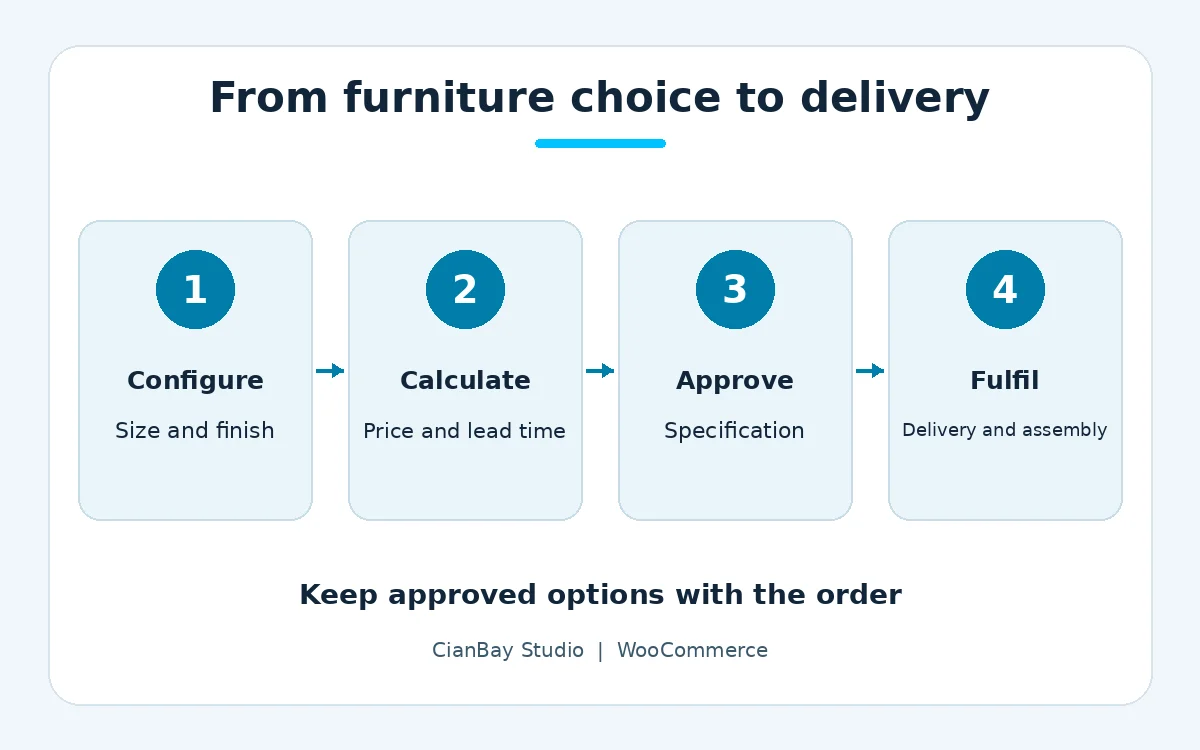
A useful configurator should only allow compatible options, update the product specification and show a meaningful price and lead time. Choosing a premium fabric might increase the price and change the manufacturing schedule. Selecting a corner orientation should make it unambiguous whether the customer is viewing the sofa from the front. For modular sofas, a diagram can prevent customers from combining incompatible connecting elements. The system should never imply that an unavailable finish can be supplied just because a product image exists.
Three-dimensional or augmented reality visualisation is a separate investment. Accurate dimensions, properly prepared models, textures, licensing and mobile performance all affect the cost. A visual representation helps shoppers imagine the result, but it is not a replacement for checking actual dimensions and building access. Begin with the decisions that cause the most support requests or incorrect orders. A simple, well-tested configuration workflow may have greater value than a sophisticated viewer with incomplete product data.
Price calculators and specification approval
A configured product requires a reliable pricing model. For example, an illustrative sofa might have a base price of €700, an upholstery upgrade of €90, an extra section of €120, freight of €60 and assembly of €40. Assuming all figures use the same tax basis, the total is €1,010. These numbers demonstrate calculation logic and are not market quotes. Taxes, discounts and currency conversions must be handled consistently.
Cabinet and kitchen pricing may include board area, hardware, edging, machining, labour, waste, minimum charges and installation. A simple multiplication of width and height is not a manufacturing estimate unless the manufacturer has explicitly approved that pricing method. When a measurement or site assessment is required, label the online result as an estimate and agree the final specification and price before the relevant contract is concluded.
Store the chosen dimensions, finish codes, hardware, orientation, pricing components and version of the specification with the order. An old order should remain intelligible even when the catalogue changes. The final price must be validated by the server rather than trusted solely because the browser displays it. Test rounding, promotional discounts, minimum and maximum dimensions and invalid combinations. These checks protect both customer trust and the retailer's margins.
Freight, white-glove delivery and installation
Furniture shipping is rarely equivalent to standard parcel delivery. A large product may arrive in several cartons, occupy pallet space, require a two-person team or be delivered by an appointment service. Product weight alone is insufficient: packaged dimensions, number of pieces, destination, carrier restrictions and access conditions matter. WooCommerce shipping classes can distinguish small accessories from bulky items, but a class is not a complete freight pricing or dispatch system.
For a European store, delivery may involve a parcel carrier for small items and pallet or specialist furniture transport for larger goods. A US seller may offer curbside freight, threshold delivery, room-of-choice service or white-glove assembly. The names and exact inclusions depend on the provider. State clearly whether stairs, unpacking, packaging removal, assembly and removal of old furniture are included. If a reliable automatic price is not available, a freight quotation is better than an invented flat rate.
Capture the details that genuinely influence service availability, such as lift access, floor level and delivery restrictions, without collecting unnecessary personal information. A customer should know which parts of the delivery process will be confirmed later. Order tracking and appointment updates should reflect actual logistics events, not optimistic estimates. Define how the seller handles damaged packages, missing components, failed deliveries and statutory remedies. A delivery condition must not be used to remove rights that applicable law gives consumers.
Connect stock, production and customer service
Stocked furniture requires reliable SKU-level availability. Made-to-order products require a different status reflecting material availability, production capacity and confirmed completion dates. Calling a product in stock when it has yet to be made misleads customers and creates unrealistic delivery expectations. Supplier feeds can be useful, but their update frequency, reserved stock and the definition of lead time need to be agreed.
A CRM workflow can record quote requests, measurements, specification approval, deposits, production milestones, dispatch and assembly. A manufacturing ERP may remain the source of truth for materials and production schedules. WooCommerce should not pretend to replace a full manufacturing resource planning system without a separately specified project. A versioned order record gives the sales team and production team the same confirmed specification.
Automation should reduce duplicate entry and improve visibility. Define what happens when an external system is offline, when a fabric becomes unavailable, or when a supplier changes a price after an estimate has been issued. A useful integration makes these exceptions visible to staff instead of silently changing confirmed orders. Payment links and deposit schedules should correspond to the actual commercial agreement and local consumer law.
Legal requirements for furniture sold into the European Union
For EU distance sales, the Consumer Rights Directive 2011/83/EU establishes a general fourteen-day withdrawal period and an exception for goods made to the consumer's specifications or clearly personalised. The exception is not a blanket exclusion for all items produced after purchase. Selecting an option in a catalogue does not automatically establish that every product qualifies. The rules concerning defective or non-conforming goods remain applicable, including the EU minimum legal guarantee of two years for consumer goods, subject to national implementation. Inform customers about return freight costs where they are responsible for those costs, including relevant information for goods that cannot normally be returned by post.
The General Product Safety Regulation (EU) 2023/988 also has specific provisions for online offers. Article 19 requires relevant product identification, manufacturer contact details, the EU responsible person's details when required, and applicable warnings or safety information in a language readily understood by consumers as determined by the destination country. A product page is therefore part of the compliance process, not merely a sales brochure. Obtain verified information from suppliers and ensure that the underlying products comply.
Commission Regulation (EU) 2023/1464 introduced a REACH restriction on formaldehyde emissions applicable to relevant furniture and wood-based articles placed on the market after 6 August 2026. The limit is 0.062 mg/m³ under specified test conditions, with defined exceptions. It is not a generic claim that a website can certify a piece of furniture as safe. Manufacturers and importers need to verify applicability and supporting evidence. For cross-border trading, also check tax, packaging, product-specific obligations and national rules before launching in each destination market.
Requirements for furniture sales in the United States
US furniture retailers and manufacturers must identify which federal and state requirements apply to their products. The Consumer Product Safety Commission provides guidance for covered clothing storage units under 16 CFR part 1261, addressing stability and tip-over hazards, and for upholstered furniture under 16 CFR part 1640, addressing flammability. Scope and exemptions matter: not every cabinet or upholstered item is regulated in the same way. Certain children's products and mattresses may have additional requirements.
Composite wood products and finished goods that contain covered materials can be subject to the EPA's TSCA Title VI formaldehyde standards, with role-specific requirements for manufacturers, importers, distributors and retailers. Maintain relevant supplier documentation and do not publish unsupported environmental or safety claims. A useful product information workflow allows technical documents and safety notices to be maintained without confusing customers with irrelevant certificates.
The FTC's Mail, Internet, or Telephone Order Merchandise Rule requires covered sellers to have a reasonable basis for advertised shipment times, or generally 30 days if no time is specified. When shipment cannot occur within the applicable time, follow the rule's delay-consent or refund requirements. This is especially important for long-lead furniture. A made-to-order policy does not exempt a retailer from its delivery obligations. Return policies must also account for applicable state requirements and consumer remedies. Review tax nexus and local rules rather than assuming one US policy applies everywhere.
SEO, marketplaces and product discovery
Category pages should reflect the language buyers actually use: compact dining tables, modular sectional sofas, solid wood desks or narrow wardrobes. Support those pages with relevant filters, clear specifications, genuine photography and useful internal links. Do not automatically publish thousands of near-duplicate URLs for every fabric combination. Search visibility depends on useful and accessible information, not simply on the number of pages.
Google Merchant Center and shopping campaigns can support eligible products when the feed accurately represents price, currency and availability. Items requiring a quotation or site measurement need a separate assessment of channel eligibility. Product structured data should agree with visible information. A marketplace or social platform may be an additional discovery channel, while the independent store provides more space for configuration and direct customer service.
Test the full mobile purchase journey, including image zoom, option selectors and freight estimates. Measure configuration starts, quote requests, checkouts, completed sales and cancellations. A furniture project can have a long consideration period, so a lead that eventually converts may be more valuable than an immediate but unsuitable checkout. Collect analytics and marketing data in accordance with the applicable privacy and consent requirements.
How much does a furniture WooCommerce store cost and where to commission it?
CianBay Studio offers basic WooCommerce store development from €600 for an agreed standard catalogue, checkout, payment and delivery setup. Custom configuration rules, manufacturing price formulas, 3D asset production, freight APIs and ERP integration are separately assessed. A complex furniture manufacturing website is not automatically included in the entry price. A combined WooCommerce, CRM and basic SEO solution starts from €1,200, with the final scope determined by the business requirements.
The core WooCommerce plugin does not require a mandatory platform subscription, but hosting, support, commercial extensions, payment providers and external services can create recurring costs. Plan these expenses alongside development, not after the website goes live. If an external configuration service is needed, clarify ownership of its account, data export rights, pricing and what happens if the subscription ends.
To commission a store, prepare representative products, actual pricing rules, material samples, delivery zones, existing stock systems and a description of the quotation workflow. CianBay Studio works with clients in Ukraine and internationally. The objective is to build a store that reflects the actual way furniture is sold and fulfilled, with room to expand the catalogue and add more advanced features when they make economic sense.
Store development · Pricing · Combined solution · Contact us
Frequently asked questions
Can I sell stocked furniture and made-to-order products on the same site?
Yes. Standard products can use checkout while complex configurations can lead to a quotation and approval workflow.
Does the €600 entry price include a 3D configurator?
No. Model creation, compatibility logic and visualisation complexity need to be assessed separately.
Can the website calculate freight and assembly automatically?
Yes, where reliable package data and service tariffs are available. Some deliveries still require a confirmed quote.
Are custom furniture orders always non-refundable?
No. Withdrawal exceptions depend on the applicable law and product specification; rights regarding defects and non-conformity are separate.
Can the website integrate with an existing manufacturing system?
Yes, provided the necessary data access and interfaces exist. The integration scope is assessed separately.
Sources
- WooCommerce: Product Add-ons
- WooCommerce: Shipping classes
- EU Consumer Rights Directive 2011/83/EU
- Your Europe: Consumer guarantees and returns
- GPSR: Regulation (EU) 2023/988
- REACH: Regulation (EU) 2023/1464
- CPSC: Clothing storage units
- CPSC: Upholstered furniture
- EPA: TSCA Title VI
- FTC: Mail, Internet, or Telephone Order Merchandise Rule