Dmytro CianBay · 26.11.2026 · 12 min read
Selling digital products through your own WooCommerce store in 2027: ebooks, templates and downloadable files
Sell ebooks, templates and files with your own WooCommerce store. Explore secure downloads, licences, taxes, payments and development costs.

A digital product can be delivered to thousands of customers without a warehouse or a parcel shipment. That does not mean that a digital product business runs itself. Customers need to understand what they are buying, pay securely, receive the correct files or access rights and obtain help when something goes wrong. The merchant must manage taxes, licensing, software compatibility, updates, customer acquisition and refunds. WordPress and WooCommerce provide a flexible foundation for an independent digital storefront, but the business model should determine its architecture rather than the other way around.
Contents
- Choose the right digital product model
- Independent storefront versus marketplaces
- Automated fulfilment with WooCommerce
- Protect paid files without promising impossible DRM
- Product pages, previews and accessibility
- Licensing, subscriptions and product updates
- EU consumer law and withdrawal rights
- VAT, US sales tax and cross-border payments
- Search visibility, analytics and unit economics
- Migration and launch acceptance tests
- How much does a digital product store cost and where to commission one?
- Frequently asked questions
Choose the right digital product model
Downloadable ebooks, printable planners, spreadsheets, presentation templates, design assets, photographs, audio, software extensions and instructional materials can all be sold through an ecommerce catalogue. However, a downloadable PDF is not the same product as a subscription to a cloud application. An ebook might be supplied once in PDF and EPUB formats. A design template can be offered with individual or commercial usage rights. Software may require activation, version updates and a mechanism for transferring a licence to a replacement device. A video course may require a learning platform rather than a public download link.
For a first launch, decide what the customer receives, how long access lasts, whether they can use it on multiple devices, and what support is included. A photographer might sell a set of presets with a commercial licence, whereas a publisher might offer a digital edition alongside a physical book. A small catalogue does not need the infrastructure of a large subscription library. Nevertheless, a clearly structured catalogue makes it possible to expand later without starting over. A useful initial deliverable is a product matrix listing each format, access policy, price, licence and update policy.
Independent storefront versus marketplaces
A marketplace can provide discovery, payment infrastructure and sometimes tax handling. In return, merchants accept its fees, listing policies, customer relationship restrictions and ranking systems. With WooCommerce, you can create a branded experience, set your own catalogue structure, build bundles, choose payment providers and manage customer support directly. The core software does not impose a mandatory platform subscription, but hosting, domain registration, transaction fees, premium extensions and maintenance remain real expenses.
There is no need to abandon marketplaces entirely. A creator might use a marketplace to reach new customers while offering more detailed bundles and a knowledge base through an independent website. Any transfer of customer data must comply with the marketplace terms and applicable privacy rules. An independent site also starts without the built-in audience that a marketplace may provide. Budget for search content, newsletters with valid consent, partner referrals, sample products and advertising. The right comparison is the total cost of acquiring and serving a customer, not just the advertised platform fee.
Automated fulfilment with WooCommerce
WooCommerce supports virtual and downloadable products in its core. The virtual setting removes the need for physical shipping; the downloadable setting associates files with the product. A hybrid product can include both a physical item and a downloadable resource. Variations can represent different licences or file formats, provided the buyer can easily understand the differences. Multiple files can be attached to a single product when all are included in the purchase.
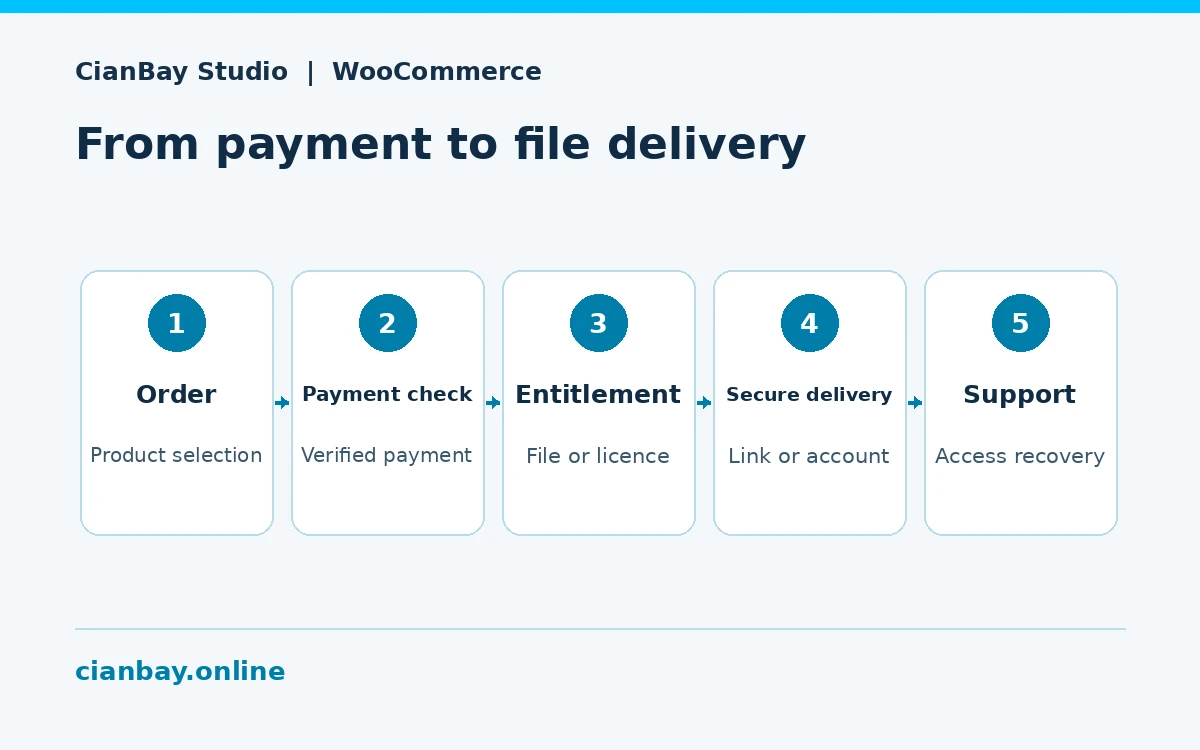
Once payment has been verified, customers can receive download access through the order confirmation page, email or their account, depending on the configuration. The system should trust authenticated payment notifications rather than a browser redirect. Pending bank payments, failed cards and incomplete authentication must not result in premature access. Repeated payment notifications should not issue duplicate keys or fulfil the same entitlement twice. The checkout and fulfilment workflows must be tested together, including refunds, partial refunds, payment disputes, expired links and customers who entered the wrong email address.
An account is useful for customers buying repeatedly or receiving updates. For a one-off purchase, guest checkout may be appropriate if the access links and identity verification are designed properly. Provide a recovery route when an email fails to arrive. Store administrators should be able to see whether the payment was confirmed and whether access was granted, without exposing private links to unnecessary staff members.
Protect paid files without promising impossible DRM
A publicly accessible file in the ordinary media library can be forwarded to other people. WooCommerce offers controlled download methods and approved download directories. Depending on the server, forced downloads or a correctly configured server-assisted download method may be suitable. Large files can require private object storage, signed delivery links or a specialist streaming platform. A redirect to a publicly reachable URL is not equivalent to protected delivery. Test the actual storage configuration, including whether unauthenticated visitors can retrieve the file directly.
Download counts and expiry periods can discourage uncontrolled sharing, but they cannot prevent a customer from copying a file after legitimate delivery. Watermarking a document can deter redistribution, subject to privacy considerations. Licence keys help manage software activation but require a separate validation and recovery system. Access limits should not punish legitimate customers who experience a network interruption or replace their device. For large media assets, consider bandwidth, simultaneous downloads, server resources and the cost of egress from cloud storage. Backups should include both the product files and the entitlement records, and restoration should be tested.
Product pages, previews and accessibility
A strong digital product page answers questions before the purchase. For an ebook, include the topic, table of contents, language, formats and a sample chapter. For a spreadsheet, list the supported application versions, included worksheets, example calculations and whether macros are used. For a design template, show realistic previews, editable elements, fonts and any additional software requirements. A customer should not discover after payment that a separate paid application is required.
A free sample, watermarked preview or short demonstration can help customers assess the quality of the product. Explain exactly how paid editions differ from free versions. Use accessible descriptions, readable contrast, keyboard-friendly navigation and suitable document formats. The European Accessibility Act can be relevant to ecommerce services and ebooks in EU markets, subject to its scope and exemptions. Review the applicable national requirements instead of assuming that a digital-only business is exempt. In large catalogues, filters for file type, compatibility, topic, language and licence can help customers make a more confident choice.
Licensing, subscriptions and product updates
Buying a digital file does not automatically transfer copyright. The licence should explain whether personal use, client work, team access, modification, printing and redistribution are permitted. A designer who includes a font or stock photograph must verify whether their own licence permits redistribution as part of a template. A resource being freely downloadable does not establish that it is in the public domain. Open-source and Creative Commons resources also have specific conditions that need to be respected.
Preserve the version of the licence that applied at checkout, together with the order record. A new product release should have a clear policy for previous customers: they may receive free maintenance updates, purchase an upgrade or retain the original version. For subscriptions, explain the renewal interval, price, billing date, cancellation mechanism and what happens to access when a subscription ends. Recurring payments require compatible billing infrastructure and a suitable extension; ordinary one-off checkout is not sufficient. Avoid hidden renewals and make cancellation genuinely usable. In the US, federal and state rules on recurring transactions need separate review.
EU consumer law and withdrawal rights
The Consumer Rights Directive has a specific exception for paid digital content delivered without a tangible medium. For immediate fulfilment, the seller must satisfy the applicable conditions, including obtaining the customer's prior express consent, acknowledgement of the loss of the withdrawal right and providing the required contract confirmation. Simply adding a blanket no-refunds statement to the footer is not equivalent to obtaining valid consent. Distinguish downloadable content from ongoing digital services, where different conditions may apply.
The Digital Content Directive 2019/770 also establishes remedies for failure to supply or lack of conformity. If a file is corrupt, the delivered template differs materially from the description, or a promised access service does not work, consumer remedies may remain available even if ordinary withdrawal rights were validly lost. For contracts with an existing withdrawal right, check national implementation of the online withdrawal function required under Directive 2023/2673 from 19 June 2026. Store order records should preserve the relevant consent, wording and timestamp, while respecting data minimisation. A locally qualified adviser should review the final checkout and terms before launch.
VAT, US sales tax and cross-border payments
For electronically supplied B2C services in the EU, VAT is generally determined by the customer's location. The combined EUR 10,000 threshold for eligible cross-border electronic services and distance sales of goods applies only under specified conditions, including establishment in a single EU Member State. A business established outside the EU should not assume the threshold is available to it. The non-Union OSS scheme may simplify reporting of qualifying services supplied to EU consumers by non-EU businesses. B2B transactions, ebooks with reduced rates, live human-delivered services and software licences may require different treatment. Classification matters more than the label used in the catalogue.
US sales tax obligations vary by state, product type, nexus and applicable exemptions. California provides a timely example for a 2027 store: according to CDTFA, from 1 January 2027 sales and use tax generally extends to digital products, subject to exceptions and the seller's obligations. Do not assume all electronically delivered products are tax-free in the US. A merchant may need registrations, evidence of customer location, tax calculations and reports appropriate to its markets. A payment processor is not automatically the merchant of record, so payment acceptance does not necessarily transfer tax responsibilities. Stripe, PayPal and local alternatives can be evaluated according to the seller's country, product category and payment needs. Obtain professional tax advice before enabling international checkout.
Search visibility, analytics and unit economics
The absence of physical shipping does not make every sale profitable. Consider an illustrative product priced at €20 before tax. If payment processing costs €1, support costs €2 and customer acquisition costs €7, the contribution is €10 before development costs and overhead. These are hypothetical inputs, not market benchmarks. A bundle or commercial licence can raise average order value without proportionally increasing fulfilment cost, provided it serves a real customer need. Track refund rates, chargebacks and support time alongside advertising performance.
Build SEO around the specific tasks customers want to solve: a wedding budget spreadsheet, a printable activity pack or a particular type of website design template. Useful examples, preview pages and supporting articles can make a store easier to discover. Product feeds and advertising platforms have their own digital goods eligibility policies; do not assume all downloadable products can be listed in shopping campaigns. Measure product views, checkout starts, successful payments and failed fulfilment separately. Do not expose customer emails, licence keys or private download links to analytics platforms. When a store attracts purchases but generates repeated support tickets, improve fulfilment before spending more on traffic.
Migration and launch acceptance tests
Moving the catalogue from another platform does not automatically transfer customer entitlements. Determine which order identifiers, payment states, product versions, licence information and expiry dates can be exported. Existing download URLs may stop working when the old service closes. Plan a way for existing customers to demonstrate their purchase and regain access without paying again. Never migrate passwords in plaintext or assume that marketing permission automatically covers a new channel.
Test a small download, a multi-file bundle and a large archive from desktop and mobile. Verify the charged amount, receipt, account visibility and access restrictions. Test direct file requests from an unauthorised session, a rejected payment, and recovery after an interrupted download. Refunds should update entitlements in accordance with the transaction and applicable law while preserving required accounting records. The acceptance checklist should have measurable expected outcomes, not simply a statement that the website works.
How much does a digital product store cost and where to commission one?
CianBay Studio builds independent WordPress and WooCommerce stores for clients internationally. A basic WooCommerce store starts at €600, subject to the agreed catalogue, payment integration and delivery workflow. A more comprehensive ecommerce solution with CRM and automation for online stores starts at €1200. Custom licensing servers, personalised watermarking, private storage integrations, subscription billing, advanced tax engines, learning platforms and migration of existing entitlements require separate assessment. The starting price does not automatically include hosting, premium extensions or external service subscriptions.
To request a realistic proposal, prepare your product list, file sizes and formats, target countries, licence rules, payment preferences and access recovery requirements. Tell us whether existing customers need to keep their download access after migration. The project scope should include testing successful and failed payments, download security, order emails and refunds, not merely a visual storefront. Visit our development prices or contact page to discuss the project.
Frequently asked questions
Can I sell ebooks and templates in the same WooCommerce store?
Yes. Each product can have its own files, licence description and access policy.
Can WooCommerce prevent all piracy?
No. Protected delivery reduces unauthorised access before download, but cannot prevent every subsequent copy.
Can I sell recurring access?
Yes, with a compatible subscription extension, billing provider and access management workflow.
Is every digital product exempt from sales tax?
No. Tax treatment depends on the product, seller and customer location, among other factors.
Do I need a separate learning platform?
Not for simple files. Courses with lessons, progress tracking and assessments may benefit from an LMS.
Sources
- WooCommerce: Digital/downloadable product guide
- WooCommerce: Approved download directories
- WooCommerce: Virtual and downloadable products
- Directive (EU) 2019/770
- Directive 2011/83/EU, consolidated text
- Directive (EU) 2023/2673
- European Commission: VAT One Stop Shop
- European Commission: Register to OSS
- CDTFA: Digital products tax guide, California
- US Copyright Office: Copyright