Dmytro CianBay · 26.11.2026 · 12 min read
Auto parts ecommerce website on WooCommerce in 2027: VIN lookup, part numbers and vehicle fitment
Build an auto parts store with vehicle fitment, VIN lookup, OEM references, supplier feeds and WooCommerce. Learn about compliance and development costs.
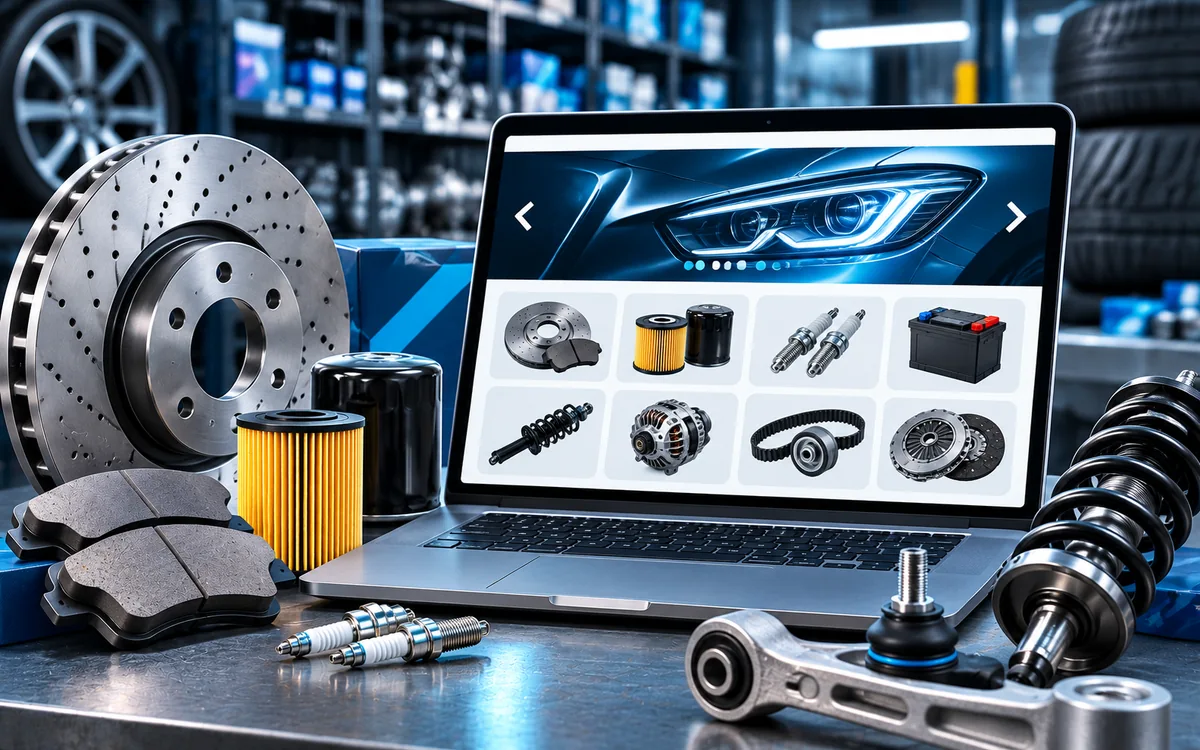
An auto parts customer is often looking for a solution to a very specific problem rather than browsing a generic retail catalogue. They might need a replacement filter for routine maintenance, a matching component for a particular engine, or a part that must arrive before a workshop can complete a repair. A low price is of little value if the part does not fit or is unavailable when the customer needs it. Incorrect orders generate extra shipping, support work and potentially lost sales.
A WooCommerce auto parts store should therefore be designed around three questions: what is the correct part, can the seller supply it, and what is the complete cost of obtaining it? WordPress and WooCommerce provide a flexible foundation for a store on your own domain. Reliable vehicle identification, catalogue licensing, supplier integration and fulfilment processes, however, need to be planned as distinct parts of the project. This guide explains what to consider when commissioning an automotive ecommerce website for 2027.
Contents
- Choose the right store model for your business
- Vehicle selection, VIN lookup and part number search
- TecDoc, ACES and PIES: choose a legitimate data source
- Build product pages that reduce incorrect orders
- Connect stock, suppliers and order processing
- Product safety and consumer rights in the EU and US
- Payments, freight and returns
- Search visibility and catalogue performance
- What does an auto parts ecommerce website cost?
- FAQ
Choose the right store model for your business
A specialist selling a limited range of car accessories, service kits or replacement filters may be able to launch with a straightforward catalogue and a manual fitment enquiry form. The merchant knows the products and can provide meaningful advice without attempting to replicate the entire automotive aftermarket. A specialist retailer can differentiate itself through clear information about its selected brands, transparent availability and useful category pages.
A distributor working with multiple suppliers needs a more sophisticated system. A customer-facing product catalogue must be connected to procurement data, stock levels, price updates and vehicle applications. A business selling to independent garages might additionally require account-specific trade prices, minimum order quantities, quotation workflows and repeat ordering. These features should follow actual commercial agreements rather than being added simply because they appear in a competitor's website.
Used and remanufactured components deserve separate treatment. Two used components carrying the same manufacturer reference may differ in condition, mileage, provenance and warranty. Each physical item may need its own stock identifier and photographs. Remanufactured products may also involve core charges or the return of an old component, with clearly disclosed eligibility and refund conditions. An ordinary catalogue of new components is not automatically suitable for a dismantling business.
Vehicle selection, VIN lookup and part number search
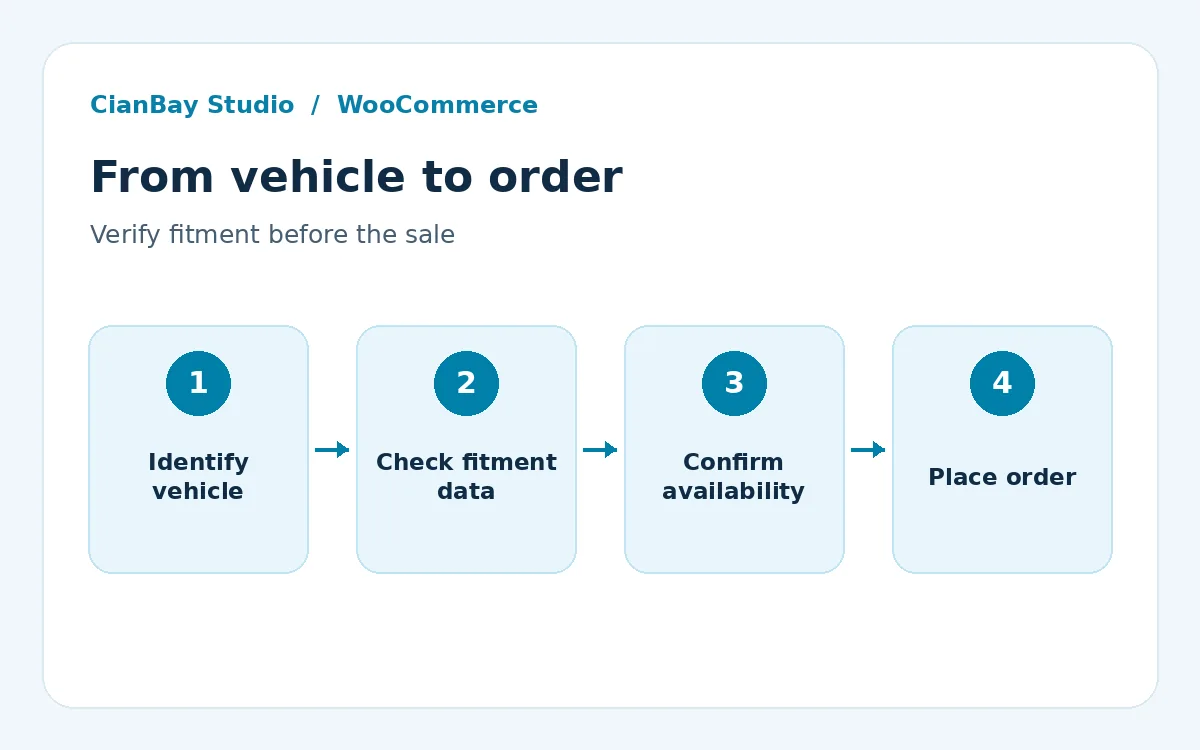
A good automotive store supports more than one entry point. A professional may know a manufacturer part number and want to locate it immediately. A vehicle owner may start with make, model, model year and engine. Another visitor may enter a VIN to identify the vehicle or submit a fitment enquiry. All of these paths should lead to consistent catalogue records instead of disconnected results that contradict one another.
A modern vehicle identification number generally contains 17 characters. It can reveal useful vehicle information, but a VIN decoder is not a universal parts compatibility database. The NHTSA vPIC decoder in the United States, for example, is a vehicle identification resource; it does not establish that every aftermarket component will fit a particular vehicle. Production changes, optional equipment, engine variations and previous repairs can matter. A single model year can include multiple brake configurations or different electrical connectors.
Part number search needs to handle common formatting differences such as spaces, hyphens and letter case without destroying the original manufacturer reference. Identical-looking numbers from different brands should not automatically be merged. When a vehicle has been selected, retaining that selection during browsing can make the store much more useful. However, the interface should clearly indicate whether a fitment match is confirmed by the data source or still requires verification.
TecDoc, ACES and PIES: choose a legitimate data source
TecAlliance offers TecDoc solutions covering product data, vehicle applications, cross-references and vehicle identification. Depending on the purchased product and territory, businesses may obtain data access, lookup capabilities or integration options. A subscription intended for staff to consult a catalogue is not necessarily a licence to republish the database on an ecommerce website. The merchant should confirm publication rights, allowed markets, integration method, update frequency and ongoing fees with the provider.
In North America, the Auto Care Association's ACES and PIES standards are particularly relevant. ACES is used to exchange vehicle application data, while PIES covers product information. Supporting reference databases require paid subscriptions. These standards help trading partners communicate structured data; they do not automatically provide a complete assortment of parts or grant unrestricted use of third-party content. The association announced ACES 5.0 and PIES 8.0 in April 2026, so compatibility with supplier exports and supported versions should be checked when planning a 2027 project.
Request sample files before agreeing to the development budget. A distributor might provide manufacturer references, descriptions and prices but no fitment links or licensed images. An integration cannot infer missing compatibility reliably. Where data rights or coverage are limited, a manual VIN enquiry can be a sensible initial service: the customer requests a match, a qualified member of staff checks the authorised catalogue and provides a quotation. Automated lookup can be introduced when the business has the necessary data and sufficient demand.
Build product pages that reduce incorrect orders
A useful product listing contains the brand, exact part reference, product condition, genuine photographs or licensed manufacturer images, relevant dimensions, installation position where applicable, fitment restrictions, availability and delivery estimate. A brake component might have an axle position and diameter restriction; an electrical component may have connector or specification requirements. These are examples of information that must come from trustworthy product documentation, not automatically generated assumptions.
Cross-references deserve careful presentation. A suggested alternative may have a different package, included accessories or vehicle application range. An OE reference can help locate related products but does not prove that every listed alternative is interchangeable. The site should present restrictions and provide a route to expert confirmation when necessary. For safety-related parts, this distinction matters more than reducing the number of clicks. The seller must not represent uncertain compatibility as a verified result.
A product review and a store service review should also be distinguished. Fast delivery does not establish a component's durability or safety. Where the same part is offered by several warehouses, the product page should retain one stable identity rather than duplicating the item for each supplier. Good catalogue design helps shoppers, search engines and staff work from the same information.
Connect stock, suppliers and order processing
Many automotive retailers operate a mixed inventory model. Some parts are physically in stock, some can be ordered from a local distributor, and others may come from a distant warehouse. The same branded part can have multiple purchase prices and delivery estimates. Treat the catalogue item and its supplier offers as separate data concepts. The system can then select an offer according to the merchant's approved rules, rather than publishing competing product pages for identical items.
Supplier connections might use CSV, XML, an API or a supported inventory management system. The integration must handle discontinued products, missing data, changed purchase prices and unavailable supplier services. A stale stock quantity should not be presented as a confirmed promise. It can be more appropriate to show an enquiry status when a feed stops updating. The order workflow should also establish what happens if supplier availability changes between checkout and procurement.
Consider an illustrative sale in which a part costs €80 to purchase and sells for €110. Payment processing, packing and handling cost €9, leaving €21 before advertising, overhead and returns. If the wrong part is shipped and cannot be returned to the supplier, the loss may exceed the contribution from several successful orders. This is why fitment accuracy and realistic delivery information deserve a budget of their own. A cheaper integration that repeatedly produces unreliable stock or compatibility data can be expensive to operate.
Product safety and consumer rights in the EU and US
For EU sales, Regulation (EU) 2018/858 provides an approval and market surveillance framework for relevant motor vehicles, components and separate technical units. Distributors have obligations in relation to required markings, documentation and conformity for products within its scope. Other technical rules may apply depending on the component. The General Product Safety Regulation, Regulation (EU) 2023/988, also needs to be considered where applicable, including the information required in online offers under Article 19. Sector-specific rules and the GPSR interact; not every accessory or spare part has the same approval requirement.
Relevant online product information may include the manufacturer and its contact details, the EU responsible economic operator where required, product identification and appropriate warnings. The store should support these fields and present information in the languages required by the destination market. EU distance selling generally gives consumers a 14-day withdrawal period, subject to statutory exceptions, and a minimum legal guarantee of two years for goods under the applicable framework. Ordinary stock ordered from a distributor after checkout is not automatically a personalised product. Warranty claims and voluntary returns need different processes.
In the United States, NHTSA administers motor vehicle and motor vehicle equipment safety requirements and recalls. Applicable Federal Motor Vehicle Safety Standards, defect reporting and recall obligations depend on the equipment and the business's role. A retailer should obtain conformity information from its suppliers where relevant and have a process for identifying and withdrawing recalled products. Under the FTC's Mail, Internet, or Telephone Order Merchandise Rule, covered sellers need a reasonable basis for the advertised shipping timeframe, or 30 days when no timeframe is specified; delays can trigger consent or refund obligations. Do not assume the European withdrawal regime applies identically to US transactions. State law, warranty requirements and category-specific obligations also need review.
These legal points were researched on 26 November 2026 and are a planning guide, not a compliance certification. The merchant should confirm current requirements for each product category and target country before launch.
Payments, freight and returns
For European stores, local card payment methods, bank payments and appropriate local carriers can be selected based on the merchant's country and customer preferences. In the United States, card payments through a supported processor and services such as UPS or FedEx may be appropriate, depending on agreements and product restrictions. Trade accounts might need invoicing and approved payment terms. The checkout should disclose the full payable amount before purchase and provide a clear order confirmation.
Shipping rules for bumpers, body panels, batteries, oils, aerosols and other potentially restricted goods cannot be treated as identical to small filter shipments. Weight, dimensions, packaging, dangerous goods classification and route affect whether a carrier will accept a parcel. Confirm the relevant carrier rules before making a delivery option selectable. An international shop should also plan customs documentation, duties and responsibility for failed deliveries or returns.
Record return reasons in a structured way: incorrect fitment data, customer selection, inaccurate supplier information, damage or a reported defect. Over time, these records reveal which product groups require better data or a clearer consultation process. A VIN associated with a customer record may constitute personal data. The EU Court of Justice addressed the relationship between VINs and personal data in case C-319/22. Collect only what is needed, limit access and avoid placing customer VINs in public URLs or advertising analytics.
Search visibility and catalogue performance
Automotive customers search by part number, brand, vehicle and product category. Product pages should have stable URLs, accurate identifiers and useful technical information. Category pages should help shoppers understand the available assortment and refine their search. Generating thousands of nearly identical pages for every possible vehicle and filter combination is not a substitute for useful content or verified applications. Only genuinely valuable landing pages should be candidates for indexing.
Google Merchant Center product feeds should reflect the actual offer, including current price, availability and valid product identifiers where required. Do not fabricate GTINs or MPNs. Structured product data can support discovery but does not guarantee a particular search placement. Large catalogues may need a dedicated search index, incremental updates and a hosting configuration sized for actual load. Test searches using real part numbers and representative vehicles before publication, not merely the homepage's appearance.
What does an auto parts ecommerce website cost?
CianBay Studio offers WooCommerce store development from €600 as a starting point for a limited catalogue and standard sales features. An integrated ecommerce and CRM solution with basic SEO starts at €1,200. Neither starting price should be interpreted as a promise to include a complete licensed fitment database, advanced search for hundreds of thousands of products or unlimited supplier connections. Catalogue access, custom integrations, hosting, payment services and other paid tools are separately scoped or paid for by the merchant.
For a meaningful quotation, provide your expected catalogue size, supplier file samples, data licensing arrangements, target markets, trade customer requirements and fulfilment process. Decide whether you need automatic VIN lookup at launch or whether manual verification will meet current demand. This helps establish which tasks belong in the first release and which can be introduced once sales justify them.
CianBay Studio builds WordPress and WooCommerce websites for clients in Ukraine and internationally. Our CaseComponents portfolio project involved an ecommerce catalogue of approximately 650 items, illustrating experience with structured product data and import workflows. It is not presented as a completed automotive fitment integration. Contact us to discuss your specific data sources, customer journeys and budget for an automotive store that can grow with the business.
WooCommerce development · Payment integrations · Integrated CRM solution · Pricing · Discuss your project
FAQ
Can WooCommerce support automatic VIN lookup?
Yes, through an appropriate integration when vehicle identification, fitment data and publication rights are available. Without them, a manual verification request is a practical alternative.
Is TecDoc included in the basic store price?
No. Commercial data access, licensing and integration are assessed separately. Confirm the required TecAlliance product and territory before purchasing.
Can a US VIN decoder replace ACES or other fitment data?
No. Vehicle identification and product compatibility are separate tasks. A decoder alone cannot confirm every component application.
Can I sell used and new components together?
Yes, with separate product condition, inventory and warranty information. Used items often need individual records rather than shared generic stock.
Is WooCommerce suitable for a very large automotive catalogue?
It can be, subject to appropriate architecture, data access, search indexing, hosting and performance testing. The required infrastructure should be assessed before committing to a budget.
Sources
- WooCommerce: Product categories and attributes
- Google: Product data specification
- TecAlliance: TecDoc Catalogue
- TecAlliance: Catalogue and ecommerce solutions
- EUR-Lex: Regulation (EU) 2018/858
- EUR-Lex: Regulation (EU) 2023/988
- Your Europe: Guarantees and returns
- Court of Justice of the EU: Case C-319/22
- NHTSA: VIN decoder
- NHTSA: Recalls
- FTC: Mail, Internet, or Telephone Order Merchandise Rule
- Auto Care Association: Data standards
- Auto Care Association: ACES 5.0 and PIES 8.0