Dmytro CianBay · 23.11.2026 · 6 min read
How Manufacturers Can Win Wholesale Orders Through Their Website in 2027: B2B Catalogues and Quotes
Build a manufacturer B2B website with technical product catalogues, RFQs, wholesale pricing, dealer accounts, CRM and WooCommerce workflows.

A component manufacturer receives an enquiry for 200 parts, a drawing and a target delivery date. A sales representative then searches spreadsheets, checks production capacity and emails a PDF quote. Repeating that work for every potential distributor is expensive, especially when specifications change. A manufacturer’s website can do more than showcase products: it can turn a technical enquiry into a qualified, traceable B2B sales opportunity.
This guide focuses on the specific needs of manufacturers in 2027, rather than repeating generic advice about wholesale ecommerce. We will cover technical catalogues, minimum order quantities, dealer pricing, requests for quotation (RFQs), account workflows and integration with production systems.
Choose the buying journey before choosing a plugin
Distributors, procurement managers and project contractors need different information. Some buy stock items at agreed prices; others need custom manufacturing estimates, lead times and engineering approval. A single public checkout rarely handles every scenario well.
- Public catalogue: searchable categories, SKUs, specifications, technical drawings and applications.
- RFQ workflow: select products, quantities, dimensions and required delivery dates, then request a formal quotation.
- Approved dealer portal: negotiated prices, purchase history, saved lists and repeat ordering.
- Direct checkout: useful for standard, in-stock components with straightforward pricing and shipping.
Do not automatically hide every product from search engines. Public technical documentation can help a buyer discover the manufacturer; sensitive contract pricing can remain available only to authenticated trade customers.
Build product pages for technical evaluation
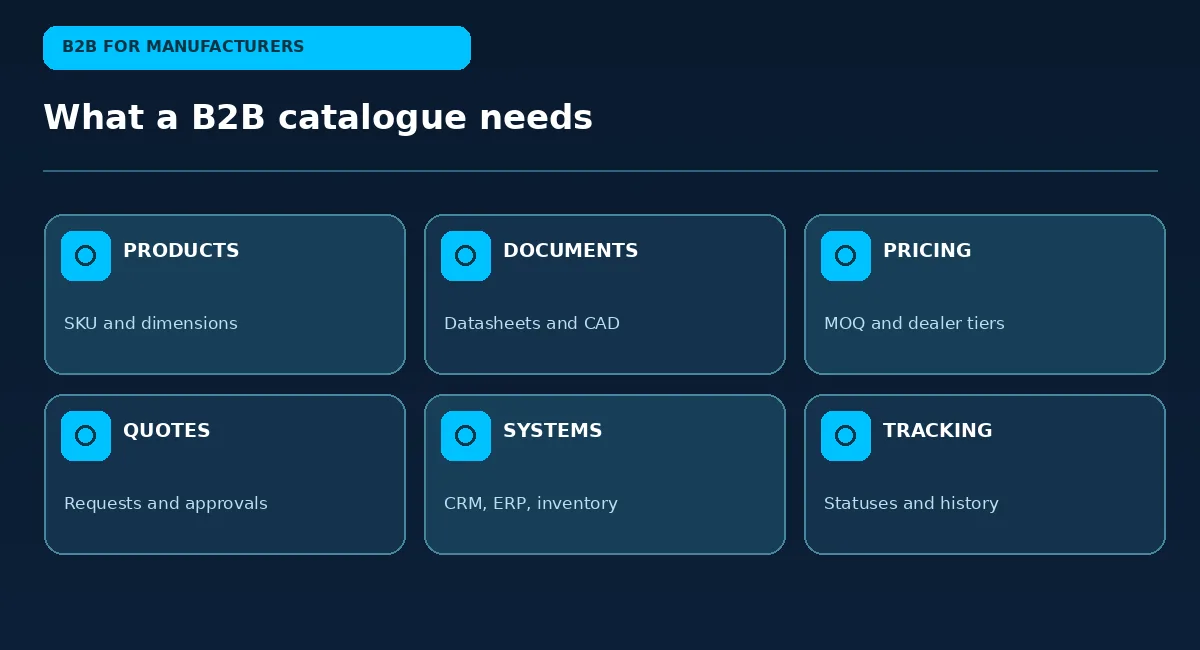
A high-quality B2B catalogue includes SKUs, materials, dimensions, tolerances where verified, compatible components, finish options, downloads and meaningful photographs. Buyers may search for a part number or a precise specification rather than a marketing slogan. Add filters for series, material, profile, capacity, size and available variants, but ensure the information reflects real products.
Provide downloadable datasheets and approved CAD or PDF drawings when appropriate. Important product facts should also appear in accessible HTML; a PDF alone is a poor substitute for a usable product page. For made-to-order configurations, the website should enforce genuine manufacturing limits rather than offering every possible combination.
Wholesale prices, minimum orders and customer groups
Several pricing models may coexist: a public indicative price, volume tiers, dealer contract rates and an individual project quote. As a fictional example, one component costs €20 each, €18.50 for orders of 50 or more, and €17.20 for orders of 200 or more. A 200-piece order totals €3,440 before tax, freight and machining adjustments. These figures illustrate the calculation, not a market quotation.
Define minimum order quantity (MOQ), carton multiples, purchasing permissions and tax treatment before configuring pricing. Multiple coupons or discounts must not accidentally stack below acceptable margins. Extensions such as B2B Pricing and Wholesale for WooCommerce support trade pricing scenarios, but require a compatibility review and may involve paid licences.
Request a quote instead of charging too early
A custom metal assembly may require a drawing, tolerances, surface treatment, volume and manufacturing deadline before the price can be confirmed. The buyer builds an enquiry basket, uploads documents and sends an RFQ. Sales or engineering staff review the details, issue a quote with a version number and terms, and then convert the accepted quote into an order.
WooCommerce quote extensions can support this process, but do not assume that every plugin offers CAD attachments, multi-stage approvals or a complex bill of materials out of the box. Establish rules for file security, quote validity, revisions and ownership of each response.
Connect enquiries to CRM, ERP and the factory
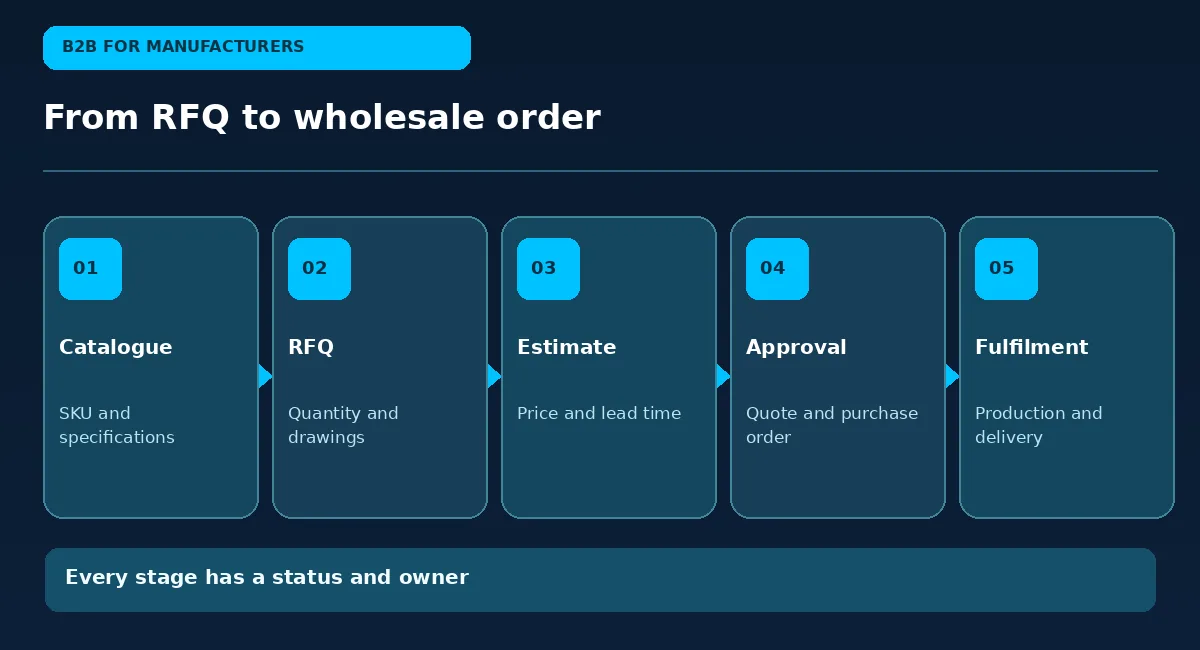
A sensible workflow runs: RFQ → technical review → estimate → quotation → purchase order → production → dispatch. The CRM needs the organisation, contact, RFQ number, lines, quantities, relevant file links and the next action. Duplicate submissions must not create duplicate production tickets, so integrations need stable identifiers and retry-safe behaviour.
Inventory, manufacturing capacity and expected procurement lead time are different concepts. One stock number cannot explain whether a made-to-order item ships tomorrow. If ERP controls stock and costing, set it as the authoritative source and record any rejected updates or failed API calls. Avoid copying personal contact details into more systems than necessary.
Invoices, payments and industrial freight
B2B purchasers may require company registration details, purchase orders, VAT/tax invoices and agreed payment terms. The availability of card payment, bank transfer, net terms or financing depends on the merchant’s location, provider and customer agreement. Do not assume a plugin automatically provides legally compliant invoicing across every country.
Long profiles, heavy goods and fragile machines often need pallet or specialist freight. Show realistic delivery zones and make it clear when freight will be quoted separately. A shipment date for custom products must account for manufacturing and any approvals, not simply the standard parcel carrier estimate.
SEO: capture buyers searching by specification
Procurement teams may search for detailed terms such as “aluminium extrusion supplier 40x40”, “industrial door manufacturer” or a part number. Build indexable category pages and product pages around accurate specifications and use cases. Avoid creating thousands of low-value near-identical URLs for minor dimensional changes.
Google describes Product structured data for publicly purchasable products. If a custom configuration only has price on request, do not invent a misleading fixed offer to qualify for search features. For large catalogues, the WooCommerce CSV importer supports structured product data; plan how SKUs, attributes and variations will be updated without duplicates.
Launch the smallest useful B2B workflow
Start with your highest-demand product families, technical specifications, an RFQ form with safe document uploads and a reliable path to the sales team. Add dealer-specific pricing and repeat ordering after the workflow is validated. Advanced ERP synchronisation and custom configurators should answer real business requirements, not become a speculative software project.
- Test searches by SKU, technical category and dimension.
- Submit an enquiry with several items and a drawing.
- Compare the quote sent to the buyer with the CRM record and approved price.
- Verify dealer permissions, quantity steps and contract discounts.
- Test large uploads, malware screening and mobile forms.
- Check errors, duplicate requests and what happens after an estimate is rejected.
Frequently asked questions
Can wholesale prices be visible only to approved dealers?
Yes. Use accounts and role-based rules while keeping public technical information available where useful.
Do manufacturers need online payments for every order?
No. RFQs, purchase orders and invoices may be more suitable for project work, while direct checkout helps with standard stock items.
Can customers attach CAD and PDF files?
Yes, with a secure upload process, allowed file types, access controls and retention rules.
Can WooCommerce integrate with CRM and ERP?
Often yes via APIs or scheduled data exchange, but every mapping, error state and inventory owner should be tested.
Conclusion
A manufacturer’s website should connect product discovery, technical qualification and sales follow-up. CianBay Studio develops manufacturer websites and WooCommerce stores with B2B catalogues, quotation workflows and integrations for clients in Ukraine and internationally.