Dmytro CianBay · 26.11.2026 · 11 min read
Online store with CRM and automation from €1,200: what businesses get in 2027
Launch a WooCommerce store with CRM, order automation, payments, shipping and basic SEO from €1,200. Explore scope and running costs.
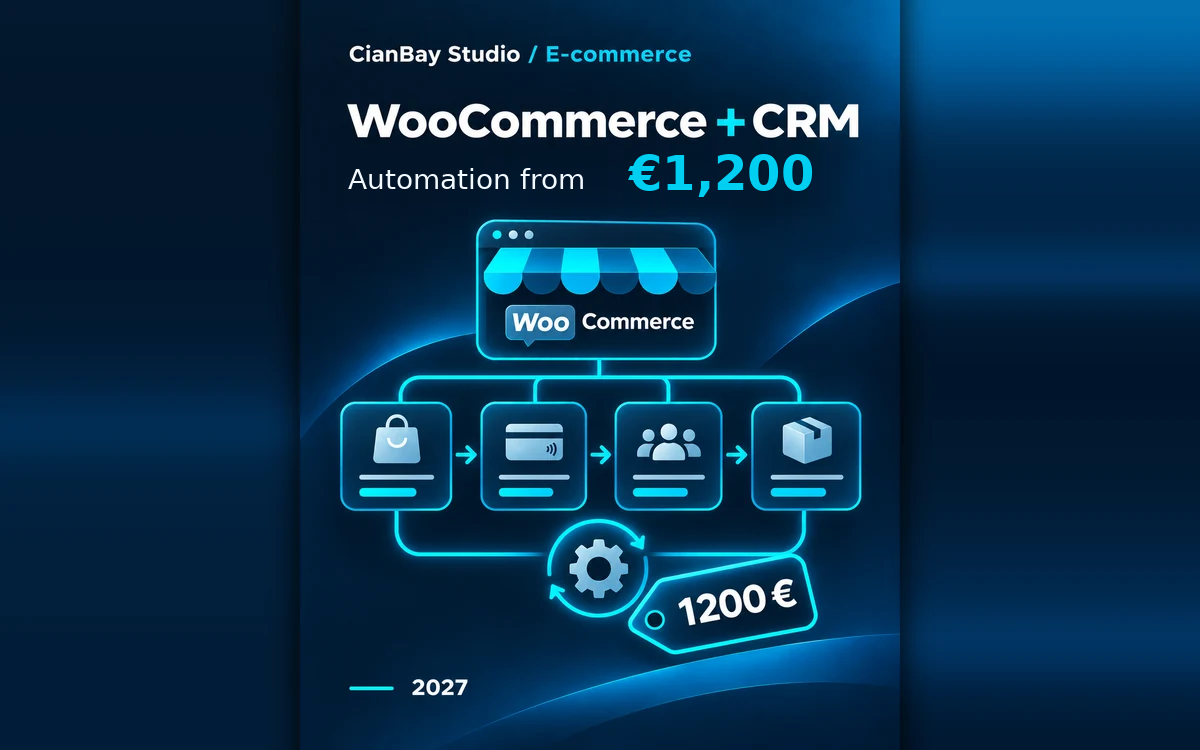
An online store can accept orders around the clock, yet the people running it may still spend hours moving information between spreadsheets, inboxes, payment dashboards and shipping systems. A beautiful storefront does not solve that operational problem by itself. CianBay Studio offers a turnkey WordPress and WooCommerce online store with CRM integration, order automation and basic SEO from €1,200. The package is designed for small and growing businesses that want a sales system rather than a collection of unrelated tools. Here is what the starting price covers, how the systems can work together and what should be agreed before commissioning the project.
What does the €1,200 starting package include?
The CianBay package combines a WooCommerce storefront with an agreed payment method and shipping integration, CRM integration, a Telegram notification workflow and basic search engine preparation. Initial catalogue setup covers up to ten products. The final specification, visual requirements, integrations and delivery schedule are agreed before work begins. A catalogue with thousands of products, multiple warehouses, complex wholesale pricing or a custom accounting integration requires a separate estimate. A starting price is not a promise that every possible ecommerce feature is included.
Think of the package as several parts of one business process. The store accepts orders, the payment provider confirms transactions, the CRM gives staff a place to manage customer interactions, and the carrier handles fulfilment. Basic SEO helps search engines discover relevant pages. Each part has a distinct responsibility. A business should not pay for a dozen sophisticated applications when a straightforward workflow solves the problem. CianBay designs the solution around the merchant's actual operations, including which data needs to travel between systems and where the team should intervene.
Commission an integrated store · Service pricing
How does it differ from a €600 WooCommerce store?
CianBay's standard WooCommerce store starts at €600. It suits a merchant who needs a catalogue, product pages, cart, checkout, agreed payments and shipping, without a separate sales management workflow. A small business can often handle early orders directly in the WooCommerce administration panel. Once several employees handle orders, or the same customers contact the business repeatedly, keeping all the operational information in a simple order list may become less convenient.
The €1,200 package addresses that next layer of work. Rather than asking an employee to copy the customer name and order contents into another application, the store can pass the agreed data into a CRM. Staff can then determine which orders require confirmation, which are paid and which are awaiting fulfilment. The appropriate order statuses, permissions and exception handling have to be designed. The difference is not just the number of plugins installed. It is the additional work required to make the components behave as one system. If a business does not need those processes yet, starting with the basic package may be the better investment.
How WooCommerce and a CRM work together
WooCommerce handles the storefront, shopping cart, orders, customer accounts and commerce-related statuses. A CRM focuses on customer relationships and the people working on them. A new order might create or update a customer record and attach relevant details such as order number, items and contact information. Staff can see previous interactions and avoid creating a second customer record unnecessarily. A useful integration preserves a consistent reference between the systems rather than relying on a customer name that might be spelled differently each time.
WooCommerce supports REST APIs and webhooks, which allow applications to read and write authorised store data and receive notifications about events such as a new order. This does not mean that two arbitrary applications will synchronise perfectly out of the box. A developer needs to establish which system is authoritative for stock, payment and shipment status, map the relevant fields and determine what happens when an event arrives twice or a connection fails. An integration should not create two orders because a network timeout triggers a retry. These requirements matter even when a retailer is small.
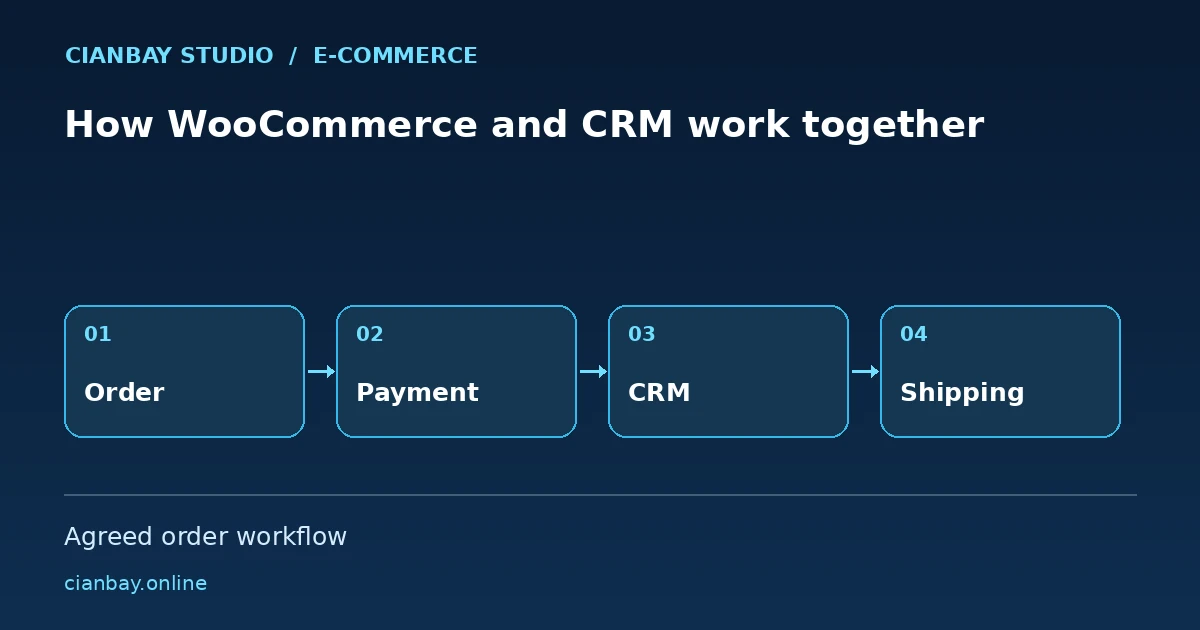
From checkout to fulfilment: an example workflow
Imagine an independent homeware retailer. A customer selects a product, confirms the shipping address and proceeds to the payment provider. Once the provider confirms payment, the store updates the order according to the agreed rules. The CRM receives the relevant information and a staff member can check whether the order needs clarification. The warehouse prepares the parcel, and the tracking number can be communicated through a configured channel. When the payment fails or a product becomes unavailable, that case should be handled separately instead of being marked as successfully completed.
The aim of automation is to eliminate unnecessary copying without removing the merchant's control. Staff must be able to correct errors and see which changes occurred. Cancellation, refunds, partial fulfilment and address changes are additional scenarios that may need their own rules. Not every store requires each of them on day one. What matters is that the normal purchase route is understood before the first customer uses it, and the team knows how to respond when an exception occurs. This approach is particularly helpful when a retailer uses an external fulfilment partner or employees work remotely.
Payments, shipping and operational notifications
For an international merchant, possible payment providers include Stripe and PayPal, subject to eligibility, supported countries, currencies and provider approval. Shipping might involve DHL, UPS, DPD or a regional carrier, depending on the delivery territory and integration available. These names are examples, not a guarantee that all providers can be integrated for the starting price. The merchant needs its own approved accounts and commercial agreements. Payment processing fees, tax services and complex shipping rules remain separate considerations.
An agreed Telegram notification workflow can alert staff that a new order needs attention and direct them to the relevant record. It is a supporting channel rather than the central database. Full addresses, payment details and unnecessary personal information should not be sent to shared chats. Customers may continue to receive transactional email and view their order status on the website. For some markets, email or a different business messaging channel may be more appropriate for customer communication; any extra channel should be scoped before the project starts. The objective is to deliver information where it is useful rather than to introduce another inbox that staff must constantly check.
Do you need a paid CRM, and what are the ongoing costs?
A business can integrate a CRM it already uses, select an existing product or commission functionality tailored to the particular workflow. Compare the number of users, subscription charges, data export options, API access and update policies before choosing a system. An organisation that already relies on HubSpot or another CRM may prefer to keep it instead of rebuilding its customer records. Conversely, a small shop may need only a focused order management module rather than a broad marketing platform. Ownership and licensing rights for custom and third-party components are defined by the agreement.
The core WordPress and WooCommerce software does not impose a mandatory platform subscription. Hosting, domains, premium extensions, CRM plans, payment processing and maintenance can nevertheless involve ongoing expenses. A realistic budget also needs to account for integration updates, backups, monitoring and support when a third-party API changes. Merchants should know which accounts and licences they pay for directly. CianBay agrees on third-party paid services and the expected scope of support before connecting them. That distinction helps businesses compare total operating costs instead of choosing a system based only on its initial development fee.
What could automation save? An illustrative business case
Suppose a retailer processes 300 orders each month and an employee spends three minutes re-entering the information from each order. This is 900 minutes, or 15 hours per month. At an illustrative labour cost of €8 per hour, the repetitive work costs €120 per month. If the integration removes half that work, the hypothetical saving is €60 per month. The €600 difference between the two starting packages would therefore be recovered in about ten months, before any additional recurring charges, training expenses or maintenance. These figures are examples, not measured outcomes or a promise of savings.
A proper assessment should measure the time staff spend on order handling before and after implementation, the frequency of mistakes and the cost of resolving them. A merchant processing ten orders per month may find that a basic store is sufficient. A higher-volume seller may see more value in avoiding missed orders, duplicate shipments and incorrect payment states than in saving minutes of labour. A company that sells expensive or customised products might need more human review, not less. Automation should handle repeatable tasks and leave decisions to the people who have the context to make them.
Basic SEO is part of the sales infrastructure
An efficient order management process does not attract customers on its own. Basic SEO preparation includes an agreed catalogue structure, readable URLs, relevant titles and metadata, indexability, mobile compatibility and technical foundations. Categories should reflect what customers actually search for, while unnecessary duplicate URLs should not overwhelm the catalogue. A business should be able to add products and expand categories without rebuilding the entire website. These are foundations for discovery, not a guarantee of rankings.
Advanced search optimisation, product copy for a large catalogue, Merchant Center feeds, editorial content, backlink acquisition and advertising can require separate work. The retailer should also consider which country and language each product page targets and whether tax, currency and delivery information are appropriate for that audience. A well-designed WooCommerce structure provides a useful starting point for international growth, but translated catalogues and cross-border compliance are not automatically included in a basic package. By making these distinctions early, a merchant can invest in the channels most relevant to its commercial goals.
Which businesses benefit from the package?
Apparel retailers may prioritise variations and stock, cosmetics shops may focus on repeat purchases, and equipment suppliers may need article numbers and an efficient catalogue search. Manufacturers may require wholesale enquiries, account-specific pricing or quotation workflows. Even two stores with the same number of products can have completely different operational requirements. The right question is which tasks the team performs repeatedly and which systems it must continue using. CianBay uses those requirements to determine the appropriate scope rather than applying a single configuration to every industry.
One real CianBay project, CaseComponents, is a WooCommerce shop with approximately 650 catalogue items. Its development cost was €1,500. It illustrates the platform's ability to support a more extensive catalogue. It is a separate project, not an example of the €1,200 package and not evidence that every CRM workflow described in this article was implemented on that website. A similar catalogue could cost more or less depending on the quality of the source data, product variations, import complexity and required integrations. Ask for an estimate based on your own catalogue rather than treating a past project's price as a fixed rate.
Commissioning a WooCommerce and CRM solution from CianBay
To request a quote, describe what you sell, your target countries, payment methods, delivery services, number of staff and current order management process. If you already use a CRM, specify its name and the information that must flow between it and the shop. Separate essential launch requirements from later improvements. Identify who provides product descriptions, photographs, hosting access and the necessary service accounts. This makes it easier to prepare an accurate offer without charging for features that the team is unlikely to use.
Before acceptance, a typical test should cover a successful order, payment confirmation, delivery selection, CRM record creation, staff notification and failure scenarios relevant to the agreed scope. The merchant should have access to the store and its infrastructure as specified in the contract. Document who will maintain each integration and what happens if a service provider changes its requirements. CianBay works with customers in Ukraine and internationally, offering WooCommerce stores from €600 and integrated solutions from €1,200. If your goal is to sell online without manually moving every order between different applications, contact the studio to discuss the workflow and receive a project-specific quote.
WooCommerce · Commission an integrated store · Contact CianBay · WhatsApp
Frequently asked questions
Can CianBay integrate CRM into an existing WooCommerce store?
Yes, subject to an assessment of the existing installation, active extensions, data structure and integration requirements. Improving an existing store may be more economical than rebuilding it. The price is based on the work required.
Is a CRM subscription included?
Third-party service charges and licences are agreed separately. The appropriate choice depends on the merchant’s current software, user count and required features.
Are all products imported for €1,200?
The starting package covers up to ten initial products. Larger imports, automated supplier feeds and stock synchronisation are quoted separately.
How long does development take?
The schedule is agreed after the specification, content and service accounts have been reviewed. Time for testing payment and fulfilment workflows must be included.
Does basic SEO guarantee sales?
No. It prepares the technical foundations, but sales depend on demand, competition, pricing, trust and ongoing marketing.