Dmytro CianBay · 26.11.2026 · 10 min read
Online store without monthly platform fees in 2027: WooCommerce as an alternative to Shopify and Wix
Compare WooCommerce with Shopify and Wix, calculate three-year running costs and order an independent ecommerce website from CianBay from €600.
Can you run a professional online store without paying a monthly subscription to an ecommerce platform? Yes. A self-hosted WordPress and WooCommerce website gives merchants the ability to operate a store without a mandatory recurring fee for the core shopping software. Instead of renting access to a hosted platform, a business can commission its own website, choose a hosting provider and decide which additional services it actually needs. CianBay Studio builds WooCommerce stores from €600.
This distinction matters to independent brands, wholesalers, established retailers and entrepreneurs whose costs rise as they add channels, apps and staff. The objective is not to eliminate every operating expense. It is to control the cost of selling online and preserve the freedom to change suppliers, technology and business processes. Here is how to compare the alternatives before spending money on a new store or migration.
What a subscription-free online store actually means
Software as a service, or SaaS, combines a hosted application with ongoing access under a subscription. A merchant pays a provider for its infrastructure, administrative tools and available ecommerce features. This is convenient for teams that do not want to maintain a server, install security updates or manage software compatibility themselves. The trade-off is that the provider decides the plans, the platform features and the conditions of access.
Self-hosted WooCommerce uses a different model. The software works with WordPress on a hosting account chosen by the business. Its core shopping functionality, including product listings, cart and order administration, does not require a paid platform subscription. WooCommerce's official pricing page distinguishes its zero core platform fee from hosting and optional extensions. Merchants can use third-party payment services under those providers' own commercial terms.
When you commission a WooCommerce store from CianBay, you pay for the agreed development work rather than a compulsory monthly fee to the studio to keep using the site. The domain and hosting accounts should be under your control. Maintenance can be arranged separately according to your business needs. This is a different commercial arrangement from subscribing to an all-in-one ecommerce service.
WooCommerce, Shopify, Wix and PrestaShop compared
Shopify is a well-established hosted ecommerce service, particularly useful when a business wants a centrally managed system, familiar integrations and a straightforward operating environment. On its US pricing page, Basic was listed at $39 per month with monthly billing when checked on 26 November 2026. Annual billing, regional pricing and promotions may differ. Third-party applications and payment-related fees may also affect the total. The quoted amount is not a forecast of 2027 rates.
Wix offers a website builder with commerce capabilities. According to its official guide to premium plans, accepting online payments requires a suitable paid plan. A merchant looking for a simple hosted business website with an integrated shop may find this convenient. Businesses with more unusual workflows should check which features and integrations are possible before committing to a particular plan.
PrestaShop also offers a freely downloadable open-source core. Like WooCommerce, a self-hosted installation requires infrastructure and maintenance. It is a genuine alternative for merchants who prefer independent software. WooCommerce has a particular advantage for businesses that want editorial content, a company website, landing pages and product sales to coexist within the WordPress ecosystem. That does not mean it is the only suitable solution for every merchant.
The right comparison is not free versus paid. It is whether the package you are buying includes the tools you need and whether the commercial relationship continues to make sense as your store evolves. Compare actual payment providers, delivery integrations, inventory processes and data portability, rather than counting advertised features without testing them.
A three-year cost comparison
Consider a small shop with standard functionality that is operated for 36 months. The table below is an illustrative budget in euros, not a quotation from any hosted platform or a guarantee of future supplier rates. Assume the store requires no premium extensions in its initial configuration and the owner performs some routine work independently. The hosted plan includes infrastructure. Development and setup costs are deliberately shown separately.
| Expense | Self-hosted WooCommerce | Illustrative hosted service |
|---|---|---|
| Initial development or setup | €600 | €200 |
| Hosting or plan | €120/year | €35/month |
| Domain renewal | €20/year | €20/year |
| 36-month total | €1,020 | €1,520 |
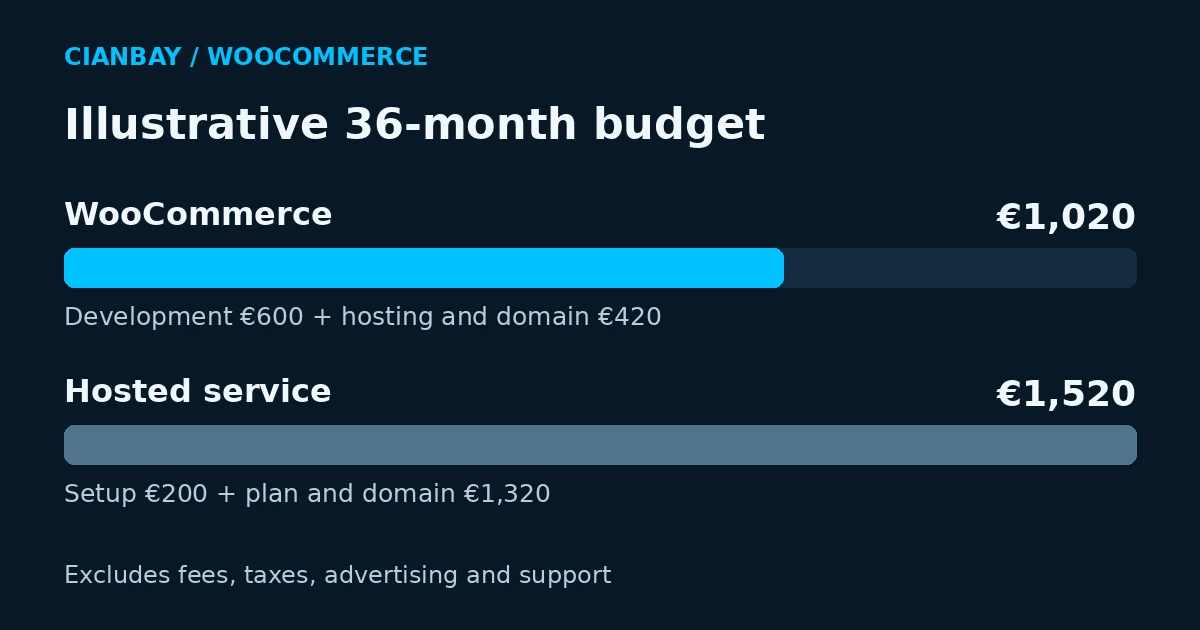
Under these assumptions the difference is €500. Adding a WooCommerce extension costing €150 annually increases its total to €1,470. Adding a €15 monthly app to the hosted store increases its total to €2,060. Taxes, transaction fees, marketing, paid support, migration and employee time have been excluded from this example. A full total-cost-of-ownership calculation must include all relevant items for the same level of service.
A merchant should also calculate costs relative to contribution margin. If every order contributes €10 after variable costs, a recurring annual expense of €360 needs the contribution of 36 additional orders to cover it. An automation that costs the same amount but saves a staff member several hours each month may be an excellent investment. The objective is not to reject paid tools; it is to pay for demonstrable business value.
Which recurring expenses will remain?
Every independent ecommerce website needs reliable infrastructure. A domain must be renewed, hosting must be paid for and backups must be maintained. A shop selling twenty handmade products and a retailer synchronising twenty thousand SKUs with a warehouse do not have equivalent infrastructure needs. A low-priced server that causes checkout failures during a successful campaign is an expensive saving.
Payment processors charge according to their contracts. For businesses in supported markets, providers such as Stripe, PayPal or local banking services can be considered, subject to eligibility and local rules. Premium plugins for subscriptions, advanced shipping, inventory or tax calculation may require annual renewal. Email delivery, customer messaging and external CRM services may introduce further costs. Ask which parts of the system stop receiving updates, support or functionality if a licence expires.
Security is another operating responsibility. Self-hosting gives control but does not eliminate the need for updates, monitoring, access management and recovery procedures. A hosting provider or maintenance partner can handle these tasks under a separate agreement. At CianBay, ongoing support is available without making a studio subscription a condition of using the completed store. We recommend assigning maintenance responsibility before launch instead of waiting for the first technical incident.
Ownership and switching providers
Ownership is more than being able to log into a dashboard. The merchant should control the domain registration, hosting account, store database, media files, backups and important external service accounts. An independent developer should be able to maintain the site with appropriate permissions without needing the original supplier to approve every change.
Open source does not mean that every third-party theme, commercial plugin or bespoke module automatically becomes the merchant's exclusive intellectual property. Each component is subject to its licence or the terms of the development agreement. What matters operationally is that the merchant has the agreed permissions and access needed to continue using and maintaining the store without compulsory studio fees. Commercial extensions should be licensed appropriately.
Hosted platforms commonly support exports of products and some other business data. That is valuable, but an exported spreadsheet is not the same thing as a portable copy of the application. Moving a hosted store to a different system normally requires a new implementation of its storefront and workflows. For brands investing in long-term organic search visibility, content and direct customer relationships, understanding exit options is part of responsible procurement.
Growing beyond the starter store
Imagine a small brand that begins with fifty products and one domestic shipping method. Over time it adds an overseas market, wholesale pricing, stock synchronisation and a second language. WooCommerce does not impose a mandatory core software subscription tier based on the catalogue size. Actual server capacity, integration complexity and development work can still create additional expenses. A larger operation needs the infrastructure to match.
For example, CianBay's CaseComponents project is a WordPress and WooCommerce store with approximately 650 product positions, catalogue organisation and product import. Its development cost was €1,500. This is an example of an extended project rather than a €600 starter package. It illustrates why a store should be estimated according to its requirements, not just its software choice.
For merchants who need an integrated sales workflow from the outset, CianBay offers a WooCommerce store with CRM and automation from €1,200. It can combine the agreed catalogue, payment and shipping integrations, order handling and basic SEO preparation in one project. Requirements, third-party expenses and delivery dates are agreed individually. A business should decide which automations remove real bottlenecks instead of purchasing unnecessary complexity.
When migrating from a subscription platform is worthwhile
A profitable Shopify or Wix store should not be migrated simply because its owner dislikes monthly fees. Establish the business case first. Compare the cost of the move with the savings and additional capabilities that an independent system would deliver. If the existing platform already meets the team's needs and generates strong sales, remaining there may be the more economical decision.
When a migration is justified, plan to preserve product information, images, categories, high-value URLs and integrations. Customer information and order history require compatible export mechanisms and lawful handling. Passwords may not be transferable. Prepare a redirect plan, test payment and fulfilment workflows and reconcile orders before the final switch. Redirects can help protect search visibility, but no developer can guarantee that search rankings remain unchanged.
A staged transition reduces operational risk. A merchant can keep its existing checkout running while a new site is prepared and tested. The final cutover should account for orders placed during the migration window and the availability of the team responsible for resolving problems. The goal is to replace the technical system without needlessly interrupting the business.
Where to order a WooCommerce store without platform subscription fees
CianBay Studio develops websites for clients in Ukraine and internationally. A starter WooCommerce store from €600 includes the agreed catalogue, cart, checkout, payment and delivery configuration, responsive presentation and technical SEO preparation. Hosting, domain registration, paid third-party services, additional catalogue work and complex integrations are estimated separately. See the CianBay price guide for the current starting prices.
To obtain an accurate estimate, share the number of products and variants, the countries where you sell, required payment and delivery methods, languages and your existing business systems. If you already have a website, include its address and the limitations you are experiencing. We can discuss whether an independent store or a hosted solution fits your objectives, rather than prescribing a particular tool without understanding the business. Contact CianBay on WhatsApp or send a project enquiry.
Frequently asked questions
Is WooCommerce completely free to operate?
No. The core platform does not require a mandatory subscription, but operating a professional website requires infrastructure and may require additional software and support. The distinction is between platform access fees and actual operating costs.
Can I cancel maintenance without losing my store?
With a properly handed-over independent website, you can choose another maintenance provider or manage the site yourself. Hosting and domain services must remain active, and any commercial components must be used according to their licences. Security updates and backups should not be neglected.
Is WooCommerce always less expensive than Shopify or Wix?
No. A hosted service may cost less for a straightforward business, particularly during the launch phase. Compare the same functions over the expected life of the store, including integration and maintenance expenses.
Can I add CRM, B2B pricing or international sales later?
Yes, subject to the architecture and necessary development. Starting with a modest store does not prevent expansion. Discuss foreseeable requirements early so the data structure and integrations can accommodate them.
Can I get a store that brings in sales without ongoing marketing costs?
No platform can guarantee that. Search visibility, product quality, competitive pricing, delivery, customer trust and marketing determine whether people buy. An independent WooCommerce store offers control of a valuable channel, not a promise of automatic revenue.
Sources
- CianBay pricing
- Official WooCommerce pricing
- Shopify US pricing
- Wix plan guide
- PrestaShop open-source download