Dmytro CianBay · 26.11.2026 · 13 min read
Cosmetics and perfume ecommerce website on WooCommerce in 2027: features, compliance and development costs
Build a beauty ecommerce website with product variants, ingredients, batch tracking, shipping rules and WooCommerce development from €600.

An online beauty shop has to answer questions that a physical shop answers through its displays, samples and staff. A customer wants to know what a product contains, which shade is available, whether a fragrance is the intended concentration and how an order will arrive. A retailer needs to manage inventory, product information and customer expectations without allowing the website to make promises that the business cannot fulfil.
WooCommerce is a flexible option for an independent beauty business because it allows the retailer to own its storefront, organise a specialised product catalogue and connect suitable external services. The challenge is not simply installing an ecommerce plugin. A shop selling its own formulations, importing cosmetics or distributing established brands may have very different commercial and legal obligations. This guide looks at what to include when commissioning a cosmetics and perfume ecommerce website for 2027, with particular attention to the European Union and the United States.
Contents
- Choose a business model before designing the storefront
- Catalogue structure and meaningful product variations
- Product pages that support confident purchases
- European Union cosmetics compliance in 2027
- Selling cosmetics in the United States
- Batch traceability, stock control and product changes
- Payments, perfume shipping and customer service
- Retention and merchandising without intrusive practices
- SEO for a competitive beauty catalogue
- How much does a cosmetics ecommerce website cost and where to order it?
- FAQ
Choose a business model before designing the storefront
A direct-to-consumer skincare brand can focus on a small collection with detailed product photography, ingredient information, routines and educational content. A multibrand retailer may need a much larger catalogue, a reliable supplier feed and a way to keep stock and pricing consistent across channels. A specialist fragrance store faces another challenge: online customers cannot smell the product, so descriptions, concentration, bottle sizes and authentic provenance matter greatly.
Professional beauty distributors may also need wholesale pricing, minimum order quantities and approved trade accounts. Those features should follow a clearly defined sales process rather than being added simply because competitors have them. A business that serves both consumers and salons can launch a retail catalogue with a separate trade enquiry route, then introduce account-based prices when the demand justifies it.
Before commissioning a website, identify the countries you intend to serve, your role in the supply chain and whether your goods will be sold under your own label. This affects what information needs to be collected from suppliers and which fulfilment methods are available. A website should reflect the actual commercial model, not create a fictitious international operation around an assortment that can only be shipped locally.
Catalogue structure and meaningful product variations
Beauty products require category-specific attributes. A makeup customer may want to filter by shade, finish, coverage or size; a perfume shopper may be looking for a particular brand, concentration, fragrance family or bottle volume. Haircare and skincare products need their own taxonomy. Apply attributes only where they help customers compare relevant products, and use consistent names supplied or approved by the brand.
WooCommerce variable products can maintain individual SKUs, prices, images and stock quantities for different options. A lipstick offered in twelve shades and two pack formats could have as many as twenty-four sellable combinations. A colour that the brand does not manufacture should not appear as a purchasable option. A fragrance available in 30 ml, 50 ml and 100 ml can often use a single parent product, but different concentrations or formulations should be identified clearly, not merged solely because they share a name.
The number of catalogue pages is therefore not the same as the number of stock records. Fifty products with many colours and sizes can be more demanding than a hundred simple products. Discuss variation counts and data availability when requesting a development quote. Where products have separate identifiers for individual variants, the inventory system and merchant feeds should retain those identifiers accurately.
Product pages that support confident purchases
A persuasive beauty product page combines strong visual presentation with precise product information. Include suitable photographs, net quantity, the verified ingredients list, directions, warnings, product identity and the relevant manufacturer or responsible-person information where applicable. Provide the required market-specific information in a readable form rather than hiding it in an image that mobile users cannot enlarge or assistive technology cannot interpret.
An ingredient list should match the actual formulation supplied. If packaging or formula changes, use an agreed process for updating the listing and identifying any affected stock. For colour cosmetics, show photographs of the selected shade rather than a generic shade range. Different displays and lighting can affect perceived colour, so avoid guarantees of exact reproduction. For perfume, clearly distinguish an eau de toilette from an eau de parfum, and a full-size bottle from a sample or a miniature.
Marketing language deserves the same care as technical data. A statement about the visible appearance of skin is not the same as claiming that a product treats a disease. Claims such as hypoallergenic, clinically proven or organic should be supported before they are published. Generative AI can assist with drafting but cannot verify a formula or provide evidence for a therapeutic claim. Have the appropriate supplier or product owner approve the content, particularly when translation might change its meaning.
European Union cosmetics compliance in 2027
Regulation (EC) No 1223/2009 is the principal EU cosmetics framework. It sets out requirements relating to product safety, the responsible person, safety assessment, product information, notification and labelling. A retailer distributing goods already placed lawfully on the EU market has a different role from an importer bringing goods in from a third country or a brand placing cosmetics on the market under its own name. A distributor can acquire responsible-person obligations in certain circumstances, including selling a product under its own name or trademark.
Commission Regulation (EU) 2023/1545 expanded the individual labelling of fragrance allergens. The transitional period for placing affected non-compliant products on the market ended on 31 July 2026; eligible products placed on the market earlier may continue to be made available until 31 July 2028. This distinction matters when older and newer packaging are held at the same warehouse. Store owners should work with their responsible person or suppliers to confirm which batches qualify and what information should be displayed.
Cosmetics Product Notification Portal (CPNP) notification is not a marketing approval or certification. Similarly, a beautiful website does not establish that a cosmetic is compliant. An ecommerce implementation can provide the right data fields, document links, internal approval status and a process for withholding incomplete listings. It is the product business and its qualified advisers that determine whether a particular product can legally be sold.
For cross-border sales, local language requirements, VAT, packaging obligations and distance-selling rules also need consideration. In the EU, consumers generally have a fourteen-day withdrawal right for distance purchases, with specific exceptions. The exception for sealed goods unsuitable for return for genuine health-protection or hygiene reasons after unsealing is not a blanket exclusion for all beauty products. Defective or non-conforming goods must be handled separately from change-of-mind returns.
Selling cosmetics in the United States
US beauty businesses need to consider the Federal Food, Drug, and Cosmetic Act and the Modernization of Cosmetics Regulation Act of 2022 (MoCRA), together with applicable state rules. Facility registration and product listing generally apply to the relevant manufacturers, processors and responsible persons, subject to statutory exceptions. A retailer should establish who is responsible for the product, not assume that every reseller must register a manufacturing facility. FDA registration or listing does not constitute FDA approval.
FDA explains that product claims can affect whether a product is classified as a cosmetic or a drug. A moisturiser marketed to improve the appearance of dry skin is different from a product marketed to treat eczema. Sunscreens, for example, are regulated as drugs in the US even though the EU generally treats sunscreen products as cosmetics. Products sold across both markets may therefore need different legal assessments, permitted descriptions and product data.
For a shop operating in multiple jurisdictions, do not reuse the same product eligibility status or marketing claims automatically. A product can be offered in one destination while being withheld from another pending review. This is a good reason to make the catalogue's market availability configurable before advertising the shop globally. Keep the date and source of approved product descriptions so that later updates can be reviewed and audited.
Batch traceability, stock control and product changes
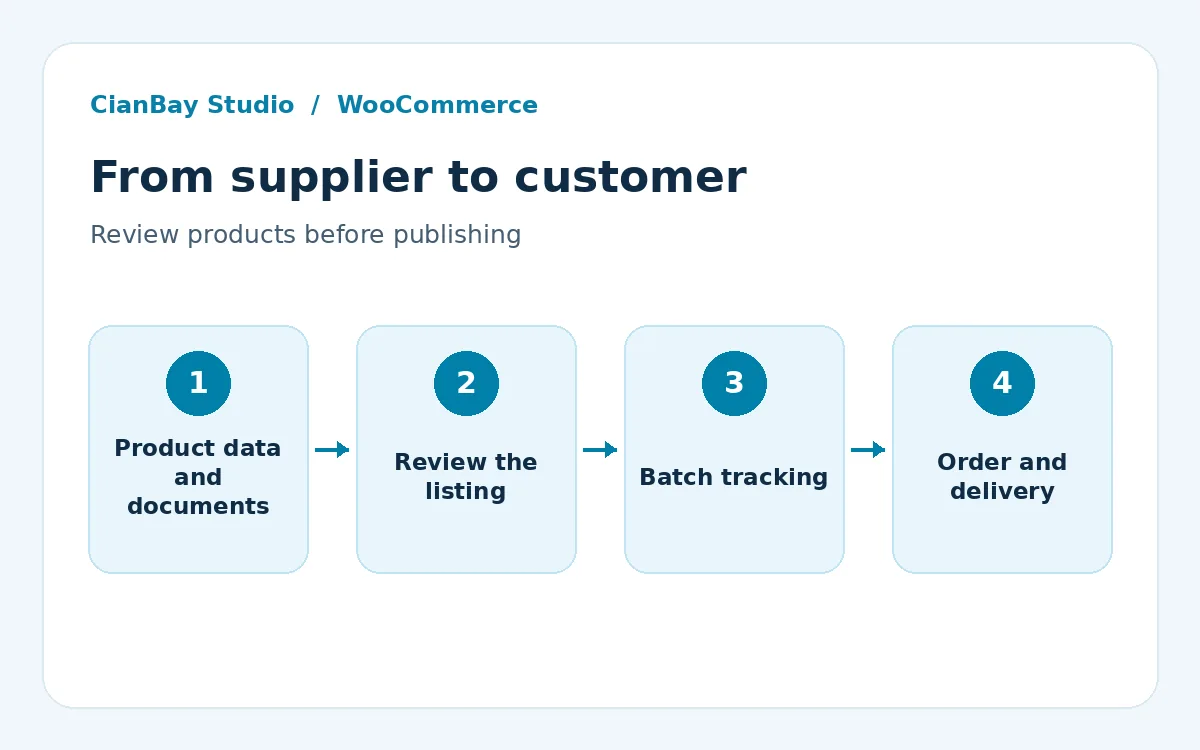
WooCommerce stock management tracks quantities by product or variation. It does not automatically provide full batch-level traceability or expiry-date management. A small brand may start with a reliable external inventory process, while a distributor holding many batches will benefit from an inventory or ERP integration that records supplier, lot number, receipt date and relevant expiry information.
Do not confuse the period after opening (PAO), often shown as an open-jar symbol with a number of months, with the unopened shelf life of a product. The warehouse should have a process for monitoring stock that is approaching its relevant expiry date, and staff must know what information is available for each batch. If a product is recalled, the business should be able to suspend sales of affected inventory and identify relevant orders according to its responsibilities.
A supplier feed may update prices and quantities frequently, but new product records should not bypass the review process. A sensible integration separates product approval from routine inventory updates, reports failed imports and protects manually verified ingredient information from being overwritten by incomplete data. If several suppliers sell the same SKU, establish how the system selects stock and determines the dispatch promise.
Payments, perfume shipping and customer service
Payment methods should match the intended market and merchant eligibility. In Europe, card payments and locally popular payment methods can be offered through suitable providers; in the US, Stripe, PayPal or other merchant services may be appropriate. Provider availability, transaction fees and terms must be checked for the actual business. Never store raw payment-card data in the shop as a substitute for using a suitable payment provider.
Perfume shipping requires particular attention. Alcohol-based fragrances and certain aerosols can be subject to dangerous-goods transport restrictions. USPS, for instance, generally allows ethanol-based perfume through authorised domestic surface services, with domestic air transport requiring prior written authorisation; its international mail service prohibits perfume. Other carriers and specialised dangerous-goods services have their own rules. A business should check the product's classification, destination and carrier approval before publishing a delivery option.
Use shipping classes or appropriate additional logic to distinguish ordinary cosmetics from restricted items. Test mixed carts, remote destinations and international checkout. If a customer adds an alcohol-based fragrance to a basket of ordinary creams, the available options may change. Showing the correct option before payment is preferable to accepting an order and then discovering that it cannot be shipped. Packaging and damage claims are equally important, especially with glass perfume bottles and temperature-sensitive items.
Retention and merchandising without intrusive practices
Many beauty products are replenished, but the interval depends on size, use and customer preference. A reorder button, wish list and optional reminders can be useful before introducing subscriptions. If customers choose recurring deliveries, the price, frequency, renewal terms and cancellation process should be clear. The ability to change a shade or pause a shipment may be more valuable than a complicated loyalty system.
A skincare routine or a gift collection can increase basket value when the products genuinely belong together. Gift sets need accurate availability across their component items. Samples can help fragrance shoppers, but the business must verify how those samples are sourced, labelled and offered. Repackaging an original fragrance into small containers is not merely a catalogue variation; it may trigger additional product and safety obligations.
Personalisation should respect privacy. Do not collect extensive skin-condition or other sensitive information unless the business has a justified need and an appropriate legal basis. A simple product preference questionnaire may be enough. Marketing consent and transactional communications should be handled distinctly under the applicable privacy and electronic marketing rules.
SEO for a competitive beauty catalogue
A useful catalogue has a clear hierarchy of categories, brands and individual products. Match pages to search intent: a brand and shade query should lead to the right product, while a broad request for a type of product should lead to a useful category. Product structured data and merchant feeds should reflect the price, availability and identifiers shown to customers. Avoid generating hundreds of indexable filter combinations that offer no independent value.
Google Merchant Center and social commerce can extend the shop's reach, but their policies are separate from legal permission to sell. Verify eligibility for products with medical claims or other regulated characteristics. Track conversion by device and category, margin after shipping and advertising costs, repeat purchase rates and the reasons for returns. High visitor counts alone do not prove that a beauty store is commercially successful.
How much does a cosmetics ecommerce website cost and where to order it?
CianBay Studio develops independent WordPress and WooCommerce websites for businesses in Ukraine and internationally. A standard ecommerce website starts at €600, with the agreed catalogue, cart, payment and delivery functionality. An integrated store with CRM, automation and basic SEO starts at €1200. These are starting prices, not universal fixed quotations for every beauty catalogue. Batch-level inventory, custom supplier feeds, advanced shipping rules, premium extensions, extensive content production and additional integrations require separate estimates. Hosting, domain registration and third-party services are also separate costs.
The first discussion should cover catalogue size, number of variations, countries served, available product documentation and the business's current fulfilment process. CianBay can help turn that information into a practical website specification and configure the required commercial functionality without a mandatory subscription fee for the WooCommerce core platform. Compliance assessment, product notification and legal advice remain separate specialist activities. The goal is a shop that can grow with the brand while keeping the retailer in control of its domain, content and sales channels.
WooCommerce development · Payment integrations · Integrated CRM solution · Pricing · Discuss your project
FAQ
Can WooCommerce handle cosmetics shades and perfume sizes?
Yes. Variable products support separate stock, prices, images and SKUs. Specialised swatches and advanced filters may need additional configuration or extensions.
Does WooCommerce automatically make a beauty store legally compliant?
No. It can display information and support workflows, but the retailer and relevant product operators must establish compliance for each market.
Is CPNP notification the same as product approval?
No. It is a notification process within the EU cosmetics framework and should not be presented as an official approval or certification.
Can I offer international shipping for every perfume?
No. Availability depends on the product, route and carrier's permitted services. Check the applicable restrictions before enabling checkout.
Can I launch a shop on a limited budget?
Yes, with an agreed standard scope and prepared product data. Additional stock integrations, multilingual content and market-specific features can be estimated separately and added when justified.
Sources
- WooCommerce: Variable products
- WooCommerce: Product categories and attributes
- Google: Product data specification
- Google: Merchant listing structured data
- EUR-Lex: Regulation (EC) No 1223/2009
- EUR-Lex: Regulation (EU) 2023/1545
- European Commission: Fragrance allergens labelling
- Your Europe: Returns and right of withdrawal
- FDA: Registration and listing of cosmetic products
- FDA: Cosmetics labeling claims
- FDA: OTC sunscreen
- USPS: Hazardous materials and perfume