Dmytro CianBay · 26.11.2026 · 12 min read
How to build a WooCommerce jewellery store in 2027: catalogue, personalisation and online sales
Build a jewellery store with ring sizes, gemstones, engraving, secure payments, insured shipping and a clear development budget.
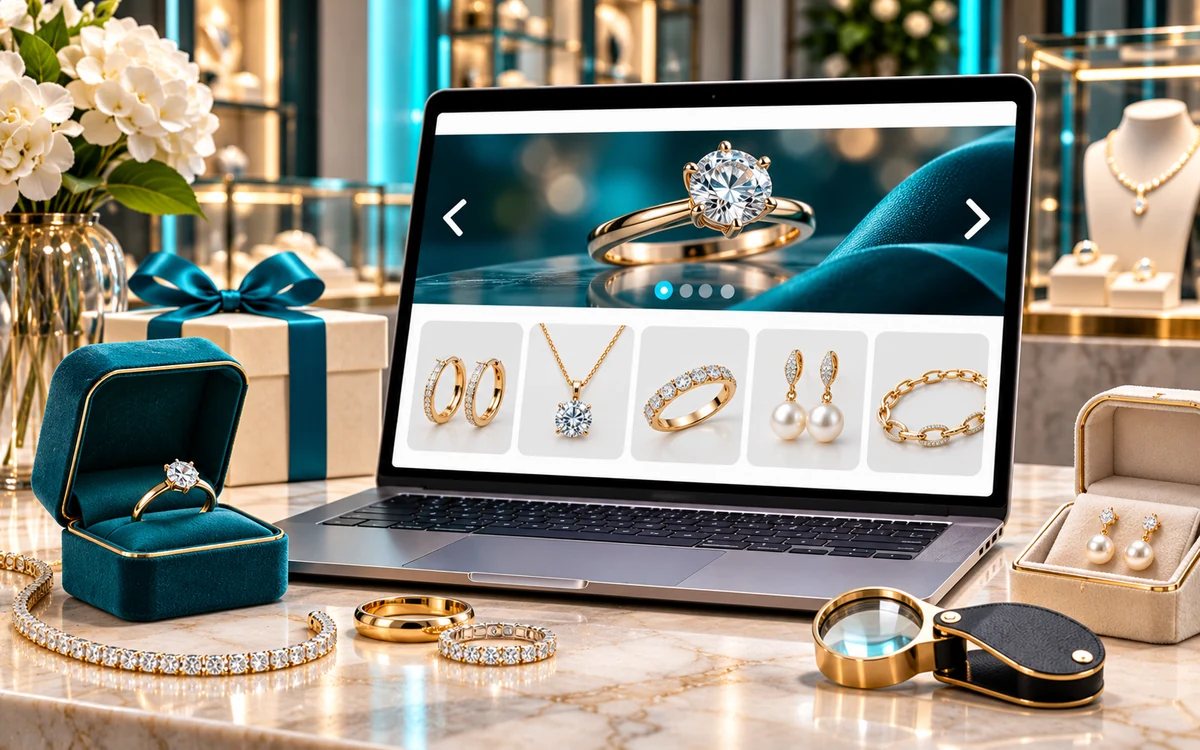
An online jewellery store needs to do more than display attractive photographs of rings, earrings and necklaces. Customers want to know what the piece is made of, whether the stone is natural or laboratory-grown, whether a ring will fit and whether a gift will arrive before an important date. The website has to reduce uncertainty at every stage of the decision. WordPress and WooCommerce can support an independent sales channel for a jewellery designer, a workshop, an established retailer or a brand with several showrooms. The right approach for 2027 is to design the store around the actual commercial and production processes, rather than relying on a generic fashion catalogue with a checkout button.
Contents
- Choose the business model before choosing the software
- Build a catalogue around jewellery-specific attributes
- Product pages that build confidence
- Personalisation, engraving and product configurators
- Inventory, point of sale and pricing
- Payments, secure shipping and unit economics
- Legal requirements in the EU and United States
- SEO, shopping feeds and customer retention
- Development cost and where to order a jewellery store
- Frequently asked questions
Choose the business model before choosing the software
A retailer selling finished pieces has different requirements from a jeweller making engagement rings to order. A finished piece needs reliable availability, a fixed price and a realistic dispatch date. A made-to-order piece needs an agreed specification, a production schedule and a clear payment arrangement. A bespoke commission may require a consultation and a quotation rather than immediate checkout. A multi-location business might additionally allow customers to reserve jewellery at a particular showroom and attend an appointment before buying it.
These models can coexist within one website, but they should not be presented as if they were identical. A visitor buying a silver bracelet for delivery tomorrow should not have to complete the same enquiry form as a customer commissioning a unique diamond ring. Conversely, the business should not promise instant delivery for a piece that still needs to be made. Design a separate customer journey for each model, and make the distinction visible in product search, on the product page and at checkout.
Build a catalogue around jewellery-specific attributes
A ring catalogue may need the metal, fineness, alloy colour, finger size, band width, stone type, stone weight and setting style. Chains need length, width, link style and clasp information. Earrings may require dimensions, fastening type and whether a weight refers to one earring or the pair. Use consistent units and avoid conflating the carat weight of a gemstone with the karat designation of gold. A product description that simply says 18 carat without explaining the context is not sufficiently informative.
WooCommerce variable products allow the retailer to maintain separate prices, stock quantities, photographs and other information for each supported variation. Six ring sizes and two metal colours would create twelve possible combinations. That does not mean all twelve are available. Publish the real options and distinguish between ready-to-ship stock and sizes that require production. For a unique stone with its own grading report, a separate inventory record may be more appropriate than treating it as an interchangeable variation.
Customers should be able to filter by metal, price range, size, stone and availability. A gift-oriented collection can also be useful for customers who have not yet decided which type of jewellery to purchase. The filtering system should consider the actual availability of variations, rather than displaying rings in a selected size that cannot be ordered. A well-organised product data model makes translation, inventory synchronisation and shopping feeds easier to maintain as the business grows.
Product pages that build confidence
For valuable jewellery, a single studio photograph rarely provides enough information. Show the piece from different angles, provide close-ups of settings and clasps and include a photograph showing its scale when worn. A short video can help customers understand how it reflects light. A diagram can communicate dimensions more precisely than an artistic photograph. Editing should not distort the stone colour or imply that a piece is substantially larger than it really is. Make it clear whether an image represents the design or the specific individual item available for sale.
A product page should distinguish natural gemstones, laboratory-created gemstones and simulants, and disclose relevant treatments or other characteristics where required. A grading report should be described according to the information it actually verifies. A report on a gemstone is not the same as a hallmark on a precious metal article, and neither should be presented as a universal guarantee that a piece is an investment. If a specific stone has a report number, preserve the association between that report and the inventory item throughout fulfilment.
Consider providing a ring-size guide with millimetre measurements and the sizing systems appropriate to the markets you serve. A customer in the United States and a customer in continental Europe may expect different size labels. If a printed sizing guide is offered, provide a scale check and explain that screen or printer settings can affect accuracy. For expensive or difficult-to-resize designs, offer a consultation or an appropriate sizing service rather than relying on an unqualified conversion chart.
Personalisation, engraving and product configurators
Simple engraving can be implemented as a product add-on, with a text field, font selection and price adjustment. It does not necessarily need to create an additional physical stock-keeping unit. The original product variation determines the inventory, while the engraving instructions become part of the order specification. The website should enforce the character limits and available symbols that the workshop can actually produce. Customers should see the additional cost before placing the order.
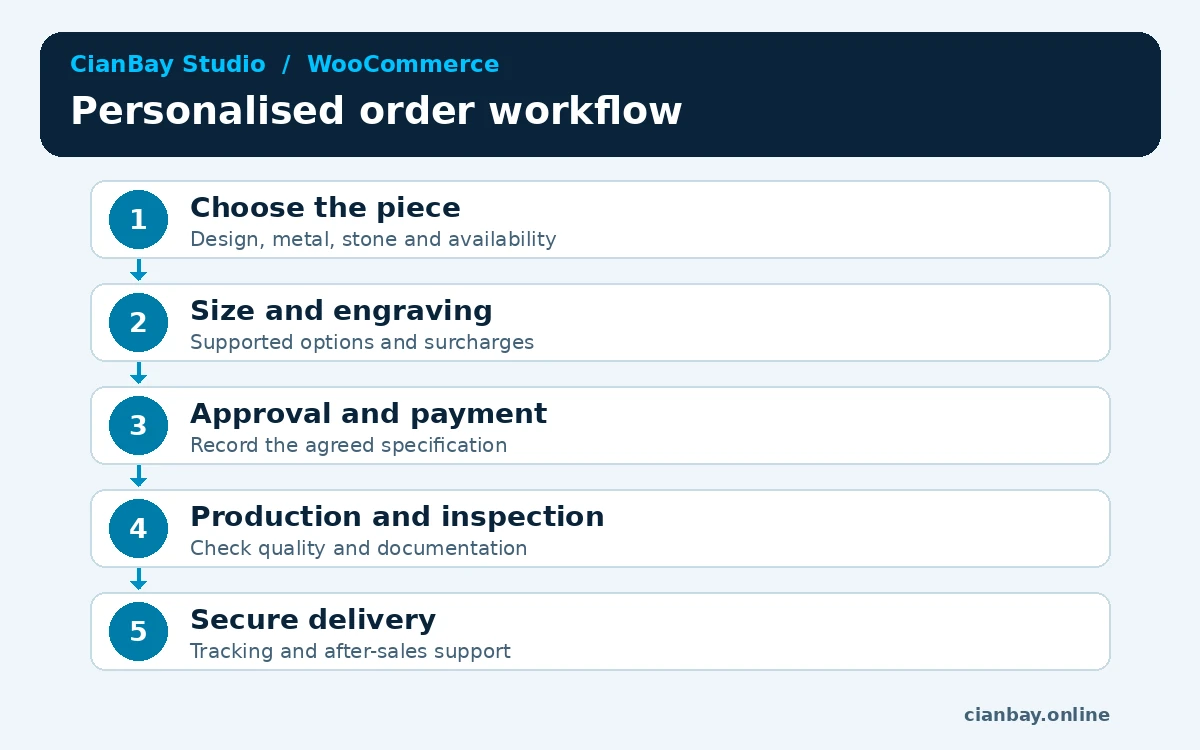
A configurator for wedding rings or bespoke pieces is a more complex project. Metal, band width, thickness, size, stone and setting may affect both price and manufacturability. Some combinations should be excluded completely. If the final price depends on the finished weight, make the quotation process clear rather than presenting an estimate as a guaranteed total. An approval step before production can record the exact engraving, design and agreed commercial terms. For a premium design, a rendered preview may help the customer visualise the result, but it should not be represented as an exact photograph of the completed piece.
Inventory, point of sale and pricing
A jewellery business with a physical showroom should have a clear source of truth for inventory. If a one-of-a-kind ring is sold at the counter, the online store must stop offering the same item. A reservation should expire if the buyer does not pay or complete the agreed appointment. If the business operates several locations, stock and reservations need to identify the location as well as the item. WooCommerce can integrate with an appropriate point-of-sale or inventory system, but the reliability of the synchronisation depends on the available integration and how stock is recorded.
Manufacturing capacity is a different resource from finished stock. A workshop might be able to make ten similar rings during a particular week, but it may have no finished examples on hand. The order management process should track quotations, deposits, approved specifications, production stages, quality checks and dispatch. A CRM can help staff manage consultations and follow-up communication. It should not be assumed that a standard CRM automatically provides all manufacturing, hallmarking or traceability functions.
When prices depend on metal costs or exchange rates, determine how often the catalogue is updated and when a customer quotation becomes binding. The amount already accepted by a customer should not silently change after checkout. A business can update catalogue prices at scheduled intervals and issue time-limited quotations for custom commissions. A separate approval workflow for unusually expensive orders can reduce errors without imposing unnecessary friction on ordinary purchases.
Payments, secure shipping and unit economics
Stripe, PayPal and other payment providers may be relevant depending on the merchant's country, business model and underwriting requirements. Confirm that the provider accepts the actual product categories before designing the checkout around it. A conventional retail jewellery business is different from a business dealing in bullion or investment products. Use hosted or tokenised payment mechanisms so that the website does not retain full payment card details. High-value orders may warrant appropriate fraud checks and an operational review before dispatch.
For international sales, a carrier's ordinary parcel service may not cover precious metals, loose gemstones or high-value jewellery. Check the permitted contents, value limits, insurance exclusions, destination restrictions and claim procedure for the specific service. A tracking number does not prove that the declared value is insured. Discreet packaging, documented packing checks and an appropriate delivery confirmation process help manage risk. Establish a safe return procedure as well, since customers may need to send a valuable item back for inspection or resizing.
Consider an illustrative order priced at $400, excluding sales tax. If the product costs $220, packaging $12, payment processing $14, insured shipping $20, customer acquisition $45 and the reserve for after-sales work $14, the remaining contribution is $75 before fixed costs and taxes. A free resizing or an additional insured return can materially reduce this amount. The business should measure contribution by product type and sales channel, not simply compare turnover. A direct store may reduce dependence on marketplace fees, but it still requires marketing, support, maintenance and payment infrastructure.
Legal requirements in the EU and United States
In the European Union, the General Product Safety Regulation, Regulation (EU) 2023/988, includes requirements for offers made through distance selling. Article 19 addresses information such as identification of the manufacturer, the relevant EU responsible economic operator where applicable, identification of the product, and appropriate safety information. The website should provide a place for these data, but the merchant must obtain and verify them. REACH restrictions can also apply to nickel release and to lead or cadmium in jewellery components. Applicable restrictions depend on the materials and product type; a marketing claim such as hypoallergenic is not a substitute for evidence of compliance.
Hallmarking rules are not identical across all European countries. A seller targeting multiple markets should establish the rules for the destination, including recognition of existing marks, any exemptions and required documentation. In Poland, the Warsaw Assay Office publishes specific guidance on internet sales. In November 2026 the Polish Ministry of Development and Technology also announced a proposal to update assay legislation for online commerce. A proposal is not an enacted obligation, so the final legal status should be checked before a 2027 launch.
EU distance-selling rules generally provide a fourteen-day withdrawal period for consumers, subject to defined exceptions. Goods genuinely made to the consumer's specifications or clearly personalised can fall within an exception. A ring selected from ordinary stock sizes should not automatically be classified as bespoke simply because the business calls every order custom. The right to a remedy for defective or misdescribed goods is a separate matter. Display appropriate return information before the contract is concluded, and avoid using one global policy for every jurisdiction.
In the United States, the Federal Trade Commission's Jewelry Guides address accurate descriptions of precious metals, gemstones, laboratory-created and imitation stones, and pearls. Descriptions and advertisements should make material differences clear, not rely on small print that contradicts the main presentation. Other requirements may apply at federal or state level, including rules for children's products, tax collection and disclosures. Businesses whose activity falls within relevant precious-metals or gemstone dealer rules should obtain advice about anti-money-laundering obligations. No single checkout checkbox establishes compliance in every state. Legal points here reflect sources reviewed on 26 November 2026 and should be checked against the actual markets and merchandise before launch.
SEO, shopping feeds and customer retention
Customers search for a specific combination of material, style, stone, occasion and budget. Organise the site around meaningful collections and categories rather than indexing every possible filter combination. An article explaining how to measure ring size can lead to a collection of rings. A guide comparing natural and laboratory-grown stones can link to accurately described products. This creates a useful path from an informational query to a purchase or consultation.
Use descriptive image text, compressed WebP photographs, accessible controls and mobile-friendly layouts. Product structured data and Google Merchant Center feeds should accurately represent price and stock availability. Test changes to size or metal on a mobile device and ensure the customer can understand the updated price without opening multiple screens. Measure product purchases, consultations, appointment reservations, completed quotations and returns separately. Collect marketing consent appropriately, and use customer information for the purposes for which it was collected.
Development cost and where to order a jewellery store
CianBay Studio develops WordPress and WooCommerce websites for businesses internationally. A standard online store starts from €600, subject to the agreed product scope, checkout, payment and delivery integrations. A broader solution with CRM and foundational SEO starts from €1,200. A bespoke ring configurator, unique-item inventory integration, multilingual product feeds and specialised security or logistics workflows require a separate estimate. Domain, hosting and any paid modules or external services should be agreed before development starts. These starting prices are not quotations for every high-value or regulated jewellery business.
For an initial estimate, provide the number of product designs and stock variations, intended markets, available product documentation, existing stock system and the required personalisation options. Also identify whether customers should book showroom appointments or purchase directly. CianBay can help define a launch scope that solves the immediate commercial needs while leaving room for future integrations.
WooCommerce development · Pricing · Contact
Frequently asked questions
Can WooCommerce support a jewellery store with several ring sizes?
Yes. Variable products can manage separately priced and stocked options, and made-to-order availability can be handled with an appropriate workflow.
Can customers personalise jewellery on the website?
Yes. Simple engraving can use additional product fields. Real-time three-dimensional previews and manufacturing-aware configurators require a more specialised implementation.
Does every piece require a gemstone certificate?
Not universally. Required documentation depends on the product and market. A retailer should distinguish hallmarking from gemstone grading and make only accurate claims.
Can all jewellery returns be refused?
No universal rule applies. Distance-selling, customisation, defects and local law must be considered separately.
Is a marketplace still useful after launching an independent store?
Yes. It can remain a discovery or sales channel while the independent website supports brand development, direct sales and customer relationships.
Sources
- WooCommerce: variable products
- WooCommerce: product add-ons
- GPSR – Regulation (EU) 2023/988
- ECHA – REACH restrictions: nickel
- ECHA – REACH restrictions: lead
- FTC – Jewelry Guides
- Okręgowy Urząd Probierczy – E-obrót
- MRiT – projekt zmian Prawa probierczego
- Biznes.gov.pl – handel przez internet
- Держпродспоживслужба – роздрібна торгівля ювелірними виробами
- Держпродспоживслужба – купівля ювелірних виробів
- Держпродспоживслужба – права покупців онлайн