Dmytro CianBay · 26.11.2026 · 13 min read
Equipment rental website with WooCommerce in 2027: bookings, payments, security deposits and asset tracking
Build an equipment rental website with availability calendars, pricing, payments, deposits, asset tracking and legal considerations.
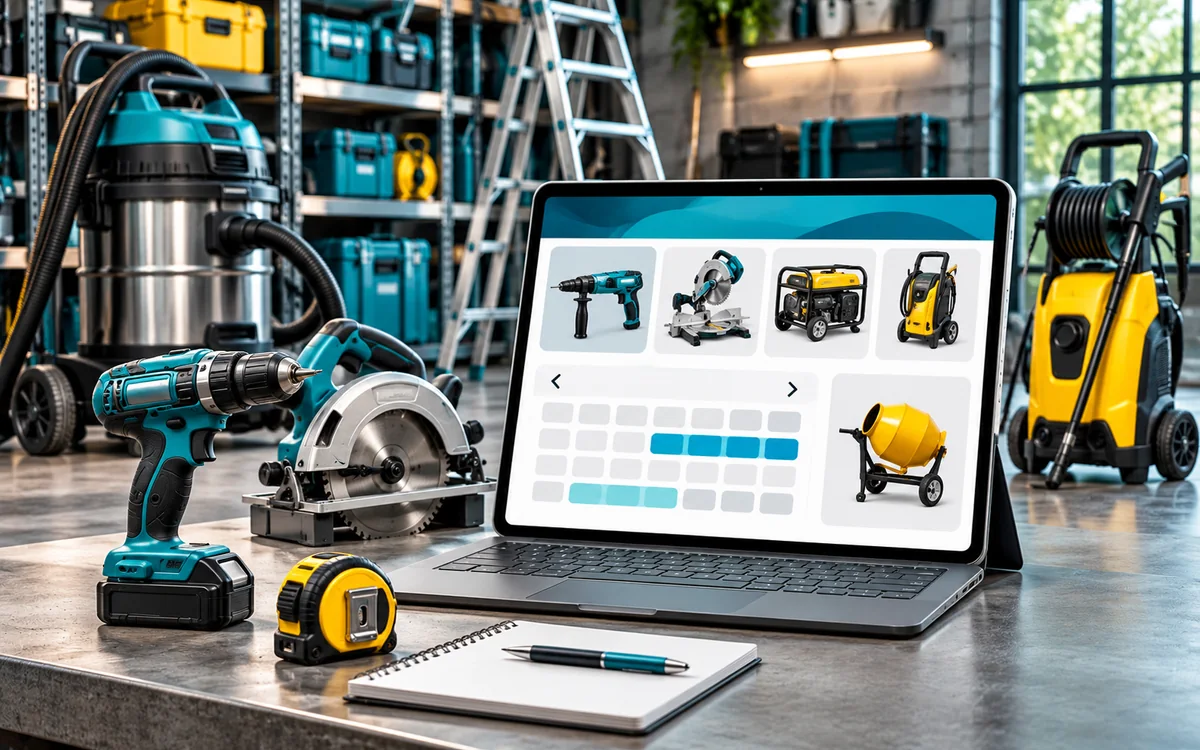
A customer hiring a carpet cleaner for a weekend, a camera kit for a commercial shoot or a generator for a construction site is buying access to equipment for a defined period, not ownership of a product. An equipment rental website therefore needs more than a catalogue and a checkout. It must answer whether the item is available, calculate the rental price, reserve the right inventory, explain the contract and support the return process. In 2027, WordPress and WooCommerce can provide the foundation for this business, provided that the booking and asset management rules are designed around actual operations rather than copied from a conventional online shop.
Contents
- Who needs an equipment rental website?
- Build a catalogue around the customer's task
- Booking calendars and real-time availability
- Pricing models and rental profitability
- Payments, advance payments and security deposits
- Handover, inspection and asset management
- Consumer rights, equipment safety and privacy in Europe
- United States and other international markets
- SEO, customer retention and useful analytics
- Where to commission an equipment rental website and what it costs
- Frequently asked questions
Who needs an equipment rental website?
Tool hire, landscaping equipment, cleaning machines, audiovisual gear, event furniture and professional photography equipment are all suitable candidates. However, their booking patterns differ significantly. A homeowner may need a pressure washer tomorrow, while an event planner reserves thirty chairs and a sound system months in advance. A contractor may require a weekly account, multiple generators and delivery to a job site. The website should support these scenarios without forcing every visitor through the same sales funnel.
For a small local business, an online catalogue with a reliable availability calendar can reduce repetitive calls. Customers want to know the rate, collection point, included accessories and whether a machine is suitable for their intended task. When those answers are available before a call, staff can focus on advice and exception handling rather than repeating basic information.
For specialist or high-value equipment, automatic booking is not always desirable. A quote request with the expected hire period, location, required capacity and delivery conditions can be a better starting point. A qualified employee can check availability, safety restrictions and additional services before accepting the order. The website can combine instant bookings for standard products with approval-based bookings for more complicated orders.
Build a catalogue around the customer's task
Each rental product should include photographs, technical specifications, dimensions, weight, intended applications, collection options, rental rates and a clear list of included accessories. For a camera package, customers need to know whether batteries, chargers and lenses are part of the package. For a floor sanding machine, they need to know which consumables are included or charged separately. Incorrect assumptions about accessories can lead to failed jobs and disputes at the counter.
Good catalogue navigation accommodates customers who do not know a particular model number. A visitor searching for a machine to clean a carpet should be able to find a suitable category without understanding every manufacturer's terminology. Filters can include application, power source, capacity and location. A package of equipment can be displayed as one offer, while the individual assets remain separately managed behind the scenes.
Product pages should also explain relevant safety limitations, manufacturer instructions and requirements for trained operators where applicable. A short video or downloadable manual can complement the listing. However, a website cannot replace legally required instruction, competence checks or inspections. Businesses renting specialist machinery should have their product descriptions reviewed by the people who understand the equipment.
Booking calendars and real-time availability
A normal ecommerce inventory count is not enough for rental operations. The same physical item can be hired by different customers during different periods. For example, if a depot has five identical drills and three are already reserved on Saturday, two may remain available, provided none is undergoing maintenance or allocated to another location.
Availability must account for collection and return times, closing hours, holidays, preparation periods and transport. If a machine is due back at 5 pm, it may need inspection and cleaning before the next customer can collect it. For expensive items with a history of late returns, a business may choose to introduce a larger operational buffer rather than promise unrealistic back-to-back bookings.
WooCommerce Bookings supports resources that can represent equipment and availability rules. Dedicated rental extensions are another option for hourly or daily physical product rentals. A business should evaluate actual scenarios before purchasing an extension: multiple quantities, shared assets, overlapping periods, time zones, extensions, cancellations, maintenance blocks and partial returns. A demonstration calendar alone does not prove that these scenarios work. A custom booking module may be more appropriate for a complex fleet.
During checkout, the system should recheck availability before confirming the reservation. Temporary holds for abandoned checkouts must expire. Payment notifications can arrive more than once or after an interruption, so the integration needs to avoid duplicate bookings. Telephone reservations, counter orders and website orders must share a reliable inventory source; otherwise two employees can promise the same equipment to different customers.
Pricing models and rental profitability
Decide whether the business charges by the hour, calendar day, 24-hour period, weekend, week or month. These are different commercial rules. A rental from Friday afternoon to Monday morning might be a three-day hire or a weekend package, depending on the company's published terms. Make the rule visible before a customer enters payment details.
Consider an illustrative euro-denominated example: a machine costs €40 per day, the customer selects three days, and round-trip delivery costs €30. The rental and delivery subtotal is €150 before applicable taxes if they are not already included. A separately collected refundable security amount of €200 brings the initial payment to €350 under those assumptions. The security amount is not rental revenue. The checkout should distinguish the service price, taxes, any optional extras and the refundable amount.
An American business can use the same calculator in US dollars and apply appropriate state and local tax rules. A British or European operator can configure the relevant currency and consumer-facing tax display. A payment provider or tax extension does not determine the correct treatment of every rental or fee; the underlying accounting policy must be established first.
Utilisation matters more than the number of reservations alone. If a machine is available for 25 days and rented for 12 days at €40, it generates €480 before other charges. Deduct maintenance, depreciation, insurance, storage, staff and acquisition costs to evaluate profitability. Track unavailable days for servicing separately from days when the equipment is simply not rented. Those figures support better decisions about whether to buy another machine or improve promotion of the existing fleet.
Payments, advance payments and security deposits
A booking advance reduces the outstanding price of the rental. A refundable security payment serves a different purpose, such as securing legitimate claims for damage under the contract. Some WooCommerce extensions use the term deposit for a part-payment rather than a security amount. Verify that the extension actually supports the financial model you intend to use.
A card authorisation hold can be useful for short rentals, but its validity is limited by the card network, provider and transaction type. Do not assume that a hold will last for a month or that the rental operator may collect any amount automatically after return. Depending on the gateway and commercial agreement, a separately captured refundable payment may be more suitable. Stripe and other providers offer different authorisation and capture mechanisms; availability must be checked for the merchant's account and country.
Explain the amount, purpose and expected release or refund process before checkout. If the equipment is damaged, document the condition, establish responsibility and communicate a justified charge according to applicable law and the agreement. Avoid a blanket policy that forfeits every security deposit for any breach. Reconciliation must distinguish collected rental fees, refundable balances and amounts legitimately retained. Payment card numbers should not be collected through ordinary WordPress forms.
Handover, inspection and asset management
Assign an internal asset ID to each valuable physical unit. A record can include serial number, location, service history, condition and accessories. At handover, the employee links the specific unit to the reservation, confirms the actual time and records its condition. When the customer returns it, an inspection determines whether the item is ready for the next hire or needs servicing.
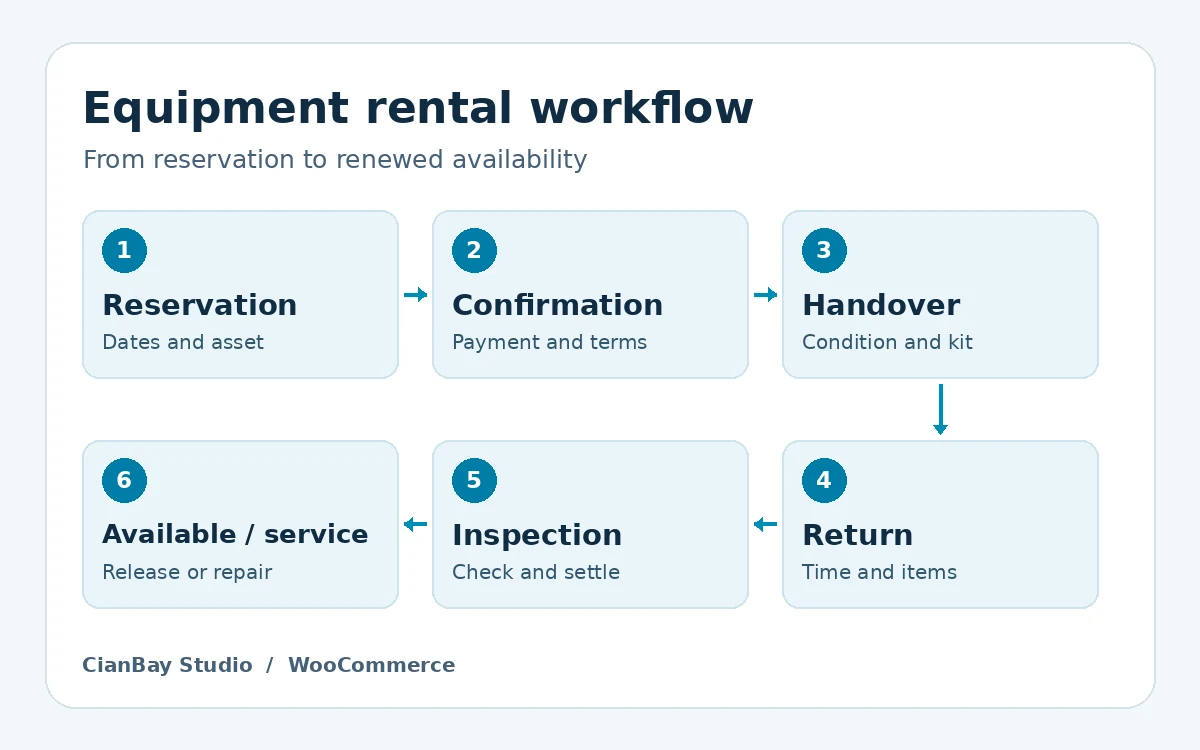
Order status and equipment status must remain distinct. An order can be paid but not collected; a returned asset may still be unavailable pending inspection. CRM software can handle customer communication and enquiries, while an asset management or rental system manages the fleet. WooCommerce can coordinate the online transaction, but the system architecture should establish which application is authoritative for availability and how changes are synchronised.
A company with several depots needs location-aware inventory. Equipment physically held in one town should not be promised at another collection point unless there is a planned transfer. Delivery capacity can itself be a limited resource. A single vehicle cannot fulfil several simultaneous deliveries to different locations just because the items are available. For large orders, allow staff to confirm transport and collection times before final acceptance.
Maintenance logs, inspection photographs and incident reports can be valuable evidence, but access must be restricted. Avoid exposing serial numbers or customer records publicly without a business reason. Keep a trace of adjustments and refunds rather than silently replacing the original order. This is particularly useful when a commercial customer disputes an invoice or an insurer asks for a record of the handover.
Consumer rights, equipment safety and privacy in Europe
For EU distance consumer contracts, the Consumer Rights Directive generally provides a 14-day withdrawal period, subject to exceptions. Its exception for car rental on a specified date does not automatically extend to all equipment rentals. Certain leisure-related contracts can qualify for other exceptions, but the actual legal classification matters. Where a service begins during the withdrawal period, the required express request and information must be handled correctly; full performance and a proportionate charge for partial performance have different conditions. Do not copy a universal no-cancellation clause from a vehicle hire website.
Product safety requirements may apply to equipment made available for consumer use, including relevant provisions of the General Product Safety Regulation (EU) 2023/988 and sector-specific rules. Check the applicable machinery, electrical or other requirements for the equipment itself. Display necessary warnings and instructions, keep appropriate inspection records and withdraw unsafe items from the booking calendar. A website is not a substitute for a compliant operational process.
Under GDPR, personal information must be limited to what is necessary and retained only for an appropriate period. A rental company may have legitimate identification needs, but collecting passport scans for every low-value rental is not automatically justified. Define a lawful basis, retention period and controlled access. Before launch, have the checkout, privacy notice, contract terms and any early-service request reviewed for the countries served. The legal information in this article was checked on 26 November 2026; national implementation and requirements should be reviewed again before a 2027 launch.
United States and other international markets
In the United States, rental contract obligations, tax treatment and consumer protection rules vary by state and sometimes locality. California, for example, publishes specific guidance for companies leasing tangible personal property. The tax result can depend on how the rental equipment was acquired, whether tax was paid at purchase and the nature of the lease. Do not apply the same retail sales tax rule to every rental nationwide. Obtain local tax advice before setting up automated calculations.
For construction customers, OSHA's rules on tools and equipment include requirements that employers maintain hand and power tools in safe condition. These workplace obligations do not replace the rental company's own duties under contracts, state law or applicable product safety requirements. Where the business supplies lifting equipment, powered access, vehicles or specialist industrial machinery, additional rules may apply. The website should support the required qualification or approval process rather than guarantee instant rental to every visitor.
For international operations, also check currency settlement, cross-border fees, insurance territory and whether equipment can legally be transported to the proposed location. Consumer and commercial contracts may require different terms. An approval-based B2B enquiry can support purchase orders, company accounts and negotiated rates without imposing those complexities on occasional consumer customers.
SEO, customer retention and useful analytics
Local rental customers often search for a specific machine and location, such as pressure washer rental in a particular city or tool hire near a collection depot. Create useful category and branch pages with actual equipment, operating hours, delivery areas and transparent rates. Avoid producing near-identical landing pages for locations where the company cannot serve customers. Real photographs and practical descriptions help users judge whether the equipment suits the task.
Track the complete booking funnel: product views, date selections, requests, confirmations, payments, handovers and completed rentals. A high number of booking requests may hide a shortage of available equipment. Monitor rejected requests, late returns, repeat customers, maintenance downtime and revenue per asset. Reminders and a self-service extension request can reduce routine calls, provided the next booking is not compromised. CRM integration can support account histories and follow-up communication without turning every notification into unwanted marketing.
Where to commission an equipment rental website and what it costs
CianBay Studio develops WordPress websites and WooCommerce stores for businesses internationally. Standard online store development starts at €600. A dedicated equipment rental system with booking rules, payment handling, refundable security amounts and asset management requires a project-specific estimate. A broader package with CRM and basic SEO starts at €1,200, but that price does not automatically include advanced rental integrations, a custom fleet management application or commercial software licences. Hosting, domain registration and external services should also be budgeted.
To request a quote, describe the product range, number of physical units, collection locations, rate rules, booking approval process, payment and security arrangements, and the workflow for inspections and returns. A small depot may need a catalogue and a reliable calendar first. A multi-branch company may require a coordinated inventory service and management interface from the outset. The goal is to select the least complicated solution that handles the actual operation without creating avoidable double bookings or financial errors.
Online store development · CRM and SEO package · Development prices · Discuss your project
Frequently asked questions
Can WooCommerce support equipment rental?
Yes, with an appropriate booking or rental extension or a custom module. Standard stock management alone is insufficient for date-based hire.
Can a single website support multiple depots?
Yes, when the inventory and booking rules account for actual asset locations and transfer times.
Is a security deposit the same as a booking advance?
No. A booking advance is part of the service price; a refundable security amount must be handled separately according to the agreement and law.
Can customers extend a rental online?
Yes, subject to availability, approval rules, recalculated pricing and applicable contractual terms.
Can every order be accepted automatically?
Not necessarily. Specialist machinery, delivery constraints or qualification requirements may warrant manual approval.
Sources
- WooCommerce: Resources in Bookings
- WooCommerce: Rental Products
- Stripe: Authorize and capture
- EU Consumer Rights Directive 2011/83/EU
- EU General Product Safety Regulation
- GDPR, Article 5
- California CDTFA: Leases in general
- OSHA: 1926.300, General requirements