Dmytro CianBay · 26.11.2026 · 13 min read
Sell event tickets on your own WordPress website in 2027: an independent ticketing channel
Build your own ticketing website with WooCommerce: event listings, seat selection, online payments, QR tickets, refunds and costs.
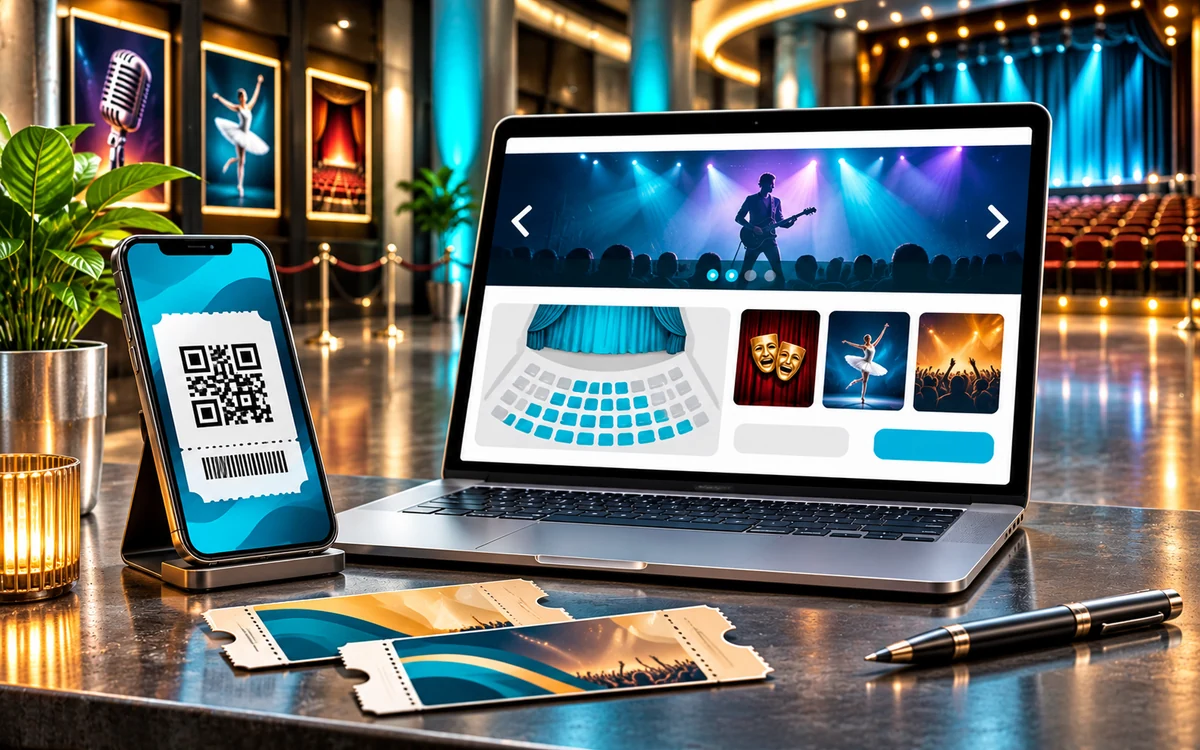
An independent ticketing website allows a theatre, concert promoter, museum, conference organiser or workshop provider to sell admission directly to its audience. Instead of sending visitors to a marketplace for the final transaction, the organiser can combine its programme, event information, payment and ticket delivery in a single customer journey. WordPress and WooCommerce can provide the commercial foundation for this approach, but a ticket is not an ordinary retail product. It represents admission to a particular event, often at a specific time and sometimes in a specific seat. In 2027, an effective ticketing project must address availability, customer rights, payment reliability and admission management as well as website design.
Contents
- Which organisations benefit from direct ticket sales?
- Event listings and landing pages that convert
- Ticket capacity, seating and concurrent orders
- Checkout, electronic tickets and QR validation
- Admission control and operational readiness
- Consumer rights, cancellation and price transparency in the EU
- United States and cross-border events
- Cost model: direct sales versus a marketplace
- Event SEO, CRM and performance measurement
- Where to commission a WordPress ticketing website
- Frequently asked questions
Which organisations benefit from direct ticket sales?
A local theatre may run several performances of the same production, a museum may admit visitors in timed groups, and a conference may sell standard, student and corporate passes. A festival might need single-day and multi-day admission, while a small training provider needs no seating plan at all. These differences determine the appropriate system. Start by defining what the customer receives, whether admission is transferable, whether a booking needs approval and how many people can be accommodated safely.
Direct sales are especially attractive for organisations with an established audience or a regular marketing budget. A visitor arriving from an email newsletter can see the next performance, choose a ticket and complete the purchase without being distracted by competing events. The organiser also controls how programme information, accessibility requirements and venue policies are presented. However, independence does not require abandoning ticket marketplaces. A marketplace may still contribute incremental discovery, and a hybrid strategy can be commercially sensible if channel allocations are managed consistently.
Event listings and landing pages that convert
The event calendar should allow visitors to find a performance by date, venue, city and category. A page needs more than an attractive poster: include the event name, start and expected end time, local time zone, venue address, organiser, age restrictions, access information, ticket conditions and the full relevant price. Explain whether a ticket includes workshop materials, meals, access to a reception or other optional services. A customer should not discover essential restrictions only after paying.
Distinguish an ongoing production from a particular performance. A theatre might stage the same play on Friday and Saturday with different casts or seat prices. A conference may offer several sessions within a single admission package. Make these relationships understandable in both the website navigation and the order record. If a performance is postponed, update the existing event page rather than silently replacing it with a new event that leaves earlier links broken. Existing purchasers should receive a clear communication explaining the new arrangements.
For mobile visitors, the buying button should be easy to locate without obscuring important details. Avoid forcing account registration before a customer can see ticket availability. Provide an accessible alternative to purely visual information such as a poster or seating map. This improves the experience for customers using assistive technology and helps search engines understand the actual programme.
Ticket capacity, seating and concurrent orders
For general admission, a limited stock quantity may be sufficient. A 300-person venue might allocate 240 tickets to its website, 40 to the box office and 20 to sponsor and operational reservations. Those allocations are illustrative; the organiser must comply with the actual capacity of the venue. If several sales channels share the same capacity, their inventories must be synchronised or partitioned into controlled quotas. Increasing each channel's stock independently is a common route to overselling.
Reserved seating introduces a separate resource model. Each seat belongs to a performance and may have a category, price and status. A seat can be available, temporarily held, sold or blocked. A reliable platform prevents two simultaneous customers from purchasing the same seat. Holds must expire in a controlled manner, and a late payment notification must not issue a ticket for a seat that has already been sold to another visitor. An exception workflow can trigger a review, refund or an agreed alternative.
The seating interface should work on a small phone screen and with keyboard navigation. Colour alone is not enough to communicate availability. A text-based list of sections, rows and seats can complement the graphical plan. Accessible seating and companion tickets may need specific eligibility or allocation procedures. Establish those rules before deciding whether a commercial plugin can implement them or a custom component is required.
Checkout, electronic tickets and QR validation
WooCommerce handles products, orders and payment integrations. A dedicated extension such as Event Tickets Plus can connect event ticket purchases to WooCommerce and support QR-based admission. Other ticketing products may suit different requirements. Evaluate the selected extension against actual use cases rather than assuming that any ticket plugin supports reserved seats, offline scanners, multiple venues and subscriptions. Check its licence terms, compatibility, update policy and support arrangements.
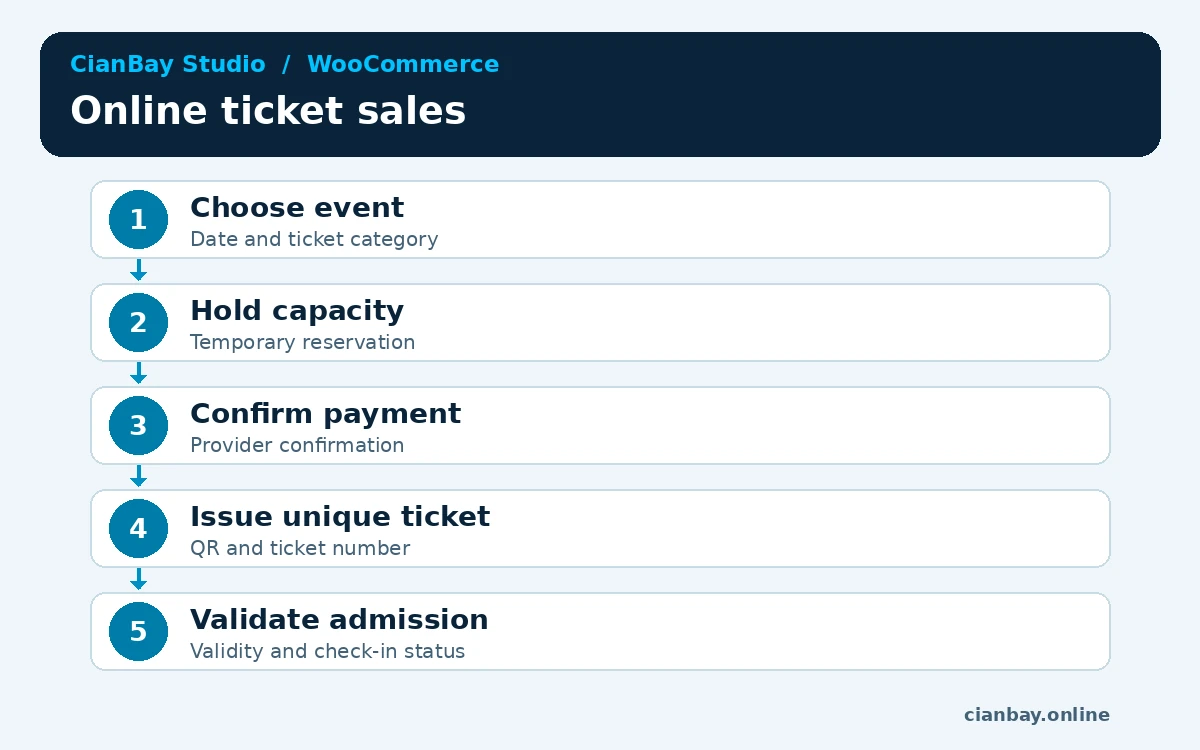
Payment providers should support the organiser's business country, settlement currency, refunds and the required payment methods. Stripe or PayPal may be relevant in supported markets; regional alternatives may suit other countries. The payment confirmation should come from a verified provider notification, not simply a visitor returning to the success page. Repeated provider notifications must not create duplicate tickets. An unsuccessful payment should not consume capacity indefinitely, and the order status should clearly distinguish payment pending, completed, cancelled and refunded.
Each ticket should be linked to its own unique admission identifier, even when several tickets are purchased together. The confirmation can include event details, a readable ticket number and a QR code, along with instructions for accessing it again. Provide a resend or download route for customers whose email never arrives. For jurisdictions with receipt or invoicing obligations, admission documents and tax receipts are separate requirements. The organiser should confirm its accounting treatment with an appropriate adviser.
Admission control and operational readiness
A printed or mobile QR code is only useful when the admission system validates its current status. The scanner should check the correct event, validity and whether the ticket has already been used or cancelled. A second scan should produce a warning rather than admitting another visitor. If the organiser permits re-entry, that requires a deliberate policy and a separate recording mechanism. Different gates must share current status information to avoid inconsistent decisions.
Before a large event, test the scanner with real devices, different screen brightness levels, printed tickets and staff accounts. Consider what happens if the venue loses internet connectivity. An offline mode requires careful reconciliation, particularly when several gates are operating simultaneously. Not all extensions provide this capability. A controlled fallback list and a trained supervisor may be sufficient for smaller events, but this must be designed and rehearsed in advance. Provide a way to search orders when a customer's phone battery is flat without exposing the entire customer database to temporary staff.
The system also needs to survive the first minutes of a highly anticipated ticket release. Cached pages can reduce unnecessary load, but cart, checkout, inventory and seat availability must remain accurate. Test the actual purchase path under realistic concurrency. Agree who will respond if the payment service fails, outgoing email is delayed or a plugin update causes a problem. Maintenance should be scheduled around the event calendar, not performed casually just before doors open.
Consumer rights, cancellation and price transparency in the EU
Article 16(l) of Directive 2011/83/EU provides an exception to the ordinary withdrawal right for leisure services scheduled for a specific date or period. This matters for concert tickets and similar admissions, but it should not be read as a blanket rule that all tickets are non-refundable. An organiser cancelling or materially changing an event raises a different issue from a buyer voluntarily changing their plans. National law and the contract determine the appropriate remedy. Polish organisers can consult UOKiK guidance on cancelled and changed concerts as a practical illustration of local consumer rights.
Publish the identity of the contracting business, the complete price, material event conditions and the contact route for complaints before the customer purchases. Distinguish voluntary cancellation, organiser cancellation, postponement and material programme changes. A replacement event or voucher can be an option, but it should not automatically replace a monetary remedy when the customer is legally entitled to one. Ensure the system can identify impacted orders, stop new sales, communicate the revised arrangements and record refunds without losing the original audit trail.
GDPR applies where its territorial conditions are met. Collect only the information required for the transaction and admission; a standard theatre ticket rarely needs a passport number. Separate essential event messages from marketing consent and apply appropriate retention rules. Restrict access to customer data and ensure ticket identifiers do not unnecessarily reveal personal details. Accessibility obligations must also be reviewed for the relevant country, service and business, including any applicable European Accessibility Act requirements and exemptions. A usable keyboard-accessible checkout is valuable regardless of the legal threshold.
United States and cross-border events
The Federal Trade Commission's rule on unfair or deceptive fees took effect on May 12, 2025. For covered live-event ticket offers, mandatory charges must be reflected in the prominently displayed total price, subject to the rule's exclusions. A seller cannot use a low advertised ticket price and reveal mandatory service charges only at checkout. Government charges and optional additions have specific treatment under the rule; the final payment amount must be disclosed before payment. The policy is relevant to direct sellers as well as ticket intermediaries where they are covered.
Individual US states can impose additional ticketing, refund, resale and tax requirements. A website that sells original admission tickets should not automatically be designed around secondary-market resale rules, but promoters must verify which obligations apply to their business. Sales tax and local admissions taxes can vary by location and event. The EU also has location-specific VAT rules for admission to certain events. Online conferences or streamed performances may have different tax treatment from admission to a physical venue. Configure taxes only after identifying the nature and location of the transaction with professional advice.
For Ukrainian venues, the consumer authority provides guidance on refunds when cultural events are cancelled, postponed or changed. Local safety and emergency procedures can also affect event operation. A multilingual organiser should maintain a consistent event status and properly localised conditions rather than copying the legal terms of another market. The information in this article reflects sources consulted on November 26, 2026 and is not a substitute for advice specific to an event and jurisdiction.
Cost model: direct sales versus a marketplace
Consider an illustrative event series selling 800 tickets at EUR 35 each. Gross sales equal EUR 28,000. If an external operator charged 8% of turnover, the fee would be EUR 2,240. If a direct channel incurred an illustrative 2% processing fee plus EUR 400 in allocated infrastructure, maintenance and licence costs, those costs would equal EUR 960. The difference is EUR 1,280 before setup costs, advertising, refund handling and tax effects. These rates are hypothetical, not published provider quotes. A marketplace that delivers incremental customers can still justify its fee, while direct sales may be more economical for an existing audience.
Budget for the initial build and ongoing ownership. Domain registration, hosting, paid ticketing extensions, payment processing, transactional email and operational support all have potential costs. Reserved seating, multiple gates, accounting integration and advanced analytics can materially change the scope. Compare the full operating cost over a season rather than judging a plugin only by its introductory price. A small organiser can start with general admission and add complexity when demand warrants it.
Event SEO, CRM and performance measurement
Each public event should have a meaningful URL, accurate details and a clear purchase route. Event structured data can describe the venue, date, availability and event status; it does not guarantee enhanced search results. Maintain accurate markup when an event is moved or cancelled. Archive completed events where the content remains useful and link interested readers to future editions. A page containing only a poster and an external booking link offers less information than a well-developed event landing page.
Measure the journey from event discovery to completed payment and admission. Useful commercial metrics include sell-through by category, direct-channel share, acquisition cost per ticket, refund rate and actual attendance. Do not assume that ten tickets purchased represent ten unique customers. Combine order data with check-in reports to understand no-shows and unused capacity. With appropriate consent, an organiser can invite previous attendees to related events or offer season passes. A CRM is useful when there are multiple venues, group bookings and business customers.
Where to commission a WordPress ticketing website
CianBay Studio builds WordPress and WooCommerce websites for clients in Ukraine and abroad. A practical starting scope may include an event calendar, general admission capacity, online payments and email confirmations. Basic online store development starts from EUR 600; ticketing projects are quoted individually according to functionality. Reserved seating, integration with existing box offices, fiscal systems, access control, multilingual checkout and load testing are separate scope considerations. Paid licences and payment provider services are not automatically included.
To obtain a meaningful quote, describe the types of events, venue capacity, number of venues, existing ticket channels, need for assigned seats, expected concurrent traffic and refund requirements. Clarify whether a conventional website with a ticketing extension meets these needs or whether a dedicated custom workflow is necessary. A solution that fits a community theatre may be inappropriate for a large festival. The objective is not to eliminate every external service but to give the organiser control over its sales channel and predictable operating costs.
WooCommerce development · Pricing · Contact us
Frequently asked questions
Can WooCommerce sell event tickets without an external marketplace?
Yes, with an appropriate ticketing configuration. Hosting, payment processing, licences and maintenance may still be payable.
Is a QR code enough to prevent ticket reuse?
No. It must be validated against a current admission record. Duplicate scans and cancelled tickets should be handled explicitly.
Can I sell tickets from a physical box office and my website?
Yes, provided both channels share reliable inventory or operate with controlled separate allocations.
Can a ticket seller refuse every refund?
No blanket policy overrides applicable consumer law. Distinguish buyer cancellation from organiser cancellation or material changes.
How much does a seat map cost?
It depends on the number of venues, seat types, locking logic, mobile interface and integration requirements. Request a scope-based quotation rather than assuming it is included in a basic shop.
Sources
- Event Tickets Plus: QR check-in
- Event Tickets: Orders and attendees
- EU Consumer Rights Directive 2011/83/EU
- GDPR: Regulation (EU) 2016/679
- FTC: Rule on Unfair or Deceptive Fees
- Google Search Central: Event structured data
- UOKiK: Wyłączenia prawa do odstąpienia
- UOKiK: Poradnik koncertowy 2026
- Держпродспоживслужба: повернення коштів за квиток
- КМДА: рекомендації щодо проведення заходів за жовтого рівня загрози