Dmytro CianBay · 26.11.2026 · 13 min read
Building materials online store on WooCommerce in 2027: quantity calculators, pricing and delivery
Build an online builders’ merchant with measurement calculators, pack pricing, trade accounts, stock integrations and pallet freight.

A building materials online store is not simply a catalogue of bags, boards, tiles and tools. Customers need to know how much material to buy, whether it is suitable for their intended application, when it can reach the job site and what the total delivered cost will be. Contractors also expect reliable availability, invoices and repeat ordering. WordPress and WooCommerce can form the basis of an independent sales channel for a builders' merchant, a specialist distributor or a manufacturer in 2027. The decisive issue is not how many products appear on the homepage, but whether the website reflects the way materials are actually priced, stocked and delivered.
Contents
- Choose the right commercial model
- Build a catalogue around measurements and product data
- Quantity and price calculators that produce usable orders
- Inventory, suppliers and multiple depots
- Trade accounts, quotations and project purchasing
- Pallet freight, job-site delivery and profitability
- Construction product regulation and consumer rights
- Search visibility and an independent sales channel
- Development budget and where to order a store
- Frequently asked questions
Choose the right commercial model
A paint retailer with small parcels can use a conventional shopping cart. A merchant selling insulation, roofing sheets, lumber and masonry may require a combination of direct purchasing, collection from a depot and requests for freight quotations. Selling concrete or other products that require specialised delivery brings another set of operational constraints. A single checkout workflow is unlikely to work equally well for every product group. Define which goods have predictable prices and delivery costs, and which need a quotation before the order can be accepted.
A manufacturer selling to contractors and distributors may also need trade accounts. These customers have agreed prices, purchasing permissions, tax documentation and delivery addresses associated with individual projects. A homeowner, by contrast, may want to compare suitable finishes, understand pack sizes and order a sample before making a decision. The store should distinguish these experiences without making casual buyers create a trade account or exposing confidential contract prices.
Before development, review a representative set of real orders. Include a small parcel, a full pallet, a mixed basket, an order collected at a branch and a large job-site delivery. The differences between these orders reveal what needs to be automated and what should remain subject to human confirmation. They are more useful for estimating the project than a list of attractive competitor websites.
Build a catalogue around measurements and product data
The catalogue must represent the characteristics relevant to each category. Flooring may require finish, dimensions, coverage per pack and manufacturer-stated suitability. Insulation requires thickness, dimensions, declared thermal properties and intended application. Lumber may require species, grade, cross-section and length. A product should not acquire a performance rating merely because a similar item has that rating. Use the manufacturer's documentation and make uncertainty visible rather than inventing missing values.
Separate the displayed price unit from the stock and dispatch units. A tile may be advertised per square foot but sold only by the carton. A timber merchant may sell fixed lengths rather than an arbitrary number of feet. Bulk aggregates can be priced by weight or volume, but converting between the two requires a material-specific basis. Do not silently assume that all materials have the same density. For international catalogues, choose the correct measurement system for the market, and retain an authoritative internal unit to avoid conversion and rounding errors.
Useful product data include SKU, manufacturer reference, gross shipment weight, package dimensions, units per pallet and the location of stock. Technical documents should be associated with the correct product and version. The search engine should recognise common manufacturer codes and relevant terms, while the filters should differ by category. A customer looking for roofing should not have to navigate the same filters as a customer shopping for interior paint.
Quantity and price calculators that produce usable orders
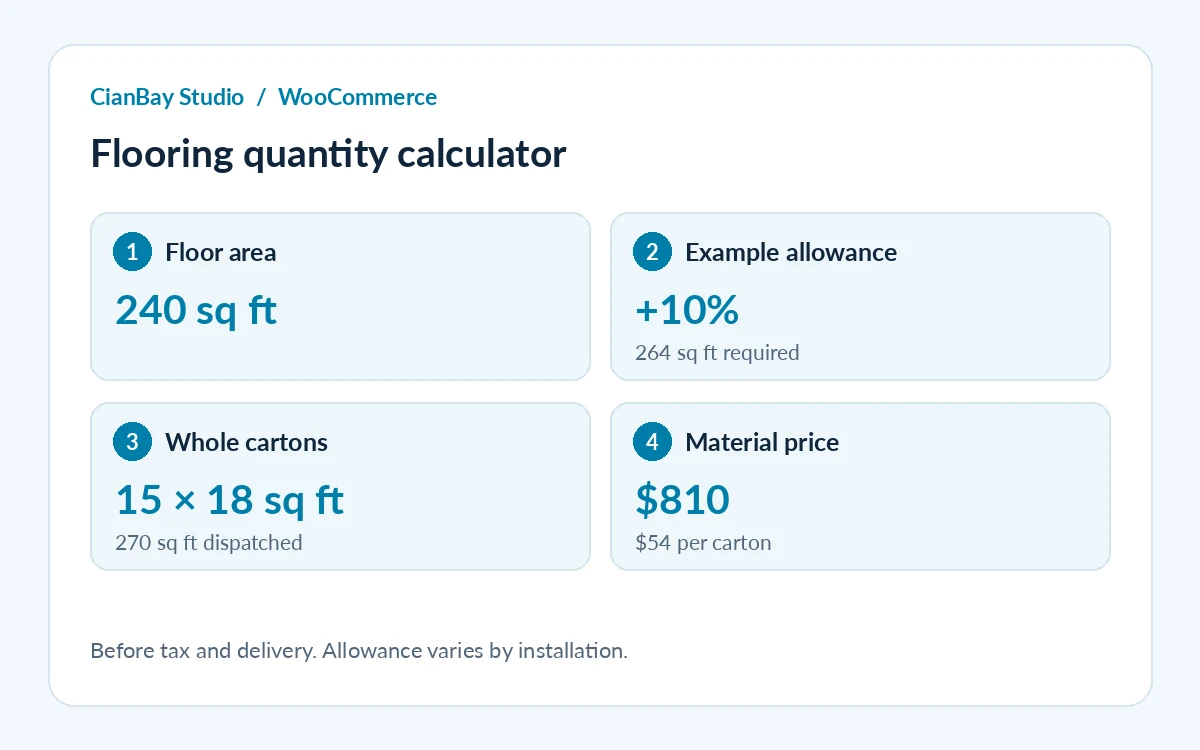
A material calculator can turn a renovation plan into a purchasable quantity. Suppose a room requires 240 square feet of flooring and the customer selects an illustrative 10% allowance, resulting in 264 square feet. If a carton covers 18 square feet, the store rounds upward to 15 cartons, covering 270 square feet. At an illustrative $54 per carton, the materials cost $810 before tax and delivery. The checkout should show the actual number of cartons, coverage and total price, rather than presenting a fractional carton that the warehouse cannot ship.
The allowance is an input, not a universal recommendation. Installation pattern, cuts, damage allowance and manufacturer instructions can change the appropriate quantity. Paint, adhesives and other consumables require their own coverage data and may depend on the number of coats or condition of the substrate. A calculator must not imply that it can certify structural suitability or replace an engineer's calculations. A complicated roof or load-bearing assembly may need specialist design before a reliable list of materials is available.
WooCommerce has extensions that support pricing by area, length, volume or weight. A standard extension can be appropriate when the business rules are simple. For more complicated products, a custom calculator may need to validate inputs, enforce minimum order quantities, round to available pack sizes and save the calculation with the order. Validation should occur on the server, not solely in the customer interface. Changes in the price list should not silently alter already accepted orders.
A helpful interface explains its assumptions and permits the customer to review the calculation. For example, the cart may show the requested coverage, added allowance, dispatch quantity and excess coverage caused by pack rounding. The same information should be available to the sales team, so a customer who telephones after placing an order does not have to explain the measurements from the beginning.
Inventory, suppliers and multiple depots
A merchant needs to distinguish physical stock, reserved stock and stock available for sale. Availability at a distributor is not equivalent to inventory held in the merchant's warehouse. If an external supplier updates its feed once per day, the website should not present that number as a guaranteed live count. Specify how often data are refreshed, which source takes precedence and how to manage a feed failure.
Batch tracking can be significant for tiles, finishes and coloured products. The customer may need additional cartons with matching shade or production identifiers. A basic quantity field cannot establish that match. Where necessary, a separate batch-aware inventory system or integration can store those identifiers, reserve compatible packs and give staff enough information to check the request. Do not promise a match unless it is confirmed.
With several branches, allow a customer to choose collection or a suitable delivery destination before promising availability. The system may need to split a basket or request approval for stock transfer. Define how long a quotation reserves goods, when an unpaid reservation expires and how cancellations return stock. A reliable process matters more than a large list of inventory features.
Supplier feeds through CSV, XML or an API can accelerate catalogue maintenance. Establish stable identifiers, log unsuccessful imports and detect abnormal changes in prices or stock before publishing them. If a supplier changes a pack size while keeping the same product identifier, the website's calculator and stock conversion rules must also be reviewed. Otherwise a seemingly successful import could produce inaccurate orders.
Trade accounts, quotations and project purchasing
Contractors regularly buy materials for different properties. A useful trade account can contain business details, approved delivery addresses, order history and negotiated prices. Larger organisations may require separate purchasing and approval roles. A purchase order number, job reference or project name can be retained on invoices and dispatch paperwork. These features reduce administrative effort rather than merely making the website look more sophisticated.
Quantity discounts should have clearly defined thresholds and interactions with contract prices. A contractor with a special price should not accidentally receive an unintended combination of promotions. For goods quoted by the sales team, let the buyer submit a material list, review the confirmed quotation, and convert it to an order after accepting it. The quote should identify its validity period, delivery terms and tax treatment.
A CRM can capture inquiries and communication, while the ERP or stock system manages physical products and finance. Decide which system is authoritative for each field. WooCommerce does not automatically provide a complete ERP or sophisticated trade pricing. A basic store with a manual approval process can be a reasonable starting point; advanced integrations make sense when transaction volume and operational complexity justify them.
Pallet freight, job-site delivery and profitability
Freight is often the largest difference between selling building materials and ordinary online retail. Weight is only part of the calculation. Pallet count, length, stackability, delivery zone, vehicle restrictions, unloading facilities and appointment requirements can all affect the quote. In the United States, small parcels may be shipped through UPS or FedEx where eligible, while heavy orders may require LTL freight or local trucks. In the UK or EU, local carriers and pallet networks can serve different product ranges. Availability and surcharges must be verified with the chosen carrier.
WooCommerce shipping classes help group products such as heavy or bulky goods, but they do not automatically calculate a freight loading plan or route. A merchant can combine collection, local delivery zones, parcel services and a request for a confirmed freight price. Show whether the quote includes residential delivery, a liftgate, curbside unloading or delivery inside the property. Avoid letting a customer pay a misleading flat rate when the real transport cost is not yet known.
Consider an illustrative order of $1,200, excluding tax. Goods cost $900, merchant-funded freight costs $160, packing costs $20, payment costs $24 and customer acquisition costs $50. Only $46 remains before overhead, returns and other expenses. A seemingly generous offer of free delivery can therefore remove most of the contribution margin. Evaluate delivery promotions by product and zone rather than using one threshold for every item.
For bulky or fragile items, provide clear instructions for reporting damage and retain dispatch and delivery evidence. Do not create procedures that override statutory consumer rights. The return journey may be expensive, so calculate its cost when deciding which products to advertise nationally. A smaller service area with dependable delivery can produce a better business outcome than an ambitious nationwide offer that cannot be fulfilled profitably.
Construction product regulation and consumer rights
In the European Union, Regulation (EU) 2024/3110 introduces an updated framework for construction products. Most provisions apply from 8 January 2026, but implementation and replacement of earlier technical specifications are phased. Manufacturers, importers and distributors have distinct responsibilities. Do not assume that every item automatically needs the same certificate, or that every product already needs a digital product passport in 2027. The applicable product family, technical specification and transitional arrangements must be checked.
For relevant products, the merchant should retain and make available appropriate performance and conformity documents, instructions and safety information. The new framework provides for a declaration of performance and conformity and a future digital product passport system. Keep documents versioned and linked to the correct product instead of copying a declaration from a similar product. Where chemical products are involved, the applicable safety data sheet, hazard labelling and transport restrictions also need separate assessment.
EU consumer distance-selling rules generally provide a 14-day withdrawal period, subject to exceptions. A product manufactured to the consumer's specifications or clearly personalised may qualify for an exception; standard stock does not become exempt merely because it is bulky. Where the consumer is responsible for returning goods that cannot normally be posted, required pre-contract information includes an estimate of return costs. Rights relating to defective or non-conforming products are separate.
In the United States, construction requirements vary by state and locality, so determine the code and product approval rules applicable to the intended market. Under OSHA's Hazard Communication Standard, covered retail distributors selling hazardous chemicals to employers with commercial accounts must provide safety data sheets on request and inform those customers of their availability. This is not a universal instruction to apply identical rules to every consumer product. The FTC's merchandise order rule also requires appropriate handling of shipment delays, including consent to a delay or a refund when required. State taxes, return disclosures and product-specific requirements must be reviewed locally. These notes are a planning guide, not legal advice.
Search visibility and an independent sales channel
Organise categories around meaningful buying decisions, not thousands of nearly identical filter pages. Product pages should include accurate measurements, availability, price and documents. For shopping feeds, the price and dispatch unit must match what a customer can actually purchase. If a product requires an individual quote, do not present a provisional amount as a guaranteed sale price. Search visibility is valuable only when users can complete the purchase or receive a reliable quotation.
Local depot pages can describe the actual collection location, opening hours and delivery zone. A builder searching for materials nearby needs different information from a national distributor. Helpful editorial articles about selecting a product range or preparing a purchase can lead readers to a relevant category, provided that technical claims come from reliable product documentation and the content does not pretend to replace specialist advice.
Own-site sales can complement established marketplaces and trade networks. Build customer retention through saved lists, repeat ordering, order status and project-based communication rather than depending exclusively on price promotions. Monitor quote conversion, freight margin, repeat orders and fulfilment errors. These metrics reveal whether the online store is improving the business.
Development budget and where to order a store
CianBay Studio develops WordPress and WooCommerce stores for clients in Ukraine and internationally. A standard online store starts at €600 for an agreed basic scope. An integrated package with CRM, automation and basic SEO starts at €1,200. A tailored measurement calculator, advanced freight rates, multi-depot stock, trade pricing and ERP connections require separate estimates. Hosting, domains, commercial extensions, data services and ongoing maintenance are not automatically included in those starting figures.
To obtain a useful estimate, provide an example supplier feed, the expected number of products, pack sizes, stock locations, shipping zones and sample trade orders. Identify which calculations are already defined by the business and which require specialist input. A phased implementation can launch the standard catalogue and straightforward orders first, then introduce custom pricing and integrations as the operational process is validated.
WooCommerce development · Pricing · Contact
Frequently asked questions
Can WooCommerce sell by area but ship whole packs?
Yes. An appropriate extension or custom calculation can show a unit price, round the required quantity to full packs and display the final purchase price.
Can customers order from several depots?
Yes, with an appropriate inventory integration or extension. Confirm the reservation and dispatch rules before promising branch-level availability.
Is automatic freight pricing possible?
It is possible when reliable shipment data and carrier rate rules are available. Unusual loads may still require a quotation and confirmation.
Does every building product require a CE mark?
No blanket rule applies to every item in a builders' merchant catalogue. Check the applicable product legislation, specification and transition provisions.
Does the basic development price include an ERP integration?
Not automatically. Integration is estimated according to the interface, data quality, business rules and testing requirements.
Sources
- WooCommerce: Measurement Price Calculator
- WooCommerce: Product Shipping Classes
- Regulation (EU) 2024/3110 — EUR-Lex
- European Commission: CPR revision and transition
- Your Europe: distance selling and bulky goods returns
- OSHA: Hazard Communication, 29 CFR 1910.1200
- FTC: Mail, Internet, or Telephone Order Merchandise Rule