Dmytro CianBay · 26.11.2026 · 13 min read
Print-on-Demand with WooCommerce in 2027: build your own brand without holding stock
Launch a print-on-demand store: suppliers, personalisation, payments, fulfilment, margins, consumer rights and development costs.
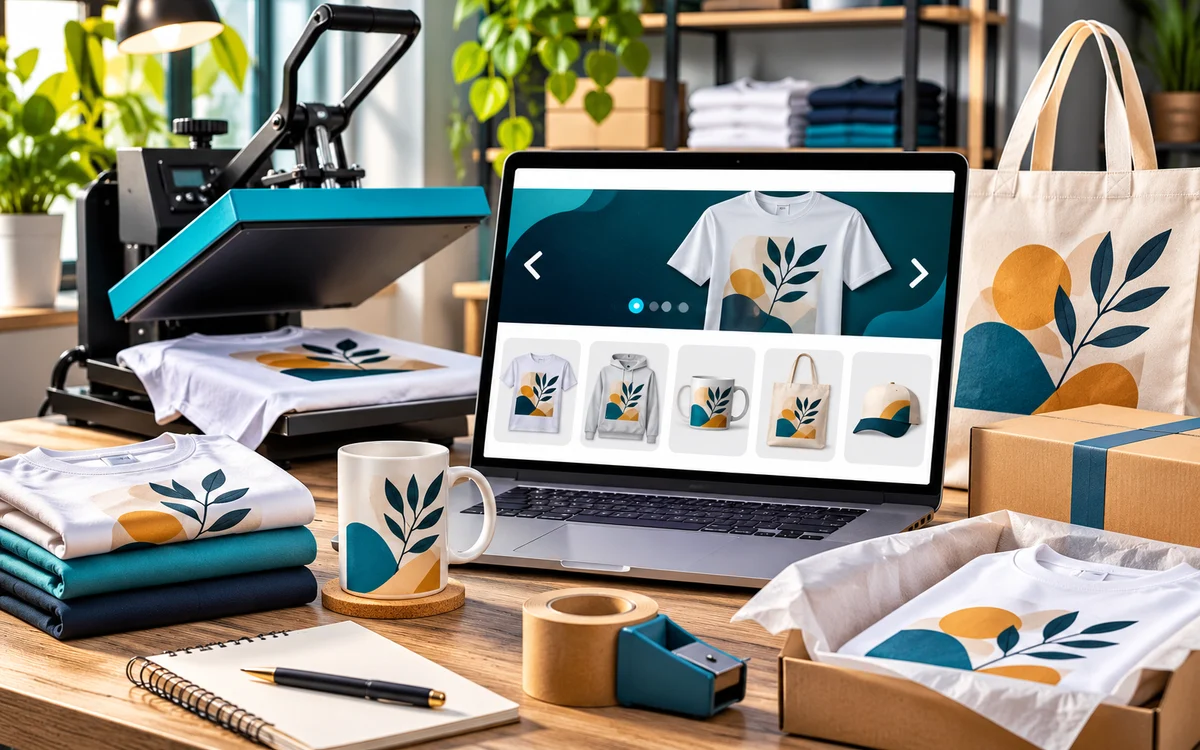
Print-on-demand lets artists, creators and independent brands sell physical merchandise without purchasing a large batch of finished stock in advance. A production partner prints, packages and ships each item after an order has been received. The store owner controls the product range, artwork, retail prices, marketing and customer experience. A WooCommerce store can bring these responsibilities together under one brand in 2027. However, operating without a warehouse is not the same as operating without costs, working capital or obligations to customers.
Contents
- How print-on-demand works and who can benefit
- Your own store versus a marketplace
- Choosing a production partner and connecting WooCommerce
- Product variants, artwork and customer personalisation
- From checkout to production and delivery
- Unit economics and working capital
- Consumer rights and product compliance in the European Union
- US rules and cross-border selling
- Intellectual property and responsible artwork handling
- Marketing, SEO and testing demand
- How much does a POD store cost and where to order one?
- Frequently asked questions
How print-on-demand works and who can benefit
Print-on-demand (POD) separates the creation of a design from the physical production of an item. Instead of purchasing hundreds of printed shirts in several sizes, the merchant publishes a collection using compatible blanks and artwork. An order determines which colour, size and print the production partner needs to manufacture. The merchant does not normally keep finished inventory, although the supplier still depends on the availability of blank garments, ink and production capacity.
The model is particularly relevant to illustrators, independent musicians, content creators, community organisations and small clothing labels. An artist might sell limited thematic collections of posters and tote bags. A coffee business could offer branded mugs to existing customers. A company could provide a private merchandise catalogue to employees or corporate clients. These businesses have different audiences, purchasing habits and product requirements even when they use the same production provider.
A focused launch is usually more useful than publishing hundreds of generic graphics. Start with a recognisable visual identity and a clearly defined customer. A design that has an enthusiastic audience may justify a higher price than a generic shirt competing solely on cost. POD makes it easier to retire unsuccessful products without liquidating a warehouse, but it does not guarantee demand. The business still needs a credible reason for customers to choose its products.
Your own store versus a marketplace
Marketplaces can provide exposure to existing shoppers, but they also determine listing rules, fees and conditions for using production partners. A merchant selling on Etsy, for example, should review the platform's current creative standards and disclosure requirements instead of assuming every outsourced product is eligible. A standalone store provides control over navigation, branding, bundles, content and the checkout experience. It can also support wholesale enquiries and direct relationships with repeat customers.
WordPress and the WooCommerce core do not impose a mandatory monthly platform subscription. That does not make the entire business free: hosting, a domain, payment processing, extensions, maintenance and production services all have costs. Compare these expenses with the marketplace fees and acquisition costs of other channels. A marketplace with good organic exposure may be a useful complement to a website even if the merchant ultimately wants to build an independent brand.
Avoid treating marketplace customer details as a ready-made email marketing list. Follow the relevant platform terms and privacy rules. For your own store, build permission-based communications and give customers a clear way to manage subscriptions to marketing messages. Your website is an asset, but its value depends on attracting and retaining customers rather than merely owning a domain.
Choosing a production partner and connecting WooCommerce
Printful and Printify provide WooCommerce integration options. These can help link storefront products to production variants, submit orders and communicate shipment information. Before committing, evaluate the actual product range, manufacturing locations, billing arrangements, supported destinations and claims procedures. A product available for printing in the United States may not have an equivalent production option in Europe, and using an overseas facility can make delivery expensive or slow.
Do not assume all partners offer the same automation. A small independent printing workshop might accept structured order files or email rather than a documented API. Manual approval is often sufficient for a trial collection. Once sales justify the investment, a custom integration can be considered if the producer provides the necessary interface and agrees to the data exchange. The important requirement is a dependable connection between the order, artwork, blank product and delivery details.
Order physical samples before publishing the full catalogue. Inspect garment measurements, print placement, seams, packaging and colour reproduction. Test washing and ordinary use according to the supplier's care instructions. For mugs and other food-contact articles, confirm applicable material safety documentation. Verify that a replacement product can actually be ordered if a supplier changes a blank. Samples also provide original photography that helps distinguish a real brand from a collection of generic mockups.
Product variants, artwork and customer personalisation
A shirt with five sizes, four colours and three print designs has up to 60 possible combinations. Some may be unavailable because a particular colour or size is not stocked or cannot be printed using the chosen method. The catalogue should represent only valid combinations and use production identifiers that remain stable even when product names change. Publish accurate sizing information, garment composition, care guidance, print dimensions and realistic pictures.
Standard merchandise with fixed artwork is generally easier to automate. Personalised products may require text fields, image uploads, artwork positioning and an approval stage. A customer ordering a shirt with a name should understand the permitted characters and length before paying. A visual preview can reduce errors, but it should not imply perfectly identical colours between a screen and printed fabric. For complex artwork, a proof approval workflow may be more appropriate than immediate automatic submission.
Integration support varies. Printful's own guidance describes third-party tools or manual handling for personalisation where a sales channel does not have native support for it. A product page with a size selector is therefore not equivalent to an online design editor. The latter may need image validation, print-ready file generation, saved designs and additional privacy controls. Establish these requirements before agreeing on a development budget.
From checkout to production and delivery
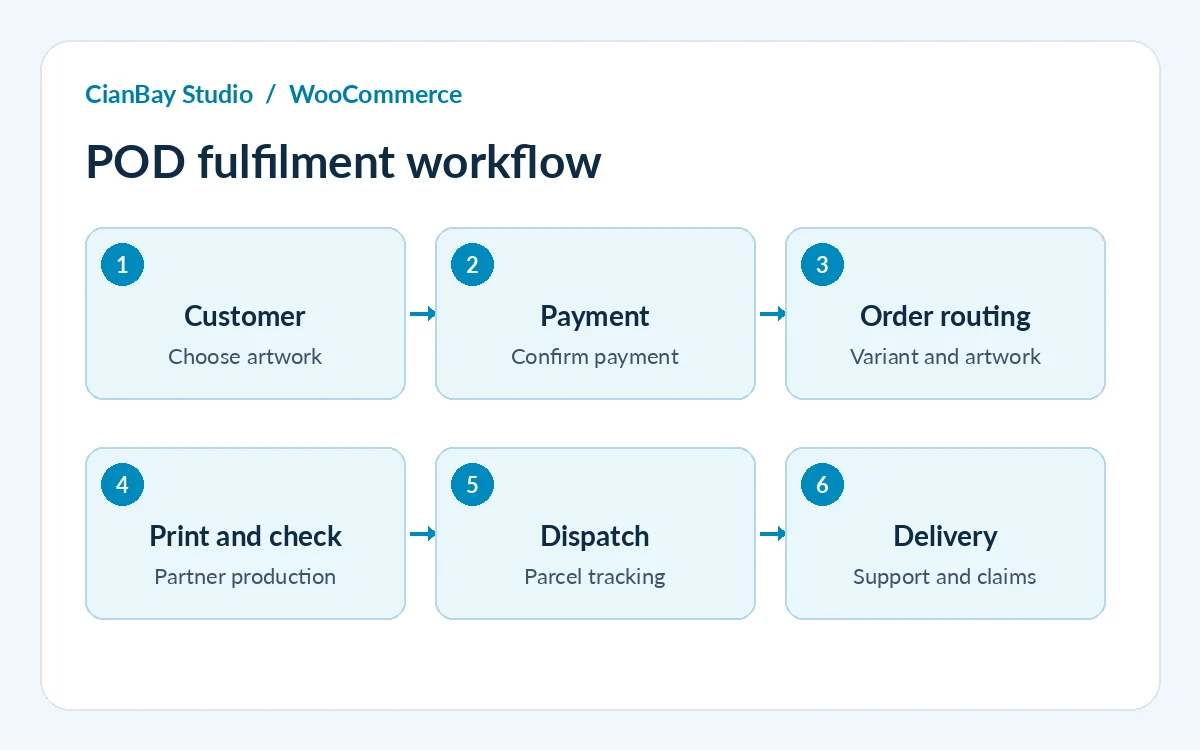
A reliable order flow begins with confirmed payment. An order can then be approved and sent to production with the correct variant, artwork and shipping address. A duplicate payment notification or retried request must not cause a second print job. The system should distinguish an order waiting for approval from one accepted by the supplier, one in production and one already dispatched. Exceptions need to be visible to the store administrator instead of disappearing into an integration log.
The production provider is usually paid separately from the transaction between the customer and the merchant. Printify, for example, charges the merchant's chosen payment method or balance for production and shipping. The merchant may have to fund that cost before its own payment processor releases the customer's money. Establish alerts for payment failures, unavailable products and delayed shipments. A small business can lose sales if a perfectly functional checkout continues accepting orders that its production account cannot fund.
Calculate shipping with the actual fulfilment arrangement in mind. A customer ordering a hoodie and a mug might receive two parcels because the products are made at different facilities. In that situation, a flat shipping rate can be unprofitable or confusing. Define delivery zones and estimates, communicate the distinction between manufacturing time and transit time, and provide tracking when the partner supports it. Do not advertise next-day delivery simply because a warehouse courier can offer it for ready-made goods.
Unit economics and working capital
Consider an illustrative order priced at €30 excluding indirect tax. Production costs €12, shipping €5, payment fees €1, customer acquisition €6 and an allowance for claims €1. The remaining contribution is €5 before fixed operating expenses and income tax. With monthly fixed costs of €150, the business would need 30 orders at that contribution to cover those costs. These numbers demonstrate a calculation, not the actual prices of any POD company or a forecast of earnings.
A 10% discount would reduce the selling price to €27. If the other costs stay unchanged, contribution falls from €5 to €2. A campaign can therefore generate more transactions while weakening the overall financial position. Track contribution by product, country and marketing channel, including refund losses, currency conversion, packaging extras and split shipments. An apparently high markup on a blank shirt means little if the cost of attracting customers consumes the difference.
Working capital matters even without finished inventory. If production and delivery cost €17 per order, twenty orders awaiting payout require €340 to fulfil. A merchant selling into multiple currencies may also face exchange-rate changes between pricing and settlement. Keep sufficient reserves for delayed payouts, reprints and disputed payments. A profitable sales model can still suffer operational failure if there is not enough money available to send the next order to production.
Consumer rights and product compliance in the European Union
EU distance-selling rules generally give consumers 14 days from delivery to withdraw from a purchase. An exception applies to goods made to the consumer's specifications or clearly personalised. A standard shirt carrying the brand's existing illustration is not automatically equivalent to a shirt printed with a customer's individual photograph merely because both are produced after checkout. Assess the exception for the actual item and disclose the applicable policy before the contract is concluded.
A manufacturing partner's commercial returns policy does not override the retailer's legal duties. Printful, for instance, generally does not accept ordinary buyer-remorse or wrong-size returns under its supplier policy. The merchant must independently assess statutory rights in the destination market and budget for obligations that are not covered by the supplier. A valid personalisation exception does not remove remedies for defective or non-conforming goods.
The General Product Safety Regulation (EU) 2023/988 includes requirements for information in online offers, such as relevant manufacturer details, identification of the product, applicable warnings and EU responsible-person information where required. Textile products are also subject to fibre-composition labelling rules. Other product categories can have additional obligations. A branded children's garment, a printed mug and a decorative poster should not be assumed to share the same compliance requirements. Obtain appropriate documents and clarify the merchant's role in the supply chain.
US rules and cross-border selling
The US Federal Trade Commission's Mail, Internet, or Telephone Order Merchandise Rule requires a reasonable basis for shipping within the advertised time. When no time is specified, the general rule uses 30 days. If an order cannot be shipped on time, the seller must follow the applicable delay-consent or refund procedures. The production partner's estimate should therefore inform the delivery promises made by the shop. Holiday deadlines deserve particular care.
Many textile products sold in the United States need labels identifying fibre content, country of origin and the manufacturer or other responsible business. Care labelling and product-specific safety requirements may also apply. State laws, tax obligations and product types can affect the merchant's responsibilities. A business should not use a generic international return policy as a substitute for checking the rules of each jurisdiction.
For cross-border fulfilment, determine where the goods are produced, who sells them, who imports them and where the customer receives them. The EU VAT One Stop Shop and Import One Stop Shop can simplify eligible transactions; IOSS covers qualifying imported consignments not exceeding €150. It does not remove all customs obligations. US sales tax and other local taxes require their own assessment. Do not promise duty-free delivery simply because an integration estimates shipping costs. A tax adviser can identify the correct treatment for a particular supply chain.
Intellectual property and responsible artwork handling
A popular illustration, character, celebrity photograph or logo is not necessarily available for commercial reproduction. Obtain the appropriate rights before using artwork on merchandise, including relevant permissions for fonts and graphic assets. Keep licences and agreements with commissioned artists. A licence that permits use in social media or personal projects may not permit resale on printed products. Check trademark risks in the intended markets as well as copyright.
Customer-uploaded artwork creates additional responsibilities. Define permitted content, accepted formats, secure storage and a procedure for handling infringement complaints. A checkbox declaring ownership is useful but does not eliminate the need to respond appropriately to a credible complaint. Restrict access to personal photographs and delete files according to a justified retention policy. For complicated questions about intellectual property or product regulation, obtain qualified advice before launching the collection.
Marketing, SEO and testing demand
Build collections around meaningful themes, occasions and customer groups instead of creating hundreds of nearly identical product pages. Original sample photography, sizing guidance and descriptions of materials help customers make a decision. A store with a recognisable visual identity can also publish stories about its artwork and production choices. Use product feeds, structured product information and analytics when appropriate, but ensure prices and availability match the real catalogue.
Track paid orders rather than relying solely on clicks or social media reach. Compare advertising cost with contribution, monitor production failures and check the rate of repeat purchases. Begin with a small group of products, place real test orders and review the full payment-to-delivery process. Scale advertising only once the economics and fulfilment are understood. This avoids spending heavily to promote products that cannot be produced or delivered reliably.
How much does a POD store cost and where to order one?
CianBay Studio develops independent WordPress and WooCommerce stores for clients internationally. A basic online shop starts from €600, with an agreed initial catalogue, checkout and payment and delivery configuration. Connecting a particular manufacturer, implementing order synchronisation or offering customer artwork uploads must be scoped against the provider's actual capabilities. An integrated store with CRM and basic SEO starts from €1,200; advanced artwork editors, multi-provider routing and custom APIs require separate estimates.
The domain, hosting, paid extensions, payment fees and production costs should be budgeted separately. To obtain a useful proposal, identify the intended market, initial product range, fulfilment provider, payment methods, design requirements and level of automation. A focused store connected to one reliable manufacturer may be the right first stage for a new brand. A mature business can then expand its catalogue and automate additional workflows as actual demand justifies the investment.
Online store development · Integrated store with CRM and SEO · Development pricing · Discuss your project
Frequently asked questions
Do I need my own warehouse?
Not if the fulfilment partner manufactures and ships orders. You still need working capital, a functioning store and a plan for claims.
Can I use two different print providers?
Yes, if product routing, shipping and order statuses are configured for each provider.
Are all POD products exempt from returns?
No. The applicable consumer law, degree of personalisation and remedies for defective goods must be assessed separately.
Is a live artwork editor included in a basic store?
Not automatically. A fixed design selector and a full browser-based editor require different development effort.
Can I sell internationally?
Yes, subject to payment availability, fulfilment regions, tax and product compliance requirements.
Sources
- WooCommerce: Printful integration
- Printify: WooCommerce connection
- Printify: Order billing
- Printful: Personalisation options
- Printful: Supplier return policy
- Your Europe: Returns and withdrawal
- EU General Product Safety Regulation 2023/988
- Your Europe: Textile labelling
- European Commission: VAT OSS/IOSS
- FTC: Internet order merchandise rule
- FTC: Textile and wool labelling
- US Copyright Office: Visual artists and copyright