Dmytro CianBay · 26.11.2026 · 13 min read
How to build a clothing and footwear online store with WooCommerce in 2027
Plan a fashion store with sizes, colours, inventory, payments, delivery and SEO. WooCommerce development costs and the CianBay Fashion demo.

What a fashion ecommerce website needs in 2027
A clothing and footwear store has a particularly demanding job: it must help customers make decisions about fit, colour, style and quality without trying an item on. Beautiful campaigns can attract shoppers, but the online store must answer the practical questions that determine whether those visitors become customers. Which size is in stock? What does the fabric feel like? Can the shoes be exchanged? How much does delivery cost? A shopper who has to message a sales assistant to resolve each of these questions is unlikely to experience the convenience they expected from online shopping.
For a fashion brand planning its 2027 launch, the right platform is one that supports its assortment, selling markets and operational processes. WooCommerce is a flexible option for brands that want to operate their own WordPress website and retain control of the catalogue, content and technical environment. Its core plugin does not require a mandatory platform subscription, although hosting, payment processing, maintenance and any commercial extensions still have a cost. Start with the business requirements rather than selecting a theme solely because its homepage looks impressive.
Plan a catalogue around styles and sellable variants
A fashion catalogue should match the way people shop. A footwear retailer might organise its selection into trainers, boots, formal shoes and sandals, while a clothing brand might use dresses, knitwear, trousers and outerwear. Collections and seasonal campaigns can provide an additional browsing route. Avoid forcing people to understand internal warehouse categories or supplier terminology before they can find a product.
There is an important difference between the number of product pages and the number of sellable stock units. A T-shirt offered in five sizes and three colours can have up to fifteen combinations. Forty similar styles can therefore represent up to six hundred variants. Each available combination needs a reliable identifier, stock record and any applicable price. Combinations that the manufacturer does not produce should not be automatically offered for sale. Define the product data before estimating the implementation budget.
Consistent attributes also matter for future growth. If one supplier uses the term navy, another uses dark blue and a third uses an internal colour code, the team must decide how those values are presented and mapped. Keep the original identifiers where they are necessary for inventory updates, while providing consistent customer-facing labels. This prevents problems when a retailer later adds new suppliers, languages or sales channels.
How WooCommerce handles sizes, colours and inventory
WooCommerce variable products support multiple purchasable options within a product listing. Individual variations can have distinct prices, stock quantities, images and SKUs. A customer can choose a colour and then an available size, rather than browsing separate listings for every combination. The standard functionality provides the foundation; enhanced colour swatches, advanced filtering and specialised sizing interfaces may require additional configuration or extensions.
Size charts should reflect the actual product rather than simply repeating a generic table throughout the store. A British shoe size, an American shoe size and a European size number are not automatically interchangeable. Some brands also differ in fit even within the same nominal size system. Give shoppers the applicable scale and measurements, explain how to measure themselves, and provide practical information about whether a garment has a relaxed, fitted or oversized cut. Where reliable model measurements are available, include those too.
Test the behaviour of an unavailable combination, a variant with a sale price and the final unit in stock. If backorders are not part of the commercial model, customers should not be able to order a sold-out size. If they are offered, the expected dispatch date and conditions should be communicated before purchase. The warehouse and customer confirmation must identify the exact ordered variant, rather than merely stating the parent product name.
Build product pages that support buying decisions
Fashion photography is more than visual decoration. A full outfit can communicate the styling, a detail shot can show the weave or fastening, and a photograph from a different angle can explain the shape of a shoe. Carefully selected images often work better than a large collection of nearly identical photographs. Use accurate colour representations wherever possible, and avoid making misleading promises about materials or appearance.
The description should cover composition, care instructions, fit, relevant measurements and any characteristics a customer cannot judge from the photographs. For footwear, include the materials used in the upper, lining and sole where those details are available. For specialist products, check the appropriate labelling and safety requirements in the intended sales market. Product descriptions should provide distinct information instead of repeating a supplier's generic advertising paragraph across dozens of pages.
On a phone, the price, size selection and purchase controls should remain easy to locate. Delivery and returns information needs to be accessible before checkout, not buried in an obscure footer link. A well-chosen accessory recommendation can help customers build an outfit, but excessive pop-ups and carousels can distract them from selecting the original item. Design each component around a specific customer decision.
Make search and filters useful rather than decorative
Customers frequently start with a broad category and narrow it down by size, colour, brand, material or budget. The filters that make sense for formal shoes may be different from those required for dresses. Avoid showing dozens of irrelevant controls and do not assume that a visually appealing filter works properly with stock availability. In a category of trainers, a shopper filtering for size 42 expects to see options they can actually buy, not styles that have sold out in that size.
Search should recognise useful product names, SKUs and common terminology. For stores serving the United Kingdom and United States, differences such as trainers and sneakers may be worth accommodating. A shopper following a campaign link may also need to find the same model again after navigating away from it. Search results, collection pages and product recommendations should all use the same reliable catalogue data.
Large photographs are necessary in fashion ecommerce, but unnecessary image weight is not. Responsive images, sensible compression and suitable caching can reduce the load on slower connections. Test the mobile catalogue, filters, a complex variable product and checkout under realistic conditions rather than relying only on a homepage performance score. A fast homepage is of limited value when selecting a size causes the product page to freeze.
Adapt payments, fulfilment and returns to the target market
A fashion website serving the US, UK or European Union should be configured around the actual business entity, accepted currencies and destination countries. Card payments, Apple Pay, Google Pay, PayPal and eligible buy-now-pay-later services are examples of options to assess, not a universal list of guaranteed integrations. Payment eligibility, merchant fees, settlement timing and the treatment of refunds depend on the provider and account. Confirm these conditions before designing the checkout around them.
Shipping should likewise reflect the fulfilment operation. A US brand may assess USPS, UPS or FedEx; a UK brand might use Royal Mail or another local carrier; an EU merchant may need parcel lockers and cross-border delivery options. The store should calculate the agreed shipping charges accurately for different basket sizes and destinations. If a free-shipping threshold is introduced, measure its impact on contribution margin rather than treating every larger order as an improvement.
Returns are especially important in fashion. Explain the return window, process, refund conditions and any lawful exceptions clearly. In the EU, consumers generally have a fourteen-day withdrawal period for distance purchases, subject to exceptions and applicable rules. The UK and US have their own requirements; do not assume an identical policy is appropriate in every country. Verify applicable consumer law, tax treatment, textile labelling and privacy obligations before launch. A store targeting several markets may need distinct policies and delivery information for each one.
Connect inventory, sales channels and customer service
Many fashion brands begin on social media, operate a physical shop, or sell on third-party marketplaces. A new online store should not become another disconnected stock list. Determine which system owns the inventory, when orders reserve stock, and how updates are shared. A product that sells in the showroom should not remain indefinitely available online. Conversely, cancelled orders and approved returns need a controlled process for restoring saleable inventory.
WooCommerce provides an order management interface that may be sufficient for a small team. As the business grows, a CRM or inventory management integration may help assign orders, track customer communications, synchronise availability and organise returns. The best solution depends on the existing systems and their APIs. Before automating a process, define what should happen if an integration is unavailable, a payment arrives late or a returned item cannot be resold.
A catalogue can be imported using WooCommerce's built-in CSV import functionality where the source data is compatible. Supplier files may need substantial preparation, especially when variants have inconsistent identifiers, missing images or conflicting sizes. Start with a representative test sample, validate the parent-child relationships and confirm that later price updates modify existing SKUs instead of creating duplicates. Keep a reliable backup before bulk changes.
SEO, Google Shopping and social commerce
Category pages should answer a recognisable shopping need, such as women's waterproof walking boots or men's linen shirts, rather than exist simply because a filter combination can generate a URL. Give important categories useful copy, clear navigation and a collection of relevant products. Decide how filtered URLs, out-of-stock items and discontinued styles should be handled, so the site does not produce an unnecessary number of repetitive indexable pages.
Google Merchant Center supports grouping variants with a shared item group identifier while submitting relevant details for the individual sellable options. Apparel and footwear data can have market-specific requirements for size, colour, gender, age group and other attributes. Keep feed price and availability consistent with the selected landing page. Google's ProductGroup structured data is another way to describe relationships between variants. Both the feed and structured data need testing; installing WooCommerce alone does not guarantee eligibility for enhanced search appearances.
Social channels can remain important discovery tools even when orders are processed through a brand-owned store. Where supported, a product feed can connect the catalogue to relevant advertising or shopping systems. Plan analytics and consent management together, including the distinction between an added item, a submitted order and a completed payment. The goal is to understand profitable sales and repeat purchases, not merely count clicks or claim revenue from orders later returned.
What does it cost to build a clothing or shoe store?
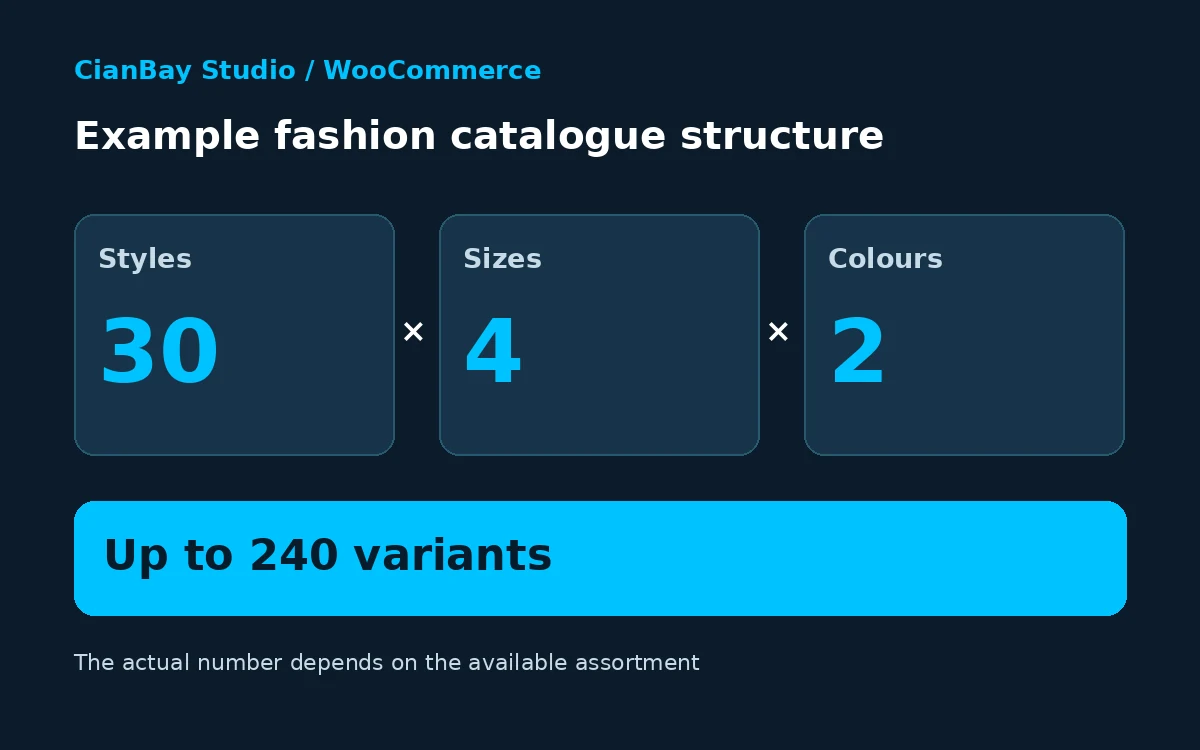
Consider a small label with thirty styles, four sizes and two colours per style. It may have up to 240 variants, even before seasonal collections are added. If the merchant has prepared images, accurate SKUs and a structured spreadsheet, implementation is more straightforward than a project that requires reconstructing the entire catalogue manually. Estimating only from the number of product pages can therefore be misleading.
CianBay Studio's basic WooCommerce development starts at €600. The agreed scope can cover the catalogue structure, product templates, attributes and variations, basket, checkout, supported payment and delivery options, mobile adaptation and basic technical SEO. Bulk product entry, bespoke size tools, advanced filters, multilingual functionality, paid extensions and integrations are priced according to the specific scope. Domain registration, hosting, transaction fees and ongoing operations are separate costs.
For businesses that also need CRM integration and order automation, CianBay offers a combined ecommerce service starting at €1,200. This is a starting price rather than a guarantee that every possible integration is included. The right implementation should match the current business process and allow it to evolve without forcing a small brand to purchase enterprise software it cannot yet justify.
Acceptance testing and measuring business results
Before launch, check a purchase on desktop and mobile using several variants. Test an out-of-stock size, an unsuccessful payment, a successful payment, order notifications, delivery calculations, cancellation and the agreed return procedure. Confirm that the merchant can identify the exact item ordered, that a stock update is reflected correctly and that a duplicate payment notification does not create a second sale. The handover should include the agreed administrator access and enough explanation for the team to operate the store.
Here is a simplified financial illustration, not a forecast. Suppose a retailer sells 100 items per month at an average €70 per item, with €25 contribution per retained sale before advertising and fixed costs. If ten sales are fully refunded and each return has an additional €5 processing cost, the resulting contribution is €2,200 before advertising and fixed costs, assuming returned merchandise can be resold and no other unrecoverable costs. The example highlights why sizing accuracy and return workflows deserve attention alongside customer acquisition.
Where to commission a WooCommerce fashion store
CianBay Studio develops WordPress and WooCommerce websites for businesses in Ukraine and internationally. CianBay Fashion is our demonstration concept for a clothing and accessories store, not a claim about the trading performance of a real client. It provides a useful starting point for discussing catalogue presentation, product layouts and the mobile shopping journey.
To request a relevant estimate, share the number of styles and variants, the origin of product data, the markets you intend to sell in, your payment and delivery requirements, and any inventory or CRM system already in use. We can then agree a workable first release and an appropriate plan for later development. The merchant retains administrative access and can continue developing the store on its own WordPress installation.
WooCommerce store development · Payment integrations · Ecommerce with CRM and automation · Development pricing · View CianBay Fashion (demo) · Discuss your project
FAQ
Can WooCommerce support different clothing sizes and colours?
Yes. Variable products support individual configurations for price, image, SKU and stock, while more specialised sizing tools can be added if required.
Can an existing fashion catalogue be imported?
Yes, if the source data can be mapped accurately and the merchant has permission to use the supplied images and descriptions. The cost depends on the complexity and condition of the data.
Is €600 enough to launch a fashion store?
It is the starting price of CianBay's basic package. The final price depends on agreed product entry, design, variants and integrations.
Can the store be connected to a CRM or warehouse later?
Yes. A consistent SKU scheme and reliable inventory source should be planned from the start to make that future integration easier.
Is WooCommerce completely free to operate?
The core plugin has no compulsory subscription. Hosting, payment processing, support and optional commercial extensions still have costs.
Sources
- WooCommerce: Variable Products
- WooCommerce: Product CSV Importer and Exporter
- Google Merchant Center: Product Data Specification
- Google Merchant Center: Item Group ID
- Google Search Central: Product Variant Structured Data
- Your Europe: Returns and the Right of Withdrawal
- European Commission: Protecting You When Buying Online
- CianBay Studio: Development pricing