Dmytro CianBay · 26.11.2026 · 12 min read
Electronics and home appliance ecommerce website on WooCommerce in 2027: features, integrations and cost
Plan an electronics and appliance store with product filters, supplier feeds, payments, delivery, SEO and WooCommerce development from €600.

An electronics and home appliance ecommerce website in 2027 has to do more than display attractive product photos. Customers want to identify the exact model, compare technical specifications, understand the warranty and find out when the item will arrive. If that information is missing or contradictory, a competitive price alone may not persuade them to order.
WordPress and WooCommerce can provide the foundation for a specialist gadget shop, an appliance retailer or a larger multichannel business. The right investment depends on the product range, quality of supplier data, distribution model and operational processes. This guide explains what a technology retailer should prioritise and which features are worth paying for when commissioning a new online store.
Contents
- Why electronics retail needs a different ecommerce approach
- Building a reliable catalogue and product identification system
- Model search, category filters and comparison tools
- Product pages that reduce uncertainty before purchase
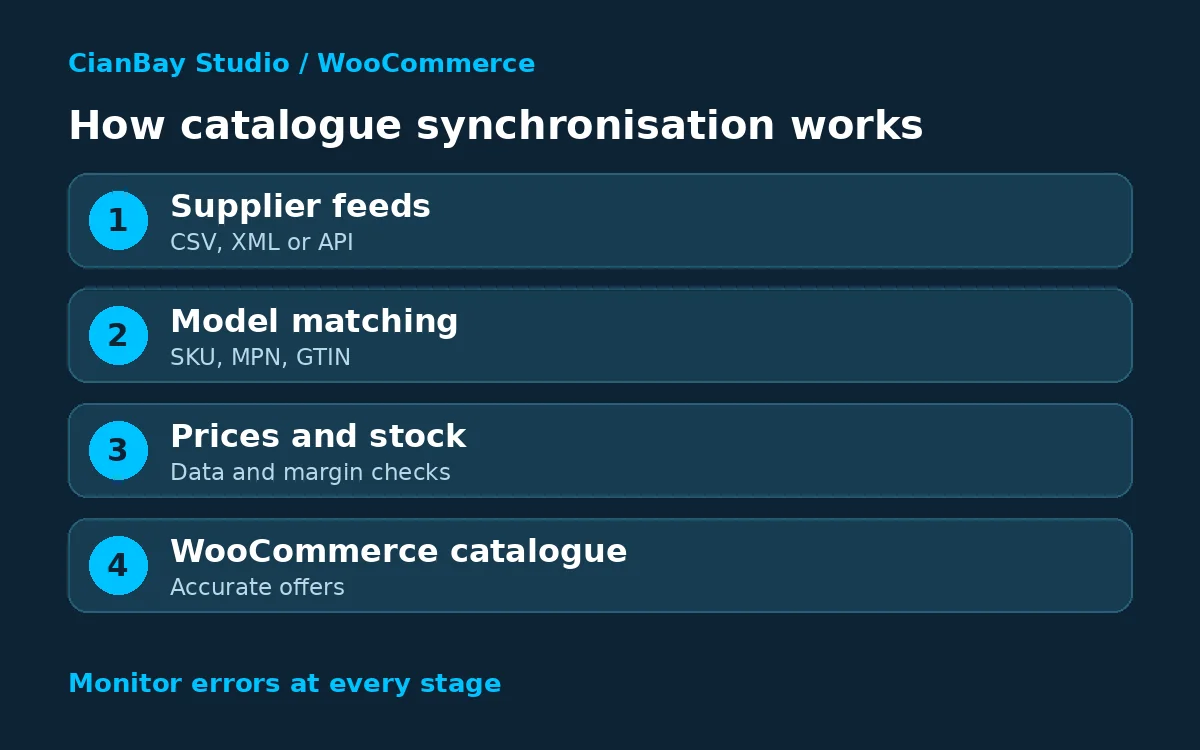
- Supplier feeds, bulk imports and live availability
- Pricing rules, margins and accessory sales
- Payments and delivery in international markets
- Warranties, returns, compliance and after-sales service
- Search visibility, shopping feeds and independent sales channels
- CRM, inventory integration and technical performance
- Development costs and where to order an electronics ecommerce website
- FAQ
Why electronics retail needs a different ecommerce approach
A customer shopping for a laptop may compare processor generations, memory, storage, display technology, keyboard layouts and battery performance. Someone buying a washing machine cares about its dimensions, load capacity, noise and energy consumption. A universal product template that treats every specification as free text cannot offer the same useful shopping experience across these categories.
Another difference is the financial risk of an individual order. A shopper considering a high-value camera or refrigerator wants to know whether the seller is legitimate, whether the product is intended for their market and what happens if it arrives damaged. Clear contact details and a credible support process are as important as the visual identity of the website.
Retailers also have different supply models. Some hold inventory in a warehouse; others order stock from distributors after a sale. The website must accurately reflect that distinction rather than presenting every supplier listing as an item ready for immediate dispatch.
Building a reliable catalogue and product identification system
Before selecting a theme, define the catalogue structure. Smartphones, computers, televisions, audio products and household appliances each need their own relevant attributes. Choose consistent units and terminology. For instance, storage capacities expressed as 256 GB, 256GB and 0.256 TB may need normalisation before they become useful filters. Do not convert units mechanically when the underlying measurement convention differs.
WooCommerce offers categories, global attributes, simple products and variable products. A parent product can group actual configurations, but a separate model may deserve a separate page. A phone with different storage options is not necessarily the same kind of catalogue problem as two laptops with different regional keyboard layouts and operating system licences.
A retailer needs an internal SKU and, where assigned, a genuine GTIN and manufacturer part number (MPN). These identifiers make supplier matching and shopping feeds easier to maintain. Never fabricate barcodes to fill missing data. Matching records also requires checking the region, included accessories and exact configuration: a shared marketing name is not proof that two offers describe the same item.
Model search, category filters and comparison tools
Customers often arrive knowing the model number. The search interface should recognise SKUs, manufacturer codes, brand names and common variations in spelling. A large product catalogue may benefit from an indexed search service or a specialist extension rather than relying on the default WordPress search alone.
Category-specific filters help customers narrow their options. For monitors, screen size, resolution, panel type and refresh rate matter. For washing machines, capacity, depth and installation type may be more important. The mobile experience should let shoppers see which filters are active, change their selection and clear constraints without repeatedly returning to the start of the catalogue.
A comparison table can be especially valuable when shoppers are weighing several similar models. It should align equivalent specifications and reveal differences rather than simply repeating product descriptions. Product comparison is not automatically part of every basic WooCommerce store; the development team should assess whether an extension or a custom comparison module is appropriate.
Product pages that reduce uncertainty before purchase
A well-designed product page answers the immediate questions first: exact model, current price, availability, images and purchase options. Essential specifications, delivery estimates and warranty information should be easy to find. Detailed technical data, manufacturer documentation and the contents of the box can sit further down the page without being buried behind a difficult navigation system.
Compatibility is particularly important for accessories. A printer cartridge may fit only certain devices, and a camera lens may require a particular mount. Cross-selling should rely on verified compatibility rather than random recommendations based on popularity. A poorly matched accessory can generate avoidable returns and support costs.
The condition of a product also matters. Make it clear whether equipment is new, refurbished, open-box or used, and distinguish the seller's refurbishment programme from a manufacturer's certification where applicable. Do not imply that a charger, power adapter, installation kit or other accessory is included unless the supplied package actually contains it.
Supplier feeds, bulk imports and live availability
A small store with a few dozen products may be manageable through manual editing. Once the catalogue grows to hundreds or thousands of items, data operations become a major part of the project. WooCommerce includes a CSV importer; XML feeds, distributor APIs and specialised data formats can require additional software or custom integrations.
Separate the first import from regular updates. Initial population may create product pages, categories, attributes and photographs. A routine supplier update should usually change stock and prices without overwriting the retailer's carefully written descriptions, corrected specifications or search optimisation work.
Suppose three distributors offer the same camera model. The website should normally publish one accurate product record, then evaluate supplier offers according to the retailer's purchasing rules. Availability, wholesale cost, dispatch time and warranty conditions may all affect the decision. The integration must also detect stale feeds and failed synchronisations. A promise to ship tomorrow is meaningless if the last inventory file was received three days ago.
Retailers should keep an import log, inspect unusual price movements and define what happens when a supplier removes a product. Automatic deletion is not always desirable: an established page may still have useful organic search visibility, even when that model is discontinued.
Pricing rules, margins and accessory sales
High turnover does not necessarily mean high profit. Consider an illustrative order worth €500 with a wholesale cost of €460. The initial difference is €40 before payment processing, advertising, packaging, delivery subsidies, support and returns. These numbers are an example, not a claimed industry average.
Automated pricing rules can protect the business from selling below its acceptable margin when distributor prices change. The retailer should define minimum margins, promotion limits and handling for unusual price changes. A sudden supplier data error must not silently turn an expensive item into a loss-making offer.
Compatible accessories, installation and setup services can increase the value of an order while helping the customer. These offers should be relevant and optional. A buyer should not discover an unwanted paid warranty or insurance product in the basket. Measuring profit per order after fulfilment is more useful than judging the shop only by its average order value.
Payments and delivery in international markets
Payment choices should reflect the business's location and target market. A retailer might consider card payments through Stripe or another supported acquirer, PayPal, mobile wallets or approved instalment providers. Availability depends on the merchant's country, account approval and provider terms. High-value orders also warrant a clear fraud review process and reliable handling of payment confirmations.
Shipping headphones and shipping a washing machine are completely different operations. WooCommerce supports shipping zones and product shipping classes, which can provide a foundation for different delivery rules. Domestic parcel carriers such as UPS, FedEx, DHL or local partners may suit compact products; larger appliances may require a dedicated freight or two-person delivery service.
For bulky items, disclose whether the price covers doorstep delivery, room-of-choice delivery, stairs, installation or removal of old equipment. A checkout should not promise an impossible delivery option for a heavy product. For international shipments, verify customs requirements, taxes, carrier restrictions on lithium batteries and the destination's electrical specifications.
Warranties, returns, compliance and after-sales service
Manufacturer warranties, commercial seller warranties and statutory consumer rights are not interchangeable. An electronics retailer should publish terms that accurately reflect the target country and its own contractual arrangements. A blanket statement that an opened box cannot be returned may conflict with consumer law.
For EU consumers, distance purchases generally have a 14-day withdrawal period subject to exceptions, and new goods normally have a minimum two-year legal guarantee. National implementation and particular circumstances matter. US, UK and other markets have their own requirements; do not simply copy EU rules into every version of an international shop.
For covered appliances sold in the EU, energy labelling requirements also apply online. Make the relevant label and product information sheet accessible near the price, using correct supplier data and the applicable product-specific rules. EPREL can help identify the registered model. This is part of catalogue compliance, not a decorative badge added to every product.
An after-sales portal can link support requests to orders and serial numbers when available. Customers should know how to report a fault, provide evidence, arrange collection or check the progress of a repair.
Search visibility, shopping feeds and independent sales channels
Electronics buyers search both exact model numbers and broader queries such as laptops with particular memory capacities or compact washing machines. A useful SEO strategy combines accurate product pages, well-organised category pages and genuinely helpful buying guides. Automatically indexing every possible filter combination can generate a vast number of near-duplicate pages.
Google Merchant Center requires accurate product data. Prices, availability, condition and product identifiers should match the landing page and checkout. Product and Offer structured data can help search engines interpret the catalogue, but they do not guarantee rich results or rankings. Feed errors should be monitored and corrected at the source rather than temporarily hidden by manual adjustments.
An independent WooCommerce store can complement Amazon, eBay or regional marketplaces. It gives the retailer control over the brand, site experience and direct customer relationships. Marketplace fees and data access rules vary, and cross-channel stock synchronisation is necessary to avoid selling the last unit more than once.
CRM, inventory integration and technical performance
WooCommerce manages products and orders, but complex warehouse operations, serial-number tracking and repair workflows can require an external ERP, inventory platform or service system. A CRM can help staff track the payment, delivery and support stages. Decide which system owns each type of data before connecting multiple services.
Performance testing should reflect real use. Check search and filtering on mobile devices, simultaneous supplier updates and checkout under expected traffic. Caching must never expose another customer's basket or show a misleading payment status. Maintain backups, limited administrative access, secure extensions and clear monitoring of integration failures.
A realistic acceptance test follows the entire journey: a supplier changes a price, the store receives the change, a customer pays for the product, the warehouse dispatches the order and a return is processed. A reliable ecommerce system is measured by the quality of these workflows, not by the number of installed plugins.
Development costs and where to order an electronics ecommerce website
CianBay Studio builds WordPress and WooCommerce stores starting from €600 for a basic scope with an agreed catalogue, basket, payment and shipping setup. Electronics projects vary in complexity: the structure of technical attributes, data quality, size of the catalogue and search requirements all influence the final quotation.
Our integrated WooCommerce solution with CRM, automation and basic SEO starts from €1,200. Supplier APIs, complex ERP integration, custom pricing rules, product comparison and dedicated service-management functionality may require additional development. Domain registration, hosting, paid licences, provider charges and external services are budgeted separately.
WooCommerce core does not require a recurring platform subscription, but running a professional online business still involves maintenance, hosting and optional service costs. A sensible quotation distinguishes the initial build from ongoing expenses. CianBay works with businesses in Ukraine and internationally. Tell us about your product range, supplier feeds, fulfilment model and existing systems; we can propose a scope aligned with your actual operations instead of forcing the business into a predetermined template.
Before requesting a quotation, share real product records from several categories and sample distributor files. Agree who supplies images, maintains specifications and approves warranty information. If an existing store is being replaced, include the migration of useful URLs and historical data in the scope. Define acceptance tests around actual business scenarios, rather than the number of plugins a developer promises to install.
WooCommerce store development · Payment integrations · Integrated store with CRM · Development pricing · Discuss your project
FAQ
Can WooCommerce support thousands of electronics products?
Yes, provided the data architecture, hosting and search solution are suitable. Large-scale imports, attribute normalisation and frequent feed updates should be evaluated separately from the basic store design.
Is a product comparison feature included in every store?
No. Depending on the catalogue, an extension or a custom module may be appropriate. Define which attributes customers need to compare before deciding on the implementation.
Can the store synchronise several distributors?
Yes, if usable feeds or APIs are available. Matching rules, update frequency, supplier priority and failure handling should be agreed during scoping.
Can I start small and add complex integrations later?
Yes. Start with a consistent catalogue and stable checkout. Add advanced functionality when order volume and operational needs justify its cost.
Sources
- WooCommerce: Product editor settings
- WooCommerce: Product CSV Importer and Exporter
- WooCommerce: Product Shipping Classes
- Google Merchant Center: Product data specification
- Google Search Central: Merchant listing structured data
- European Commission: Energy labels for dealers
- Your Europe: Consumer guarantees and returns