Dmytro CianBay · 26.11.2026 · 12 min read
Buy now, pay later for online stores in 2027: how to increase sales of high-value products
Explore BNPL payment integration for WooCommerce, merchant fees, checkout, returns and profitability. Ecommerce development and payment integration by CianBay.
Why shoppers hesitate over high-value purchases
A customer may already have chosen the right sofa, laptop, set of headphones or piece of specialist equipment. They know what it costs and have compared the alternatives, but paying the full amount on the day they place the order may be inconvenient. An abandoned basket does not always mean a product is too expensive or that a competitor has a better offer. Sometimes the immediate timing of the payment is the obstacle. A discount reduces the revenue from every sale; a suitable financing option can instead give eligible customers another way to pay the advertised price.
For online retailers planning their 2027 strategy, Buy Now, Pay Later (BNPL) should be considered as part of the buying experience, not simply as another logo underneath the checkout button. The shopper must understand the total cost, payment schedule, relevant fees or interest and the fact that approval is subject to the provider's criteria. An ordinary card payment should remain available wherever appropriate. A merchant cannot promise that everyone will qualify, and offering flexible payments is not a substitute for a trustworthy website, accurate stock information and a reliable delivery service.
How BNPL works with WooCommerce
WordPress and WooCommerce provide the storefront, product information, basket, checkout and order management. The finance provider or payment processor supplies the financing product, makes the eligibility decision and processes payments under its agreement with the merchant. After the customer selects an eligible option, the provider may request confirmation through its own secure interface. WooCommerce receives the resulting transaction information and updates the order as appropriate. The merchant's payout timing, charges, reserves, fraud responsibilities and refund process depend on the agreement rather than on WooCommerce itself.
The terminology matters. A short pay-in-four product is different from a deferred payment due on a specified date and from longer-term installment credit. The Consumer Financial Protection Bureau has documented the expansion of the US BNPL market between 2019 and 2023. That establishes a genuine market trend, but it does not mean every merchant will experience higher sales. Use the provider's approved disclosures and avoid describing every available financing offer as interest-free. Where the law requires specific information about credit, make sure the store displays it correctly. A developer can integrate the appropriate interface, but does not replace the merchant's legal adviser or lender.
Choosing payment providers for the US, UK and Europe
Klarna, Affirm and Afterpay are among the available BNPL options supported through WooCommerce's payment ecosystem. WooPayments offers several such methods in supported markets. PayPal Pay Later is another option that can be integrated with WooCommerce for eligible merchants. Provider availability varies by business registration, customer location, currency, industry, order value and individual eligibility. In the UK, the Afterpay brand is also known as Clearpay; the relevant product terms must be checked for the intended market rather than copied from a US offer.
A US electronics retailer and a European furniture retailer may need different providers despite using the same ecommerce platform. A multinational store should not display a US financing plan to every European shopper or assume that a euro-denominated checkout makes a merchant eligible for a European credit product. Start with the merchant's actual registered entity, settlement account and main shipping destinations. Compare written proposals from providers, including charges for refunds, payout timing, support, category restrictions and compatibility with the existing payment gateway. A familiar brand can improve recognition, but operational fit and the cost of the agreement are equally important.
Which products are good candidates for flexible payments?
Furniture and home improvement products are natural candidates for analysis because a purchase may include several items, delivery and installation. Consumer electronics, audio equipment, musical instruments and higher-value sports goods may also suit an installment option. In each category, the merchant should examine the distribution of order values and where customers stop progressing through the funnel. A shop selling mainly inexpensive accessories might see little incremental demand from financing and may pay extra fees for transactions that would have happened anyway.
For bespoke items or products manufactured to order, the relationship between payment confirmation and fulfillment requires more care. If a customer purchases a made-to-measure cabinet that will ship in six weeks, the merchant must know whether the provider permits the category, when payment can be captured, and how cancellation and changes to the specification affect the order. For business equipment, confirm that the financing product accepts business customers rather than assuming that consumer BNPL supports every B2B purchase. The aim is to match a real purchasing need with a suitable payment option, not to encourage customers to borrow unnecessarily.
Calculate the incremental profit, not just the sales volume
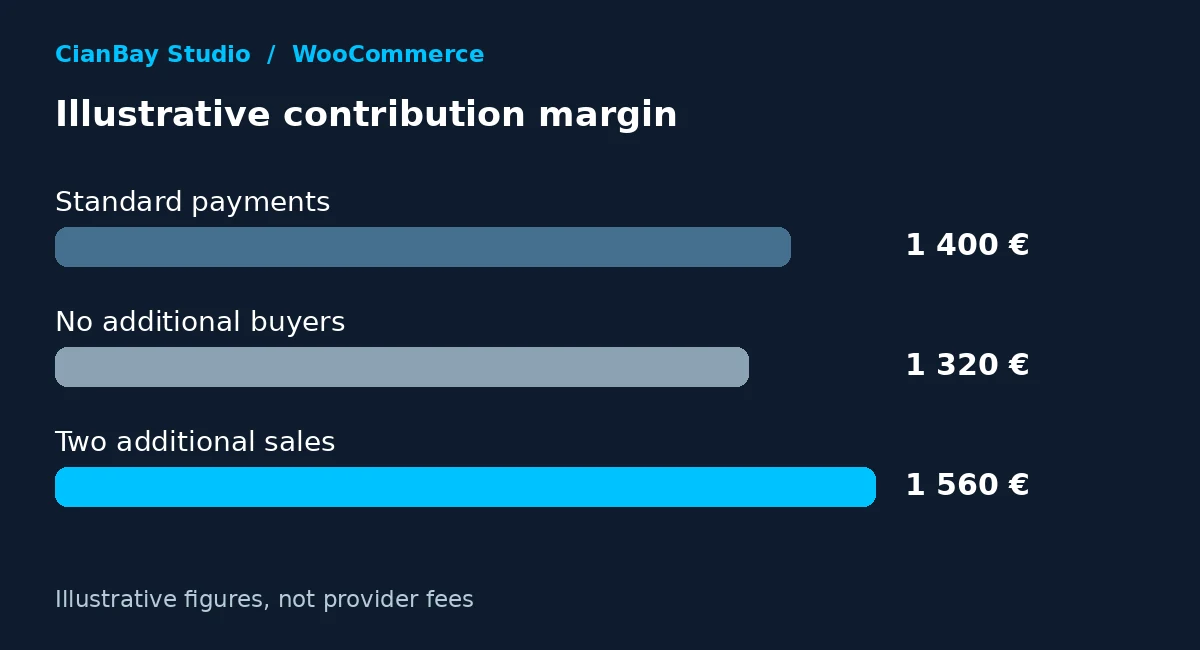
Consider an illustrative product priced at €500, with €350 in product and other variable costs before payment processing. Assume a conventional payment costs 2% and the financing method costs 6%. These are hypothetical figures, not the published rates of Klarna, Affirm or any other provider. A conventional order contributes €140 after these costs, while a financed order contributes €120. Actual calculations must use the merchant's agreed fee schedule, taxes, returns and other costs.
If a merchant normally sells ten units, the contribution is €1,400. After adding BNPL, suppose four of the original ten customers switch to financing and two additional customers purchase. Six conventional and six financed sales would then contribute €1,560, an increase of €160 before integration, support and other incremental expenses. If no additional customers bought, the contribution would fall to €1,320. The distinction is critical: a high share of financed payments can simply mean customers changed payment methods, not that the retailer acquired more business. A practical trial should measure additional completed orders and contribution margin alongside adoption of the new payment option.
Put payment information where it supports the decision
A shopper should first discover the financing option near the product price, where they decide whether to continue. The full price must remain clear. In the basket, the message should reflect the current total, and at checkout the shopper needs to see the available payment options and applicable disclosures. The payment plan should not appear to be available if the product, location, amount or currency is excluded. Provider-approved widgets can help keep the information consistent with the actual offer.
Variation changes, discount codes, taxes and delivery charges can change the amount of an order. A static message copied into a product description can therefore become inaccurate. On mobile, a clear compact message is preferable to multiple large promotional panels that push the main purchase controls out of sight. Test with real product variations, including out-of-stock options and sale prices. Keep delivery details, warranty information and returns policies easy to find. A financing feature should remove uncertainty, not add another layer of confusion or obscure the real cost of the purchase.
What happens after a shopper selects financing?
An order created at checkout is not necessarily paid. The customer may leave the provider's interface, fail an eligibility check, close the browser or need additional verification. The store should maintain a coherent pending state and wait for the authoritative payment confirmation specified by the integration before releasing goods. A return to the merchant's thank-you page is not by itself sufficient evidence of a successful transaction. Payment callbacks also need to be handled safely when the same notification arrives more than once.
This is where the relationship between the payment gateway, WooCommerce, stock management and the CRM becomes valuable. Staff need to see whether a transaction is confirmed, pending, rejected or refunded without searching several dashboards. A failed financing application should not permanently reserve the last unit of a popular product. The merchant should agree on stock reservation and order expiry rules that reflect the provider's actual payment flow. Where a customer chooses another payment method, avoid generating duplicate orders or double-counting revenue. Clear automated status updates can reduce administrative work, but ambiguous or exceptional transactions still need a documented manual escalation route.
Returns, cancellations and reconciliation
Higher-value orders often have more complex after-sales requirements. A customer might cancel before shipping, return one item in a multi-product order or request a replacement. Deleting or editing an order in WooCommerce does not automatically cancel a financing agreement. The merchant must initiate or confirm the refund using the approved payment workflow and check that the final transaction status reflects the result. Whether partial refunds, authorization reversals and amended order totals are supported depends on the provider and integration.
Finance teams need to reconcile the original amount, provider fee, actual settlement and any subsequent refund or charge adjustment. An integrated order identifier and transaction reference make this much easier, particularly during a promotion when many customers buy identical items at identical prices. The merchant should also clarify whether payment fees are returned, how disputes are handled and what happens if a shipment is delayed. In cross-border sales, local consumer rules, credit advertising requirements, tax treatment and cancellation rights may differ. Confirm these matters with the provider and relevant professional advisers before launching the feature in a new market.
Measure conversion and profit after implementation
A useful measurement plan covers the product page, basket, checkout, payment attempt and confirmed order. Compare the percentage of visitors who reach each stage for the relevant higher-value categories. Monitor average order value, financing adoption, rejected or abandoned applications, net contribution, returns and support enquiries. Separate customers who use financing instead of a standard payment method from genuinely additional purchases as far as your experimental design allows. This is more useful than reporting a percentage increase without explaining how it was measured.
Seasonal events, promotional discounts, changes in advertising spend and product availability can all distort a simple before-and-after comparison. If possible, use comparable categories or a controlled rollout and monitor the results over a meaningful period. GA4 can provide behavioral insights, but WooCommerce and financial records should remain the reference for confirmed orders and settlement. Avoid sending credit application information, account details or unnecessary personal information into analytics systems. The objective is to learn whether the payment option makes the buying journey easier and improves the economics of the business, not to collect sensitive details about shoppers.
WooCommerce development and payment integration by CianBay Studio
CianBay Studio develops online stores on WordPress and WooCommerce from €600. A standard starting package includes a product catalogue, basket, agreed standard payment and shipping setup, mobile-friendly presentation and basic technical SEO preparation. The scope of BNPL integration depends on the chosen provider, existing merchant agreement, checkout configuration, available extension and required tests. Hosting, domain registration, commercial licenses and payment processing charges are separate unless explicitly agreed. The starting price should not be interpreted as a promise to include every financing system or a custom credit workflow.
For businesses that already have a WooCommerce store, we can assess the existing checkout and integrate a compatible payment option without rebuilding the entire website when the technical situation permits. Our integrated WooCommerce, CRM and automation offering starts at €1,200, with the exact scope agreed for each project. It is designed for businesses that want orders, payment statuses and customer service processes to work together. The merchant retains control of the website and provider account. The finance provider makes approval decisions, and its contractual charges are paid separately from the development work. Our role is to deliver a coherent ecommerce system that the business can operate and extend.
What to prepare before commissioning the work
Send us the existing store address, or a description of the planned catalogue, together with the business's country of registration, trading currencies, target markets and preferred provider. Tell us if the checkout is customized, if orders are managed in a CRM or ERP, and if you sell preorders, subscriptions or products with long delivery times. These details distinguish straightforward extension configuration from an integration requiring custom development, supplier approval and extensive testing. Please do not send live payment credentials in a public message; secure access can be arranged after the project is agreed.
Before going live, define acceptance criteria for successful payments, unsuccessful applications, cancellation, refunds, repeated payment notifications and order reconciliation. Include testing on phones and desktop browsers and verify that existing card payments remain functional. Decide who will contact the provider if a transaction has an unclear status. A well-implemented WooCommerce store gives the merchant flexibility to add and change payment partners without committing to a proprietary storefront subscription. It still incurs infrastructure, maintenance and processing costs, so the aim is a controllable and commercially sustainable solution rather than a supposedly cost-free store.
WooCommerce store development · Payment gateway integration · WooCommerce with CRM and automation · Pricing · Discuss a project
Frequently asked questions
Can BNPL be added to an existing WooCommerce store?
Yes, subject to compatibility and merchant eligibility. A review of the checkout, payment extensions, stock management and refund workflow is advisable before integration. A full rebuild is not necessarily required.
Does every shopper qualify?
No. The finance provider decides whether the product and customer are eligible. Keep ordinary payment options available and avoid suggesting that approval is guaranteed.
Who pays the fees?
The merchant and customer obligations depend on the specific finance product and the agreement. Review settlement terms, merchant charges and applicable customer costs.
Does BNPL guarantee more sales?
No. Evaluate incremental confirmed orders and contribution margin, not just adoption of the payment method. Seasonal demand and discounts also affect the outcome.
Is financing integration included in the €600 store package?
€600 is the starting price of the basic CianBay WooCommerce package. The scope of any additional finance integration, testing and commercial extensions is agreed separately.
What about refunds?
Follow the payment provider’s authorized refund process and verify the resulting transaction status. Confirm partial refund support before going live.