Dmytro CianBay · 26.11.2026 · 10 min read
Where to get an ecommerce website for under €1,000 in 2027: a practical WooCommerce guide
Find out what an ecommerce website under €1,000 can include, how WooCommerce reduces platform dependency, and what CianBay offers from €600.
Can a small business commission an ecommerce website for under €1,000 and still receive a functioning online store rather than a collection of demonstration pages? Yes, provided the first release has a clearly defined scope. A seller with a modest catalogue, reliable product information and straightforward shipping does not necessarily need the same infrastructure as a multinational retailer. The objective is to start accepting orders, retain control over the store and have a sensible path to expand it.
CianBay Studio develops WordPress and WooCommerce stores from €600. This is a starting price for a basic implementation, not a fixed price for every ecommerce project. This guide explains how to compare offers, decide what belongs in an initial build and budget for ongoing expenses. It is intended for business owners looking to commission a store, not developers looking for instructions to install software.
Is a professionally built online store under €1,000 realistic?
It depends on where you commission the work and what you need. Published UK agency prices often exceed this threshold. For instance, WE-DEV lists its business/ecommerce package at £2,650 plus VAT, while BM.studio advertises ecommerce development from £2,495. These are examples of published offers, not a survey of completed transactions. They illustrate the difference between buying a full local-agency engagement and commissioning a carefully scoped implementation from an international specialist.
Across Europe the starting price varies considerably. Polish developer Ftech Online advertises a configured WooCommerce shop from PLN 2,999 gross. Marta Dalba publishes a starter package from PLN 3,699 gross. Both illustrate that comparatively modest entry budgets exist. A buyer should nevertheless compare the actual deliverables, product population, tax treatment and ongoing obligations rather than assume the cheapest advertised price includes everything.
A small store selling skincare, apparel, craft products, home accessories or specialist supplies can often use proven ecommerce components rather than bespoke software. A site requiring a custom product configurator, live stock synchronization between warehouses and wholesale pricing rules is a different assignment. Product complexity can matter more than the number of visible pages.
Freelancer, web studio or hosted platform: where should you look?
Freelance marketplaces can offer competitive proposals for a standard WooCommerce build. Review relevant ecommerce work rather than simply the number of completed jobs. Ask whether the supplier will set up the actual purchasing journey, test payment and shipping, provide administrator access and agree on a process for defects after launch. Low hourly rates alone tell you little about the quality or the final cost.
A small web studio can combine a coherent visual layout, catalogue architecture, payment configuration and basic technical SEO within one assignment. At CianBay, the emphasis is on a working sales system that the merchant can manage and develop. An international specialist may be a sensible alternative to a large domestic agency, particularly if your business does not need in-person meetings or enterprise-level project management.
Hosted platforms such as Shopify can be convenient when you want the platform provider to handle much of the underlying infrastructure. Their subscription and optional app costs should be evaluated alongside setup fees. WooCommerce takes a different approach: it is open-source ecommerce software that can be installed on hosting chosen by the merchant. Neither model eliminates every operational expense, but the choice affects how much freedom the business has in the long term.
Why WooCommerce is a strong starting point for an independent business
WooCommerce does not require a recurring platform subscription for its core software or charge a share of sales simply for using it. Hosting, payment processing, optional extensions and technical maintenance are separate considerations. The important distinction is that the merchant can choose those providers and change them when appropriate, rather than be committed to a single platform's feature tiers.
A well-planned WordPress store can grow from a small collection of products to a more sophisticated catalogue. It can accommodate product attributes and variants, discount codes, multiple content sections and additional integrations. Rather than paying immediately for a system designed around a larger operation, an owner can invest in functions that customers and staff actually need at the current stage.
WordPress also provides an established content management environment. Product categories, helpful buying guides and brand information can be developed around actual search demand. Google Search Central's ecommerce guidance describes how site structure and product information help search engines understand an online shop. Basic technical SEO provides a useful foundation, although ranking and traffic depend on factors beyond a development package.
What CianBay includes in a WooCommerce build from €600
The CianBay WooCommerce development service covers the core store setup, category structure, product-page templates, prices, images and agreed product attributes. The basic purchasing flow includes the cart, checkout, order statuses and email notifications. Suitable payment and shipping methods are connected within the agreed scope and subject to provider availability.
We check the shopping journey on mobile devices, perform a test order, prepare basic technical SEO for product and category pages, and provide administrator access. The goal is to hand over a working store rather than simply activate an ecommerce plugin. Your initial product population, content preparation and particular extensions are agreed before development starts.
Consider two businesses: a craft brand selling a few candles in standard sizes, and a manufacturer whose customers specify dimensions, finishes and made-to-order delivery. Both may use WooCommerce, but the first can rely on standard product options while the second may require a dedicated quoting tool. Their development fees should not be identical simply because both sell physical products.
How to allocate a €1,000 launch budget
First decide whether the limit covers development alone or all initial website expenses. The following is an illustrative allocation for a simple store with prepared content. It is not a fixed CianBay quotation, a market average or a guarantee that hosting and extensions will cost those amounts.
| Budget item | Illustrative amount |
|---|---|
| Basic WooCommerce development | €600 |
| Domain and first-year hosting | €100 |
| Reserve for extensions or minor additions | €150 |
| Unallocated contingency | €150 |
| Total | €1,000 |
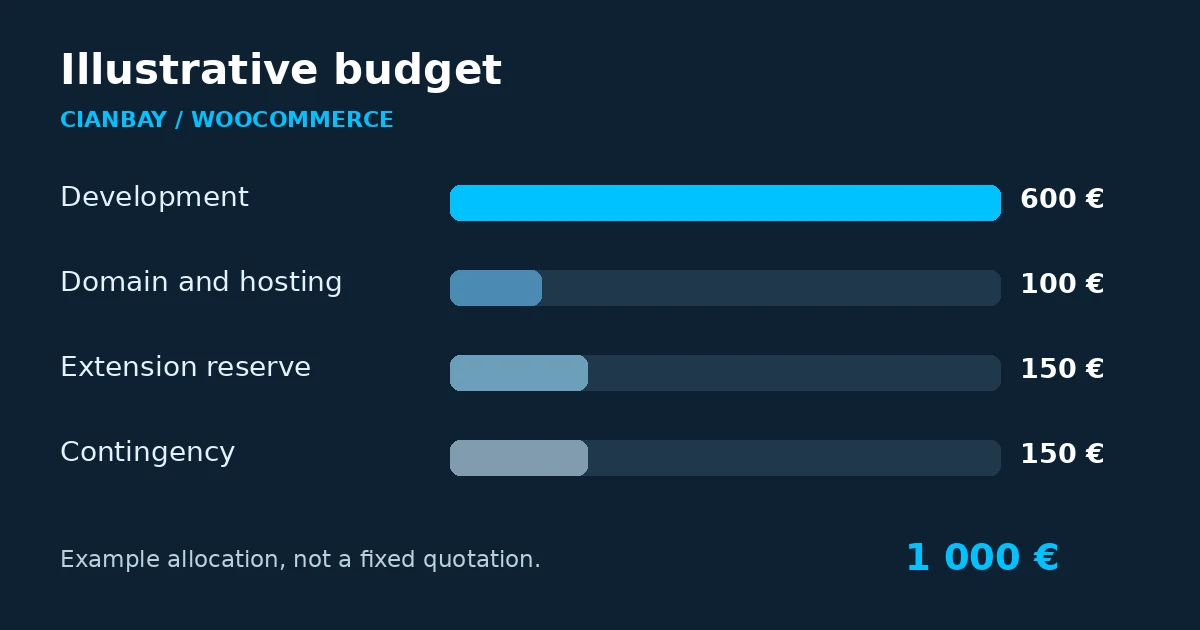
This model leaves room for expenses that can appear during a project. If no premium extension is necessary, the reserve may go towards improving product photography, adding content or staying unspent until the next development phase. Payment fees, inventory, fulfilment, legal documentation and advertising are not included in the illustration. Check applicable VAT and exchange-rate effects before agreeing to a budget.
In a hosted setup you also need to consider the subscription, theme and app renewals. Compare recurring costs over at least a year, but avoid assuming that the self-hosted alternative automatically costs less in every situation. A complicated WooCommerce shop may require more maintenance than a standard hosted store. The decision should reflect your required features, technical responsibilities and business plans.
Choose payments and shipping for the market you actually serve
For a business trading in the UK, examples might include Stripe or PayPal for payments and Royal Mail or DPD for shipping. In the United States, USPS, UPS and other carriers may be appropriate; in the EU, options vary by country. These are examples to assess, not promises that every service is available to every merchant. Eligibility, settlement currencies and integration options depend on the company's registration, business category and provider terms.
A reliable checkout displays shipping options and costs, records the correct order status and makes the next step understandable. Customers should receive appropriate order confirmation, while staff need sufficient information to fulfil the purchase. A store does not become better merely because a dozen payment logos are displayed on its homepage.
International sales may require separate tax rules, translated terms, consumer information, additional currencies and different delivery zones. Agree on the initial target market before developing the site. If a seller wants to enter several markets immediately, the additional localization and payment requirements can move the project beyond the starter budget.
What not to sacrifice when controlling costs
The priority is a functional buying experience. Customers should be able to find a product, understand its variations, see the price and delivery conditions, and complete the purchase on a mobile device. Product photographs and useful descriptions often contribute more to the shopping experience than elaborate animations.
Equally important are the administrative side and handover. Make sure the domain is under your control, hosting access is available, backups are arranged and your administrator account is independent of the developer. Agree who pays for licences and who is responsible for renewals. A platform with open-source software offers greater flexibility, but ownership and control still depend on the practical arrangements of the project.
Ask the developer to explain what happens if an update breaks a payment extension or if your staff needs a new feature. There is no need to purchase an indefinite maintenance commitment automatically. However, a live online store must have a reasonable plan for updates, security and recovery.
Compare quotations by deliverables, not just by price
A clear proposal should identify the product types, initial catalogue volume, pages, payment methods, shipping rules, supported languages and required integrations. It should also state who supplies the material, what is tested and what is excluded. A quote that describes a beautiful shop without mentioning the checkout or administrative handover may be less useful than a modest but precise offer.
One of CianBay's published projects is CaseComponents, a WooCommerce components store with a catalogue of around 650 products. The project demonstrates experience with structured product data, categories and imports. The project cost €1,500, so it illustrates an extended solution rather than a store within the €1,000 budget. Bulk imports and complex integrations are quoted separately. Reviewing genuine projects helps a buyer distinguish demonstrated capabilities from generic promises.
Where to order an affordable WooCommerce store in 2027
CianBay Studio works with clients in Ukraine and internationally. If your business is moving away from social media sales, replacing a hosted shop or launching its first independent store, we can evaluate a manageable initial scope. More advanced requirements such as CRM, stock synchronization, multilingual catalogues and custom checkout flows are assessed separately rather than squeezed into an unrealistic fixed-price promise.
See our development pricing and contact us via WhatsApp or the contact form. Tell us what you sell, where customers are located, how many product types you have, which payments and shipping methods you need, and your preferred budget. We can then identify what belongs in the first release and what can be added later.
Frequently asked questions
Can I commission a complete store for less than €1,000?
Yes, when the scope is suitable for a standard WooCommerce implementation. Complex development and third-party costs require separate evaluation.
Is WooCommerce free to use?
The core software has no mandatory platform subscription. You still need hosting, a domain and, where applicable, paid extensions and provider services.
Will I own and control the store?
You can operate WooCommerce on hosting chosen by your business and register the domain in your own name. Agree on the transfer of access and third-party licences in the proposal.
Can I add CRM or more products later?
Yes. A suitable initial architecture allows expansion, with further development priced according to the work involved.
Does the price include Google rankings or advertising?
No. Basic technical SEO supports discoverability, but rankings, campaigns and ongoing marketing are separate matters.
Sources
- WooCommerce pricing and ownership model
- Shopify pricing
- WE-DEV published ecommerce pricing
- BM.studio UK pricing guide
- Ftech Online starter offer
- Marta Dalba starter offer
- Google Search Central ecommerce guidance