Dmytro CianBay · 21.11.2026 · 8 min read
On-page SEO in 2027: a practical guide for business owners
Understand what on-page SEO includes, from content and page structure to metadata, indexing, internal links and measuring business results.
A business can invest in a polished website and still struggle to appear when potential customers search for its services. Before assuming that the answer is more advertising or backlinks, investigate whether the website itself communicates clearly with visitors and search engines. On-page SEO creates a foundation for discoverability, useful content and measurable commercial outcomes. It is not a shortcut to guaranteed rankings, but it is an important part of making a website work for the company rather than merely presenting its logo.
What does on-page SEO actually include?
On-page optimisation involves improving individual pages and their relationship to the rest of the website. It covers the content, descriptive headings, HTML titles, descriptions, URLs, images and internal links. Technical SEO is closely related and addresses crawlability, duplicate URLs, indexing and performance. Off-page SEO concerns reputation and signals from outside the website. These areas reinforce one another, but they are not interchangeable.
When purchasing a website, ask exactly which activities are included. Installing an SEO plugin, filling in a few title fields and submitting a sitemap is different from developing a search strategy, researching demand and writing a complete set of service pages. A clear scope makes it easier to compare proposals and to avoid paying twice for unfinished work. A useful agreement identifies the deliverables, the pages covered and the responsibility for updating them later.
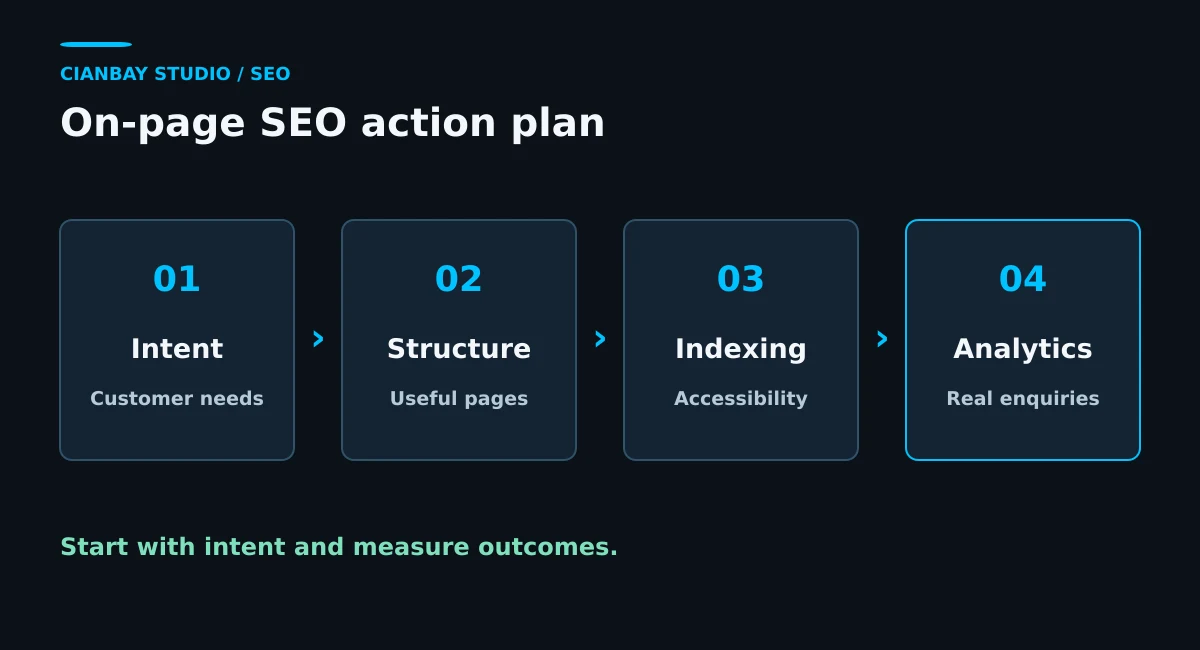
Start with the customer's search intent
A person searching for information about heat pumps is at a different stage from someone looking for a local heat pump installer and asking about installation costs. One needs an explanation; the other needs a suitable contractor, a clear service description and a way to obtain a quotation. Sending both users to a generic home page is unlikely to satisfy either need completely.
Map your important pages to the audience's needs. A service page can explain installation options, areas covered and the quotation process. An educational article can answer questions about operating costs, and a project case study can demonstrate relevant experience. Each page has its own role while supporting the customer's next decision. Use different pages when the actual service or intent differs, rather than producing near-identical documents for minor variations of the same keyword.
For a company serving several industries, this approach also helps determine whether industry-specific landing pages are justified. A clinic and a law firm may need different appointment processes, terminology and examples. If the requirements are genuinely different, provide a genuinely useful page for each audience rather than changing only the name of the sector in a template.
Build understandable page structure and URLs
A well-organised website gives important commercial pages logical places within the navigation. The home page introduces the business, service categories group related offers, individual pages provide detail, and articles and case studies offer supporting information. Visitors should not have to know your internal organisational structure to find what they need. Search engines also benefit from consistent, discoverable links to relevant pages.
Use descriptive page addresses and keep them reasonably stable. If an old address must change, configure a permanent redirect to the appropriate replacement rather than sending every discontinued page to the home page. Preserve useful links when migrating a website to a new platform. Make sure the new navigation and sitemap point to the final destination addresses rather than unnecessary redirect chains.
The visible main heading should explain the page's purpose. Subheadings break down the information into questions customers actually ask: who the service is for, what is included, what it costs and what happens after an enquiry. Heading levels represent structure, not just visual size. A specific number of headings does not guarantee rankings; clear organisation is the real goal.
Create descriptive titles and meta descriptions
The HTML title identifies a document. A descriptive title such as “Laptop repair in Warsaw: diagnostics and pricing” provides more context than “Home | Our Company”. The meta description can summarise the actual offer, including the type of work, service area and quotation process. Write distinct metadata for each important page and make sure the details match the content visitors will find.
Google may construct its own title link or description snippet using the visible page content and other signals. The wording entered into an SEO plugin is therefore not a permanent contract with the search engine. A compelling description may help a searcher decide whether to visit, but it is not in itself a ranking guarantee. Avoid putting repeated lists of keywords or misleading discounts into titles solely to attract clicks. The ideal result is a relevant visit from someone whose expectations are met.
Provide useful commercial content
Service pages should offer concrete information rather than a generic collection of claims about quality. A service business can describe the problems it solves, geographical coverage, timescales, pricing factors, exclusions and the process for starting work. An online shop should explain specifications, compatibility, availability, delivery and returns. A training provider can present learning outcomes, course format and access conditions. The content should allow a customer to make a more informed decision.
There is no universally ideal word count. A focused page answering a narrow question may be short, while a complex service may require more examples, explanations and answers. Repeating the target search phrase does not compensate for missing information. Keep the content current as products, services, prices and policies change. Link to supporting evidence where it is available, and do not publish invented reviews or achievements just because a template has space for them.
Connect relevant pages and optimise images
Internal links support both navigation and discovery. Use descriptive link text that explains where the visitor will go. An article about repair costs could link to the relevant repair service; the service page could link to genuine case studies and a contact form. Important material should not depend on inclusion in a sitemap alone. Consider the paths visitors take from informational pages to commercial ones.
Describe meaningful images through appropriate alternative text. Decorative images may use an empty alt attribute. Avoid stuffing unrelated search terms into alt text. Compress images, reserve their display space and pay attention to loading behaviour. A visitor who cannot comfortably scroll, read or submit a form on a phone is unlikely to benefit from improved discoverability. See our website performance optimisation service for more information.
Make important pages eligible for indexing
Check that priority pages return successful HTTP responses, can be accessed without logging in and do not accidentally carry a noindex directive. Robots.txt controls crawling and should not be treated as a guaranteed method of removing a URL from search results. An XML sitemap helps discovery, but does not ensure indexing. When similar content is accessible through several URLs, a canonical reference signals the preferred version; Google may still select another URL.
International businesses need separate, properly localised language versions with appropriate links between them. Canonical references must not incorrectly consolidate all translated pages into one language. Local search vocabulary and commercial details matter as much as translation. Our multilingual website development service addresses these requirements. Structured data can also describe eligible content more clearly, provided the markup accurately reflects what users can see. Its presence alone does not guarantee enhanced search results.
Measure the business outcome
Google Search Console reports impressions, clicks, click-through rate and search queries. Compare similar date ranges and examine individual pages, countries and devices rather than relying only on a website-wide total. Use configured analytics to observe relevant enquiries, confirmed orders or bookings. Suppose a service page receives 2,000 impressions, 80 clicks and 8 enquiries attributed to those visits in one month. The CTR is 4%, and the enquiry-to-click rate is 10%. These are illustrative numbers, not a forecast.
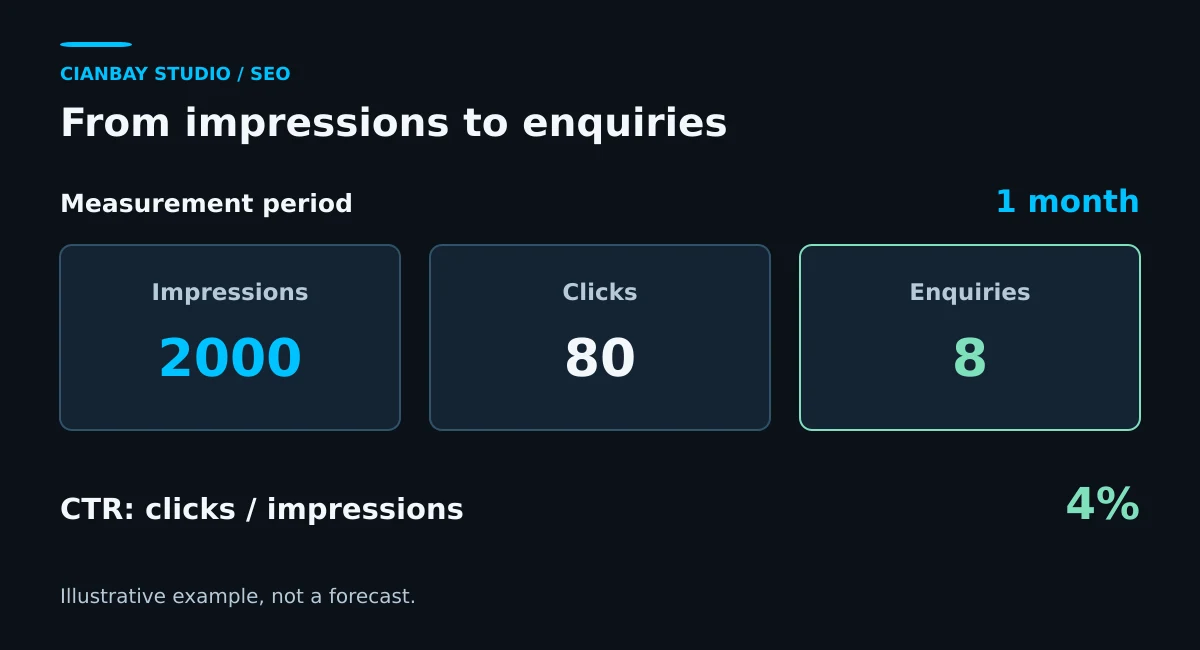
Growing impressions with few clicks can suggest a need to review queries and search presentation. Clicks without enquiries can reveal a mismatch in the offer, missing information or problems with the customer journey. Do not infer that every change in traffic was caused by your latest SEO edit. Seasonality, competition and changes in demand can also affect results. Record major changes so that the next analysis has useful context.
What to ask your developer before launching
- Do priority pages have distinct titles, descriptions, clear headings and stable URLs?
- Have indexing directives, canonical references, redirects, broken links and the sitemap been checked?
- Will the company own its Search Console and analytics access, and can enquiries be measured?
- Which content and SEO tasks are included in the quotation, and who will maintain them after launch?
Frequently asked questions
Is installing an SEO plugin enough?
No. A plugin can make metadata and some technical settings easier to manage, but it cannot replace customer research, useful content and sensible architecture.
How soon will rankings improve?
Timing depends on discovery, crawling, competition and the condition of the website. Specific rankings, deadlines and lead volumes cannot be guaranteed.
Should a brand-new website receive on-page SEO?
Yes. Establishing the architecture and ownership of measurement accounts from the beginning avoids many unnecessary migrations and revisions. Use actual search data to refine the initial strategy later.
Our perspective
At CianBay Studio, we consider discoverability and customer experience part of preparing a business website. We want each commercial page to explain something useful, be accessible to search engines and provide a logical route to a real enquiry. Explore our business website development and technical SEO preparation services if you are planning a new website or improving an existing one.
Official sources
- Google Search Central: SEO Starter Guide
- Google: title links in search results
- Google: canonical URLs
- Google Search Console: Performance report