Dmytro CianBay · 24.11.2026 · 10 min read
Hotel Website with Direct Booking in 2027: More Reservations Through Your Own Channel
Hotel websites with room availability, direct reservations, secure payments and PMS integrations. What owners should plan before commissioning development.

A traveler discovers your property on Google, likes the rooms and looks for a way to reserve five nights. If the hotel's site shows only a telephone number or a button leading to a third-party platform, the guest has little reason to complete the transaction directly. The property may still receive the reservation, but it has not built an independent sales channel. A professional hotel website must do considerably more than display photos and an address.
That does not make booking platforms the enemy. Online travel agencies can introduce a hotel to customers who would never discover it otherwise. A direct-booking website serves a different purpose: it provides a credible alternative with transparent conditions, a reliable booking process and a direct relationship with the guest. The commercial question is not whether an owner can install a calendar, but whether the website supports the hotel's real operating model and protects its inventory.
1. What makes a hotel website a booking channel
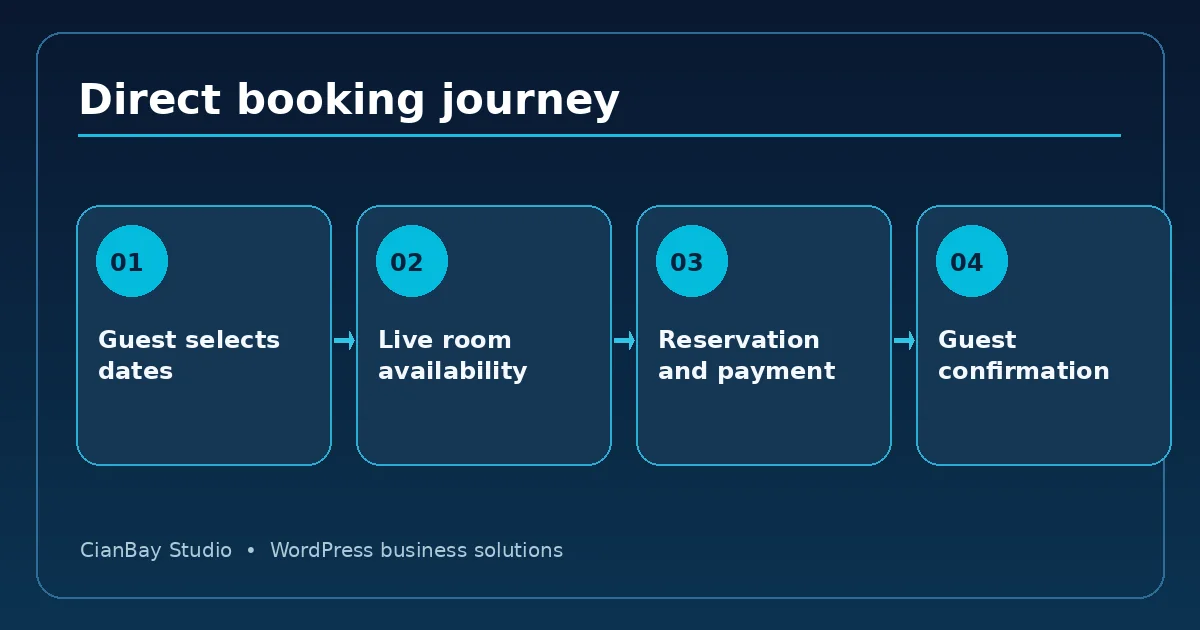
A traditional brochure site answers who you are and where to find you. A reservation website answers whether accommodation is available on specific dates, which room matches a guest's needs, what the stay costs and when the booking is confirmed. The difference is a customer journey that can produce an actual reservation without the guest calling reception.
A meaningful direct-booking experience includes searchable dates, occupancy limits, room descriptions, prices for the entire stay, cancellation conditions, suitable payment methods and a clear confirmation. These elements form one operational flow. A beautiful homepage cannot compensate for an availability calendar that displays rooms which have already been sold elsewhere.
2. Direct bookings versus intermediaries: compare contribution, not headlines
OTA fees vary by contract, country, partner program and transaction. It would be misleading to promise that every direct booking saves the same commission. Consider an illustrative example: 40 room nights at €90 produce €3,600 in accommodation revenue. At an assumed 15% intermediary commission, the fee would be €540. But the direct channel also has acquisition, payment processing, maintenance and customer service costs.
An owner should compare the contribution from each channel after channel-specific costs, including refunds and cancellations. If a direct-booking campaign attracts guests who would otherwise stay empty, it may have different economics from redirecting existing regulars away from an intermediary. A useful booking strategy generally combines discovery through relevant platforms with a strong website for returning guests, brand searches and local partnerships.
3. What a prospective guest needs to know before booking
Guests compare far more than nightly rates. A family may need clear child-occupancy rules, a parking space and breakfast arrangements. Business travelers may prioritize early checkout, invoicing and transport links. Guests with accessibility requirements need factual information about entrances and room facilities, not a generic accessibility badge. A hotel site should organize this information where the decision is made.
Room pages should describe actual configurations, square footage where applicable, bed choices, amenities and meaningful differences between rate plans. If an advertised price excludes compulsory local charges, the checkout can turn a promising visit into distrust. The complete price for the selected dates and party size should be understandable before the guest commits, according to applicable market rules.
4. The inventory challenge: rooms, dates and overlapping sales
Hotel inventory is not an ordinary product count. Availability changes by date, length of stay, room category, maintenance holds, minimum-night rules and reservations coming from multiple sources. A small apartment operator may have a simple set of calendars. A larger hotel may operate multiple rate plans, blocks for group sales and separate units within the same room category.
The costly failure is a double booking: two systems confirm the last available room because the updates did not reach each other in time. That is why a developer must identify the authoritative availability source before selecting a booking plugin. Whether the source is a property-management system, a channel manager or a dedicated reservation platform determines the integration architecture and the scope of testing.
5. Rates, deposits, cancellation rules and guest expectations
A flexible rate, non-refundable deal, corporate price or long-stay promotion has implications beyond how it looks on screen. The website should show whether payment is full, partial or due on arrival, when a reservation becomes binding, and what happens after a date change or cancellation. Pending requests should not be labeled as confirmed bookings.
The payment integration must support the actual countries, currencies and settlement arrangements of the business. Refunds, invoices, notification emails and payment failures deserve explicit design. For multilingual properties, policies must be accurately localized, not simply copied from another hotel's template. The most effective booking flow is not the one that hides conditions to get a click, but the one that reduces surprises after the transaction.
6. Booking.com, Expedia and channel-manager synchronization
Integrations are possible, but not through an imaginary universal switch. Booking.com supplies Connectivity APIs through an authorized partner model. Hotels often depend on a PMS or channel manager that coordinates room inventory and rate updates across OTAs. The existence of a public API page does not mean every individual WordPress website has the permissions required to publish or change that hotel's inventory.
Before development, identify the current provider and verify exactly which data can move in each direction: room availability, confirmed reservations, rate plans, modifications and cancellations. Some smaller accommodations may use calendar-feed interoperability where appropriate, but a calendar feed is not equivalent to a fully synchronized hotel inventory system. Test concurrent bookings and failure recovery rather than relying on a successful demonstration with one test reservation.
7. The role of WordPress and WooCommerce
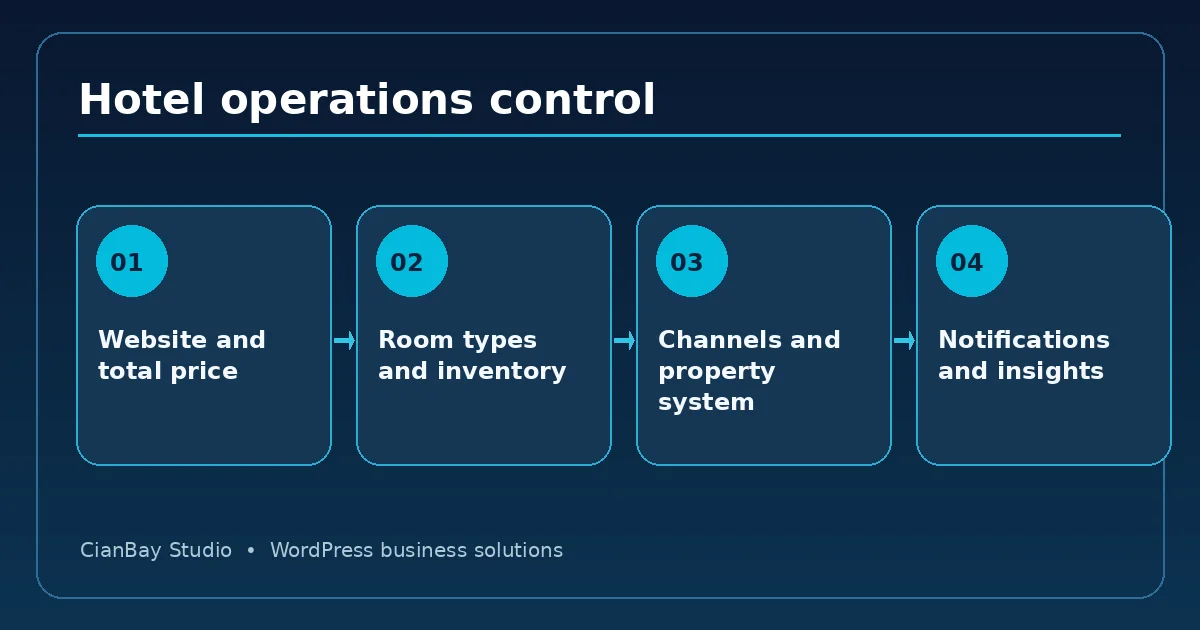
WordPress gives the property control over destination content, brand pages, photography, multiple languages, SEO and seasonal offers. WooCommerce can provide familiar commerce infrastructure for payments, order management and customer communication. Accommodation requires dedicated booking functionality, such as WooCommerce Bookings alongside an appropriate accommodation extension or another supported booking engine.
This flexibility is valuable because a hotel can keep its own website while integrating specialist software where it belongs. WooCommerce is not automatically a complete PMS: housekeeping, rate management, accounting, guest records and channel distribution may require separate platforms. A responsible developer designs the visitor-facing website around verified operational needs rather than pretending a set of plugins solves every hotel process.
8. Trust signals are operational facts
Honest photographs, accurate room descriptions, a verifiable address, clear contact information and visible booking conditions make a stronger argument than decorative trust badges. Reviews should be authentic and presented with enough context to be useful. If the property lacks an elevator or has limited arrival hours, burying that information until checkout invites poor reviews and refunds later.
A guest reserving from another time zone should not be forced to wait until reception opens merely to discover whether a room is available. At the same time, a human contact channel still matters for accessibility requests, late arrivals and unusual group needs. The best website gives visitors the option of self-service without making staff unreachable.
9. Hotel SEO is about specific travel intentions
Potential guests search for more than “hotel in [city].” They may want accommodation near a train station, apartments for a family, a hotel with accessible rooms, a pet-friendly stay or a place suitable for business meetings. Pages that honestly describe these facilities can answer real search intent more effectively than repeating a hotel name and the word “luxury” twenty times.
Google provides free hotel booking links, but participation and display depend on eligibility, feeds, price accuracy and relevant partners. The website does not receive these features automatically because it runs on WordPress. Clear facts about rates, location and conditions also help search and AI systems interpret the property, although no schema or GEO tactic guarantees inclusion in an AI-generated answer.
10. Measure bookings, not just traffic
A busy site that generates few completed reservations needs diagnosis. Owners should follow the stages between selecting dates, viewing availability, picking a room, initiating payment and receiving confirmation. Cancellation rates, repeat visits, average booking value and source-specific acquisition costs add essential business context. Telephone reservations can also be tracked without treating all phone calls as confirmed sales.
A conversion problem may stem from room unavailability, an unexpected charge, a broken date selector or a payment method unavailable in the visitor's country. WordPress and WooCommerce support analytics integrations, but the event tracking should be verified against real transactions. Reporting tools should also respect visitor privacy and required consent practices.
11. Multilingual content should help guests make a decision
A French or Polish visitor needs more than translated navigation. The booking process should communicate check-in times, refund policies, total charges, house rules and confirmation messages in a language they understand. Currency displays must not imply a payment currency that the gateway does not actually support. Localized pages should refer to the same inventory and business conditions as the primary site.
International SEO benefits from coherent localized URLs and accurate language relationships. Adding many versions without maintaining them is rarely a growth strategy. Choose languages based on the hotel's market and staff's ability to keep content updated. A small domestic hotel may be better served by two excellent language versions than ten inconsistent ones.
12. What does development actually cost?
A guesthouse with six rooms, a small booking calendar and a deposit option is a different project from a forty-room property requiring rate-plan logic, several currencies and a live PMS connection. The budget should reflect discovery, design, room content, booking integration, payment configuration, QA, localization, hosting and ongoing support. Existing systems may save time, but unfamiliar APIs can also create integration work.
Domain fees, hosting, paid booking extensions, PMS subscriptions, channel management and transaction fees are separate cost categories. Licenses should normally remain under the client's control. A specific estimate follows a review of the hotel's booking rules and current software; guaranteeing a complex launch in a few days before that review would be irresponsible.
13. A phased launch can be the sensible business choice
Some small operators start with a clear room catalog and reservation requests that staff confirm manually. This may be appropriate when inventory is modest and the hotel is still validating direct demand. A later phase can introduce live availability, prepayments, automated guest messaging and channel synchronization. That is a commercial staging decision, not a technical failure.
For a busy hotel with several sales channels, however, a manual bridge may create unacceptable overbooking risk. There the initial architecture needs to put the existing property systems first. WordPress can be the customer-facing foundation for both situations, while the internal tools and implementation timeline differ substantially.
14. What to clarify before commissioning a hotel website
Bring the number of actual rooms and categories, supported occupancy combinations, your current PMS, booking channels, rate plans, deposit requirements, countries of sale and content assets to the first discussion. Decide whether a booking is instantly confirmed or becomes a request for staff approval. Map modifications, no-shows, refunds and maintenance blocks. These questions determine both the user experience and the cost of development.
CianBay builds WordPress websites and WooCommerce-based business solutions and can scope room booking, payments, localized landing pages and integrations according to the hotel's verified needs. The goal is not simply a new interface. It is an independent, measurable booking channel that remains useful as the property grows. Discuss your requirements through CianBay Telegram and see our services at cianbay.online.
Frequently asked questions
Can a hotel website replace Booking.com entirely?
It can capture direct demand, especially from returning and brand-search guests, but OTAs may still be useful for discovery. Compare the economics of each channel rather than assuming one should disappear.
Is WooCommerce Bookings enough for a full hotel?
Not necessarily. Booking functionality and hotel operations are different. A PMS or channel manager may be essential for inventory control, rate distribution and staff workflows.
Does Google Calendar integration prevent double bookings across OTAs?
Not automatically. Calendar events and hotel inventory synchronization can have different capabilities and update speeds. Verify the chosen integration with the actual providers.
Can an independent hotel accept deposits online?
Yes, where supported by its payment provider and booking engine. Payment settlement, refunds and local consumer rules need to be planned into the flow.
Does a new hotel website guarantee more bookings?
No. It gives the hotel an owned route to conversion. Demand, price, reputation, search visibility, channel strategy and booking usability still determine results.
More from CianBay
Sources and documentation
- WooCommerce Bookings
- Accommodation Bookings
- Booking.com Connectivity APIs
- Booking.com Connections API
- Google Hotel Free Booking Links
- Google Hotel Price Accuracy
- Google Helpful Content