Dmytro CianBay · 21.11.2026 · 7 min read
How to build a dropshipping store in 2027: costs, suppliers and automation
Launch a WooCommerce or Shopify dropshipping store, connect suppliers, synchronise inventory and calculate the real margin per order.
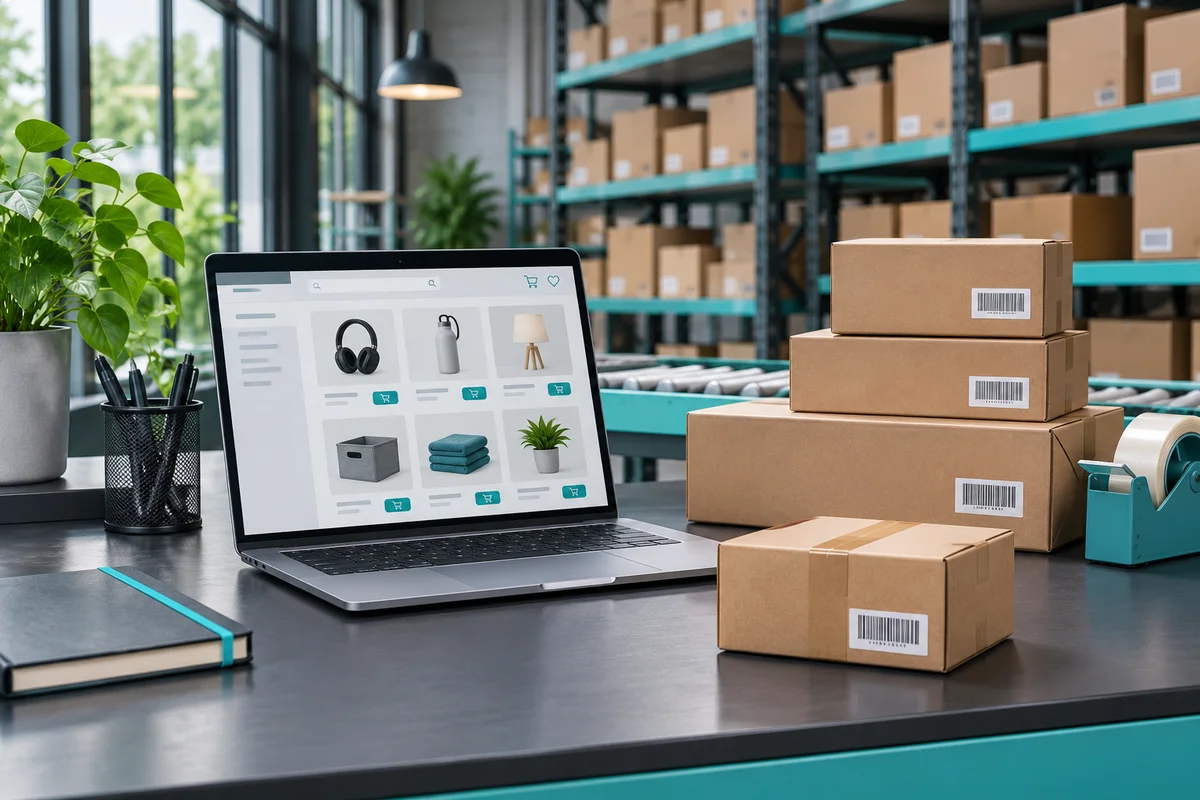
Dropshipping makes it possible to sell products without purchasing a large amount of stock or operating your own warehouse. But eliminating a warehouse does not eliminate costs, risks or responsibilities to customers. A successful online store must do more than display products. It needs current prices and availability, a dependable checkout and a way to transfer orders to suppliers.
This guide explains how to build a dropshipping store in 2027, which features are important at launch and when automation is worth the investment. It is written for business owners who are considering starting or expanding an online retail operation.
How does dropshipping work?
In a typical arrangement, a customer places an order with your online shop. You confirm the order, send the required information to the supplier and pay for the goods according to your agreed terms. The supplier packages the product and ships it directly to the customer. You receive sales revenue, while your expenses include the supplier price, delivery, payment fees, advertising and other operating costs.
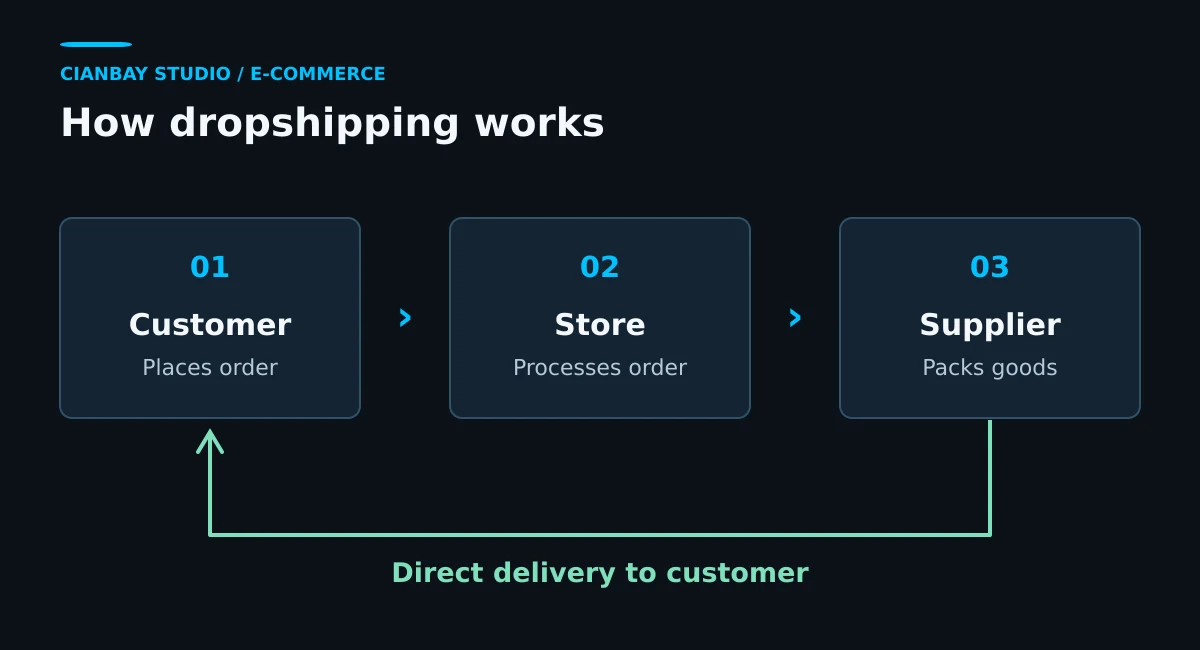
Unlike a conventional retailer, you do not have to purchase the entire range in advance. However, you have less direct control over packaging, quality and dispatch times. It is important to establish whether your supplier can deliver consistently before investing heavily in advertising.
Start by choosing products and reliable suppliers
Building a catalogue of ten thousand products is rarely a useful first step. Select a niche, establish what customers need, investigate available products and check whether you can sell competitively while leaving enough margin to cover costs.
When discussing an agreement with a supplier, ask:
- What is the wholesale price and can you receive updated prices automatically?
- How often is availability updated, and can stock be reserved?
- Who packages the items, which documents are included, and whose branding appears on the parcel?
- How long does dispatch take, and how will you receive the tracking number?
- Who handles returns, repeat deliveries and damaged or incorrect items?
- Does the supplier have permission to provide the images, descriptions and trademarks you intend to use?
Order a sample yourself. Assess packaging, product quality, delivery time and how returns are handled. Checking these basics before launch can prevent costly customer complaints later.
WooCommerce or Shopify for dropshipping?
WooCommerce is suitable for a business that wants control over its website, hosting choice, extensions and custom integrations. The core WooCommerce platform does not require a recurring software licence fee, but hosting, paid extensions and technical support may have ongoing costs.
Shopify is a hosted platform with its own subscription model. Its ecosystem offers ready-made applications for connecting suppliers. Budget separately for the platform plan, applications and payment costs. Confirm compatibility with the particular suppliers you intend to use rather than assuming the existence of an app guarantees a complete integration.
The choice depends on catalogue size, target markets, order volume and business requirements. If you need specialised pricing rules, multiple suppliers or ERP integration, estimate those costs before committing to a platform. Our WooCommerce versus Shopify comparison explains the differences in more detail.
Synchronising product information and inventory
A supplier might provide product information through CSV, XML, an API or another supported method. Establish which fields need regular updates: purchase prices, availability, product codes, images, specifications, colours and sizes.
WooCommerce offers a built-in CSV product importer and exporter for appropriately structured data. But a one-off import is not the same as ongoing synchronisation. Scheduling, frequency, failure handling and markup rules need to be configured according to the supplier's capabilities.
Each product needs a stable identifier. Two suppliers might use the same product code, so their offers must be distinguishable. If a supplier's data feed temporarily fails, the store should not automatically delete the catalogue or reset all prices to zero. Agree on a safe way of marking and handling outdated information.
Decide which information your team will maintain independently. An inventory update should not overwrite carefully written product descriptions, translations or SEO metadata. Learn more in our guide to bulk product imports.
Automating orders and shipping
A small shop may initially forward orders manually. As sales grow, the process becomes harder to manage, particularly when a single customer's basket contains products from several suppliers.
An integration can separate order items by supplier, send the relevant details, record confirmations, collect tracking numbers and inform customers. For example, the WooCommerce Dropshipping extension supports supplier workflows, including order notifications. Assess whether a particular extension actually supports your agreement and requirements.
If you require payment in advance, make sure an unpaid order is not sent for fulfilment prematurely. Consider cancellations, items that become unavailable after checkout, split shipments and returns. Delivering the same order notification twice must not result in two purchases from a supplier.
The team also needs a way to identify failed transfers and deal with exceptions manually. A useful automation does not prevent staff from investigating a problem; it gives them mechanisms to understand what has happened.
How much is left from each sale?
The difference between the retail and wholesale price is not your final profit. Consider an illustrative order with €60 of net revenue excluding VAT. Product cost is €30, shipping €6, payment fees €2, advertising €10 and a €3 allowance for expected return-related costs. That leaves €9, or 15% of revenue.
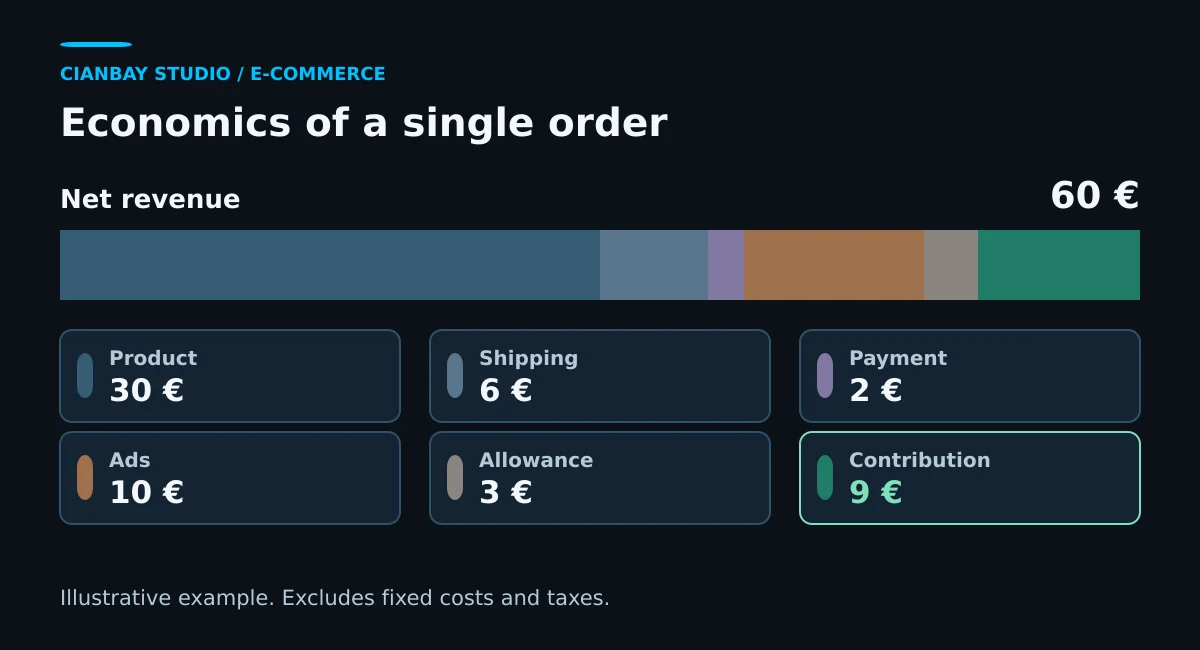
The €9 is a contribution towards fixed costs, not net profit. It still needs to cover hosting, maintenance, subscriptions, accounting and other overheads. If monthly fixed costs are €180, twenty fulfilled orders would be needed to cover them, assuming the same contribution per order.
If advertising costs rise from €10 to €16 per order, the contribution falls to €3. Covering the same €180 requires sixty orders. That is why purchasing, shipping and customer acquisition matter just as much as the store's appearance. These figures illustrate the calculation; they are not an earnings forecast.
Essential features for a new store
- A mobile-friendly catalogue, filters, product variants and accurate specifications.
- A basket and checkout with suitable payment and delivery options.
- Current prices and availability, with realistic dispatch estimates.
- Clear return information, seller contact details and relevant customer information.
- Order management, a way to recover from integration failures and basic sales analytics.
Additional features such as multilingual content, CRM integration, multiple supplier inventories and dynamic pricing should be introduced according to actual business needs. There is little value in buying a complex automatic synchronisation solution when a supplier cannot provide a dependable data source.
Consider which tasks the shop owner can manage without developer assistance. Updating retail prices, pausing a problematic supplier and reviewing failed orders should be part of the operating process. Document how the store works and keep access under the business's control.
Responsibilities towards customers
Dropshipping does not automatically transfer all retailer obligations to the supplier. If a customer purchases from your business, establish responsibilities for product quality, delivery, consumer rights, returns and handling personal data. Shopify's dropshipping compliance guidance emphasises that applicable requirements depend on the jurisdictions involved.
Before selling internationally, check product safety, labelling, import, tax and consumer requirements with qualified professionals. Customers should receive accurate information about the item and its shipping arrangements. Do not promise next-day dispatch if your supplier needs a week.
Frequently asked questions
Can I launch without automated supplier integration?
Yes. Manual processing can work for a small product range and few orders. Before scaling, assess the staff time and risk of processing errors.
Can I use several suppliers?
Yes. You will need clear rules for matching products, prices and availability, allocating purchases and calculating shipping from multiple suppliers.
Can I combine my own stock with dropshipping?
Yes. A hybrid operation can hold popular items in its own warehouse while sourcing a wider range from partners. The store must represent the delivery arrangements for each product accurately.
How much does it cost to build a dropshipping store?
The development cost depends on catalogue size, available supplier feeds, payment and delivery options and integration complexity. A standard shop and a store with automated multi-supplier synchronisation require different amounts of work.
Our perspective
At CianBay Studio, we recommend validating the niche, unit economics and supplier capabilities before building a store around the actual sales process. We work with clients in Ukraine and internationally, developing WooCommerce online shops and business automation integrations that can grow alongside the business.
Sources and further reading
- WooCommerce: product CSV importer and exporter
- WooCommerce: Dropshipping documentation
- Shopify: legal requirements for dropshipping