Dmytro CianBay · 21.11.2026 · 8 min read
Backlinks and their impact on SEO in 2027
Learn how to earn relevant backlinks, evaluate publishers, avoid link spam and measure the real business impact of external promotion.

A business launches a new website, publishes useful content and waits for customers to find it through Google. After several months, the owner notices competitors appearing higher in search results, even though their websites are not necessarily better. One possible difference is external visibility. Other websites mention these companies, recommend their products or link to their resources. In 2027, building that visibility should be approached as a business development activity, rather than an exercise in purchasing a fixed number of links.
What are backlinks?
A backlink is a link from another website to yours. For example, a trade publication might publish a guide to commercial furniture suppliers and include a link to a manufacturer's catalogue. That is an inbound external link. When your own company blog links to an industry publication, that is an outbound link. A link between two pages on your own website is an internal link.
Inbound links can help search engines discover pages, understand connections between resources and bring visitors directly from other websites. Google's guide to ranking systems describes link analysis among the numerous systems used in search. However, there is no public formula that promises a particular ranking improvement for each additional backlink.
Why quality matters more than quantity
Imagine two businesses selling equipment to restaurant owners. The first has one hundred links from unfamiliar directories covering unrelated subjects. The second has five mentions: in a specialist publication, on a manufacturer's website, in an industry association, in a supplier comparison and in a restaurant consultant's article. From a buyer's perspective, the second business is substantially more visible within its relevant industry.
This demonstrates why counting domains is insufficient. Look at who reads the publication, whether a recommendation fits naturally into the article and whether it provides readers with meaningful additional information. Even a well-known website can publish an article that almost nobody reads. A smaller regional publication with a focused audience may generate more meaningful enquiries.
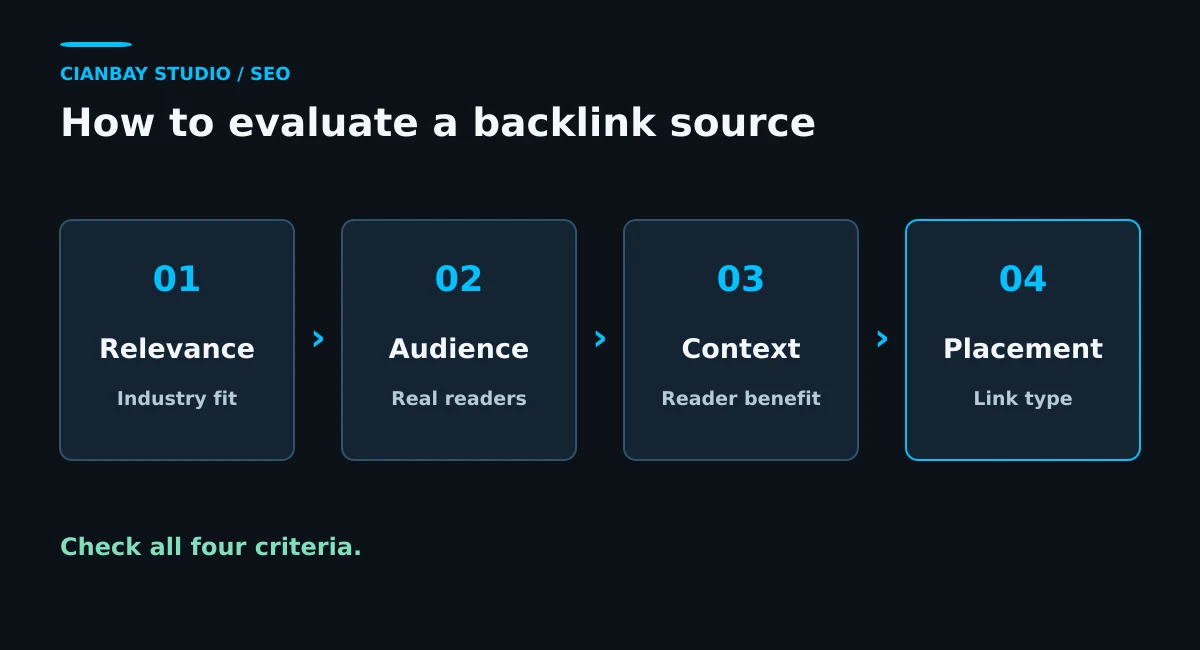
How to evaluate a potential publisher
Before contacting an editor or joining a directory, browse several recent articles. Is the publication focused on a clear subject? Are real contributors identified? Is it actively maintained? Can its articles be found through search? Does its audience speak the language of your potential customers? Do you see extensive advertisements about entirely unrelated businesses?
Examine other external links within the articles. A real estate publication that regularly promotes casinos, short-term loans and dozens of unrelated shops deserves particular scrutiny. By contrast, a local publication that recommends contractors within the context of a relevant home renovation guide may be a useful way to introduce your services to customers.
Third-party SEO platforms calculate metrics such as Domain Authority and Domain Rating. These can be helpful for comparing sites using the methodology of a particular provider, but they are not Google's own website ratings. A high score alone guarantees neither readership nor indexing nor improved search rankings for your business.
Where businesses can earn relevant backlinks
- Specialist publications. Offer editors a practical contribution based on your experience, verified data, photos or a detailed industry example.
- Business directories and trade associations. Create an accurate profile where prospective customers genuinely look for suppliers or contractors.
- Partners and manufacturers. Prepare a joint case study or explain the practical application of a product or technology.
- Regional media. Share meaningful news about a new service, an office opening or participation in a relevant local event.
- Industry resource lists. Offer a useful resource that complements existing recommendations rather than duplicating them.
Many businesses already have opportunities that remain unused. A manufacturer publishes an authorised dealer list, a partner presents a completed project or a conference organiser introduces participating companies. Ask for the appropriate website address to be included when such a reference genuinely makes sense. Avoid requiring every partner to insert a particular commercial keyword or link to your homepage.
Create resources worth recommending
Editors rarely have a strong reason to reference another generic article about the benefits of a company's services. Practical calculators, comparison guides, original research, detailed customer instructions and documented case studies provide a more compelling editorial reason. For example, a garage door manufacturer could publish a guide to opening dimensions and installation requirements. A maintenance business could explain what customers should expect from a scheduled service visit.
Give the resource a permanent address, a visible author, an update date and sources for important figures. Make it easy for other writers to verify information and direct their readers to a particular relevant page. Before carrying out outreach, ensure the website structure is sound and complete the necessary technical SEO preparation.
Is paying for a backlink acceptable?
Paid advertising and sponsorship are legitimate marketing activities. A business may pay a publication to introduce its product to a relevant audience. The issue arises when the purpose of payment is to manipulate search rankings. Google's spam policies explain that links purchased for ranking manipulation, excessive reciprocal arrangements and automated link creation can constitute link spam.
Google recommends the sponsored attribute for advertising links; nofollow is also accepted. The ugc attribute is designed for user-generated content. The official guide to outbound link attributes explains the distinctions. A correctly labelled advertising link can still bring valuable visitors to your website. Do not judge a campaign solely by whether a link could pass a ranking signal.
Anchor text and editorial context
Anchor text is the visible clickable text of a link. A business name, website address or descriptive phrase can each be appropriate in different situations. If dozens of articles all repeat the phrase 'cheap website development', the repetition does not make those recommendations more convincing.
Avoid imposing an artificial ratio of different anchor types. Do not require editors to place particular keywords independently of the article's meaning. Descriptive anchor text should set the reader's expectations about the destination. Check that the target page works, returns the expected content and has no unnecessary redirects. The customer should not land on a page about an entirely different service.
How much does an external promotional campaign cost?
Suppose a company spends €150 on a clearly labelled advertising article in a specialist publication. Website analytics attributes 120 visits to that article, and the company identifies six qualified enquiries. The cost per qualified enquiry is €25, and the enquiry rate is 5% of those visits. The business can then compare those figures with its margins and its other marketing channels.
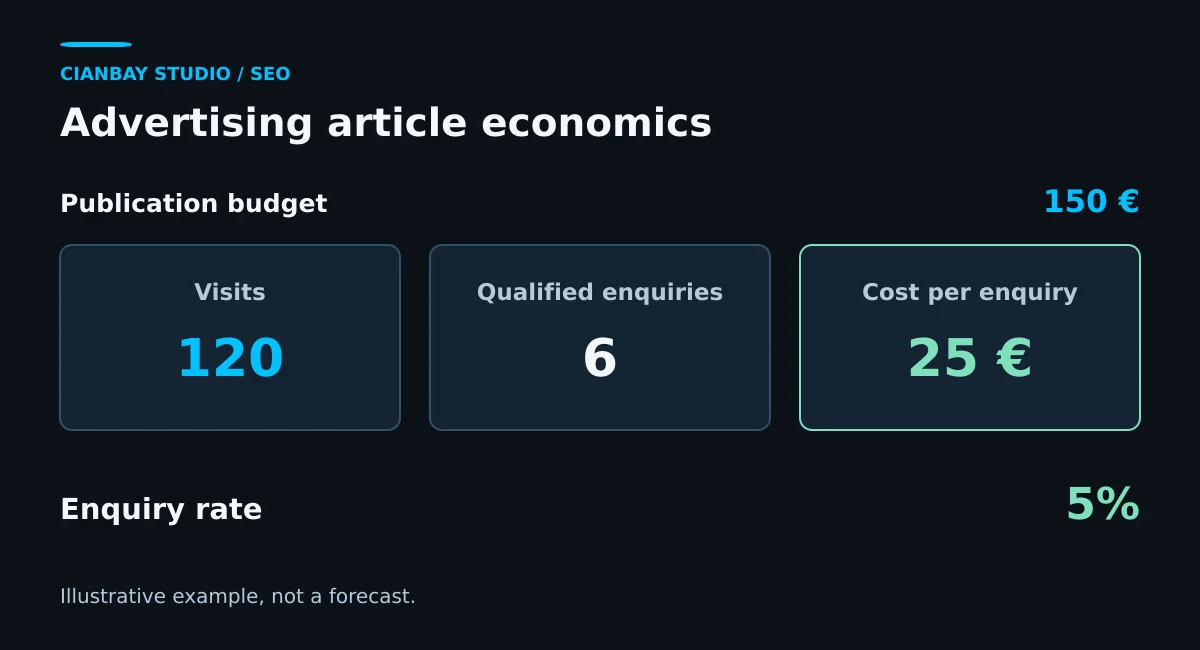
This is an explanatory example, not a forecast. If there are no qualified enquiries, a finite cost per enquiry cannot be calculated. If organic visibility subsequently increases as well, the business cannot automatically attribute all future organic enquiries to that one link.
How to measure the results
The Links report in Google Search Console provides a sample of external links, linking domains and destination pages. It is not an exhaustive list of every link. Separately, use website analytics to examine referral traffic. Where appropriate and agreed with the publisher, add campaign tracking parameters to advertising links. Record each publication's date, address, subject, cost and outcomes.
Review qualified enquiries monthly instead of reacting to every daily ranking fluctuation. Keep organic search and referral traffic separate, and account for seasonality, changes to your website and concurrent campaigns. If the destination website has no clear offer, pricing information, contact details or usable enquiry process, external promotion alone will not solve those problems.
What about suspicious backlinks?
An unexpected spam link does not automatically mean that Google has penalised a website. Google explains that most websites do not need its disavow tool. The disavow documentation describes exceptional situations involving substantial artificial links that have caused, or are likely to cause, a manual action. Incorrect use can harm a website's search performance. Investigate the situation and seek removal of problematic links when justified before considering disavowal.
Our perspective
At CianBay Studio, we recommend starting with a useful website capable of converting visitors into customers and then systematically developing its external presence. A handful of relevant publications with measurable business outcomes is preferable to purchasing hundreds of unrelated mentions every month. When developing a business website, plan the pages that other publishers might genuinely want to recommend and configure analytics from the beginning. External promotion belongs alongside content quality, technical health and an attractive business offer.
Frequently asked questions
How many backlinks does a website need?
There is no universal target. Consider your competition, industry, relevance of sources and available resources. Start with genuine business partners and a few appropriate publications.
Are nofollow links worthwhile?
They can introduce the company to new readers and generate referral traffic. Do not assume or promise a particular organic ranking benefit.
How long does it take to see an effect?
Direct referral visits can begin as soon as a publication appears. Changes in organic search visibility may take longer and depend on numerous factors beyond the link itself.
Should we purchase links every month?
No. Plan a budget for useful resources, partner activities and measurable advertising rather than a compulsory monthly quota of backlinks.