Property listings
Group listings by sales, rentals and property types.
Each property has its own page and status; agents can add or update listings in WordPress.
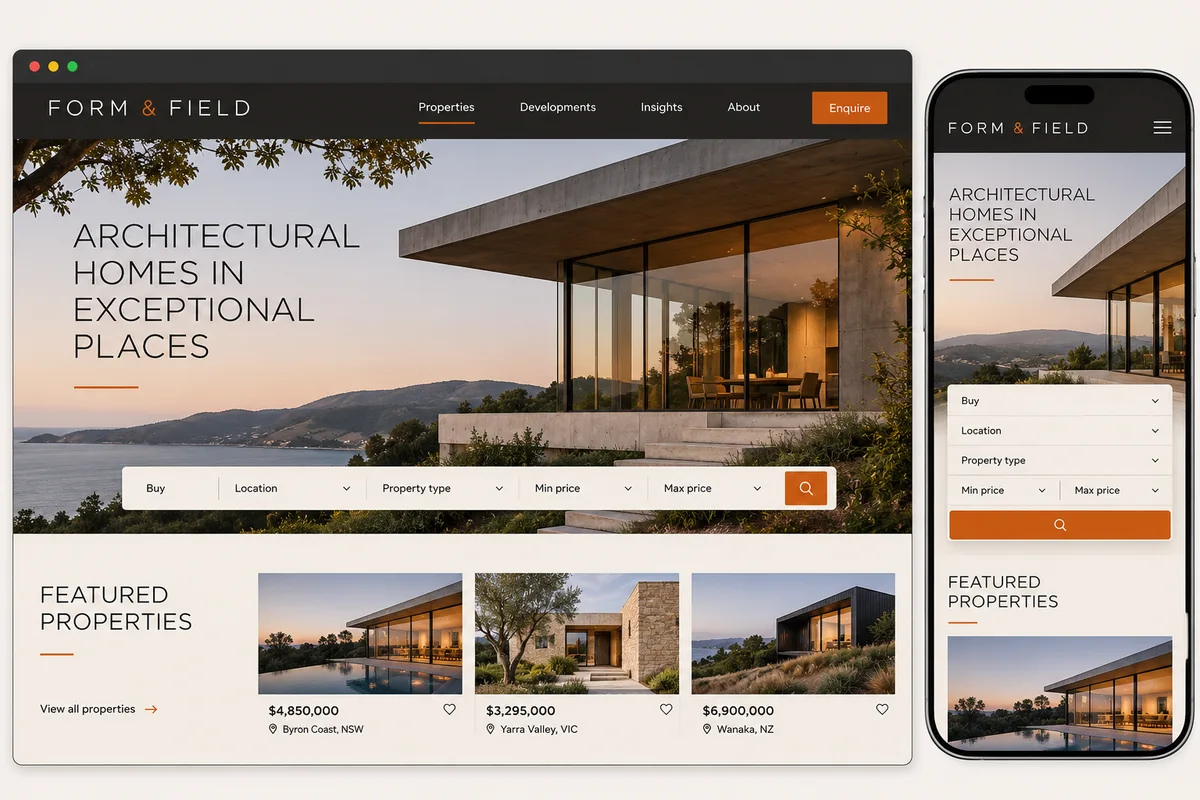
Group listings by sales, rentals and property types.
Each property has its own page and status; agents can add or update listings in WordPress.
Filter by price, area, district and agreed attributes.
Filter options depend on property types. We agree required fields and sorting rules.
Show photos, floor plans, specifications and agent contact details.
A listing can include a map, floor plan, area, amenities, gallery and agent contact form.
Collect viewing requests for a specific listing.
The enquiry identifies the property so the agent can understand the request and arrange a viewing quickly.
The basic website starts at €500 and includes: Property listings, individual property pages, photos, basic filters and enquiries. Quoted separately after assessing requirements: Automated imports, agent CRM, maps and advanced filters. Domain, hosting and paid third-party licences are not included. We confirm the scope and final quote before starting.
Manage listings in WordPress. Imports, CRM synchronization and maps are estimated after reviewing the data sources.
A real-estate website depends on accurate listings: current status, asking price, floor area, plans, location context and authentic photos. Buying, selling and renting need different enquiry paths, so define required property fields and filters before building templates. Each viewing request should identify a particular listing and its responsible agent.
Listings may be sold, rented or withdrawn at short notice. Define who updates property status, filters, photos and agent contacts so users are not sent to outdated offers.
CRM and feed synchronisation depend on documented access and source permissions. Plan duplicate detection, removed listings, price changes and outdated photographs rather than assuming every import is reliable. If several agents edit records, agree on ownership, approval and publication rules so visitors do not see contradictory availability.
Search architecture follows genuine property types, areas and individual listings. Empty filter combinations and parameter URLs must not generate thousands of thin indexable pages. Test mobile search, gallery performance, maps and listing status changes; avoid fabricating transaction histories or marketing properties that no longer exist.
A buyer, a commercial tenant and a property owner seeking an agent arrive with different goals. Separate these journeys: search by budget and specifications, inspect a listing and request a valuation or viewing. A property page needs its current status, an appropriately precise location, size, floor plan, photographs, transaction terms and a responsible agent. Do not promise automatic feeds from multiple portals until export formats, API access, field mappings and update frequency have been checked. Distinctive neighbourhood content should be supported by genuine listings, not generated as empty search landing pages.
Listings change status quickly. Decide what a visitor sees after a sale or rental: a completed notice, a suggestion of similar properties, removal from search results or a carefully chosen redirect. Filters must handle empty results, price ranges, multiple currencies and duplicate data. Before handover, test agent notifications, viewing enquiries, maps, galleries, imports with invalid fields and the first mobile view of a new property. Agree who owns the photos and who updates status, so the website does not continue advertising unavailable homes or commercial units.
Prepare an accurate service or product list, real locations and contact details, up-to-date prices or quotation rules, rights-cleared media and someone to approve the facts. Confirm whether an existing CRM, calendar, stock system or other tool provides a documented API. Unknown integrations are assessed first, not included as an unsupported promise in a proposal.
Test mobile tasks, key-template performance, forms, notifications, contact routes, internal links, sitemaps, canonicals, language URLs and indexing readiness. Check exceptional conditions too: incomplete fields, unavailable slots or items, repeated requests, failed payment and external service outages. Analytics should capture meaningful enquiries and completed actions, not merely page views.
We agree the main pages and customer journeys first, then move through layout, content, integrations and end-to-end testing. The owner can update material in WordPress after handover. Timing depends on approved assets and checked integrations; we do not advertise an arbitrary universal three-day launch.
A starting guide for this category is €500. Basic scope: Property listings, individual property pages, photos, basic filters and enquiries. Scoped separately: Automated imports, agent CRM, maps and advanced filters. Domain, hosting and third-party paid services are agreed upfront; external accounts belong to the client.
Yes, after checking the data structure and available export methods. We map fields, images, prices and statuses, run a sample import and verify the result.
Yes. Sale, rental and archive statuses can control listing visibility. If needed, an informational page can remain available with similar active properties.
Yes, if your CRM supports the required data exchange. Enquiries can identify the property and responsible agent; catalogue synchronisation is scoped separately.
Tell us about your business and the functionality you need.
Message on WhatsApp ↗