
Course catalogue
Present programmes, instructors, durations and pricing.
Each course can show its syllabus, level, requirements, instructors and access format.
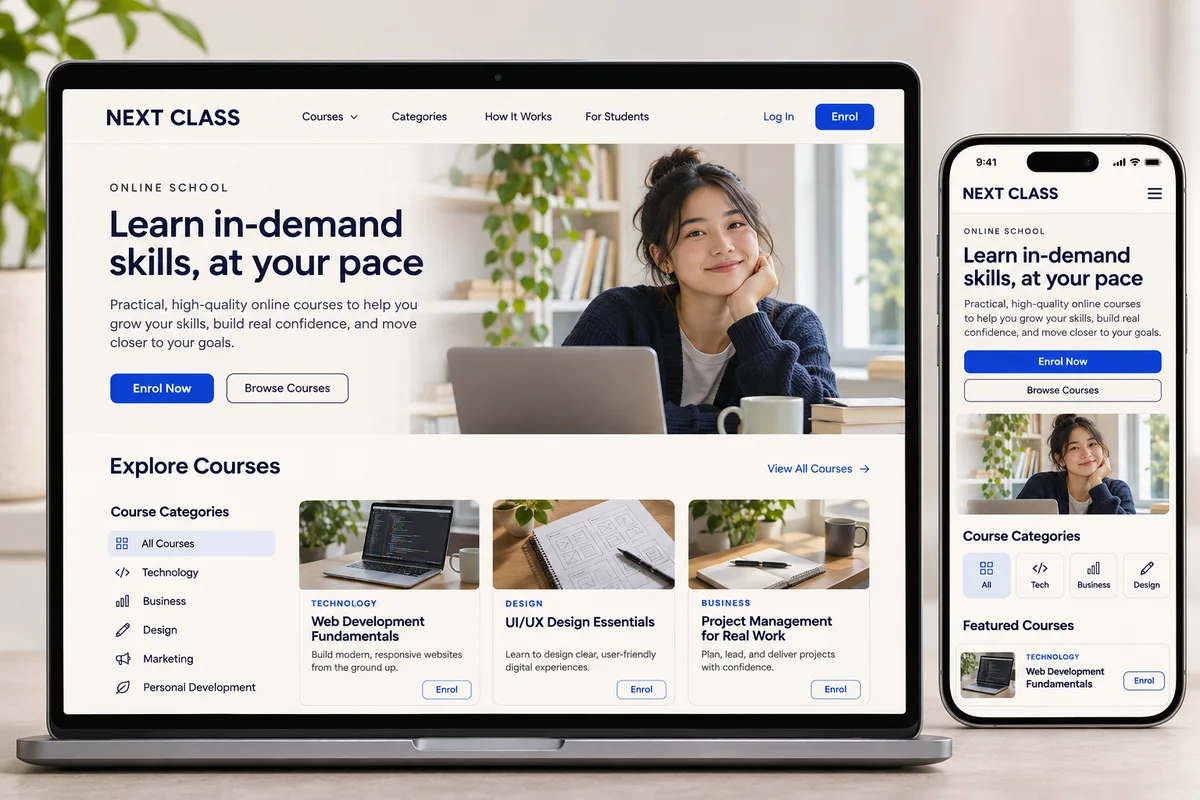
Present programmes, instructors, durations and pricing.
Each course can show its syllabus, level, requirements, instructors and access format.
Registration and individual access to learning materials.
Students see assigned courses, completed lessons and progress. Instructor and administrator permissions are configured separately.
Modules, video lessons, quizzes, assignments and feedback.
Learning modules can contain videos, files, quizzes and reviewed assignments, subject to LMS capabilities.
Sell access to courses using agreed access rules.
After payment confirmation, the system can unlock the relevant course. Bundles, subscriptions and access periods are agreed before launch.
The basic website starts at €800 and includes: Course catalogue, learning modules, student and tutor roles, progress tracking. Quoted separately after assessing requirements: Paid LMS licences, custom assignment review processes and video hosting. Domain, hosting and paid third-party licences are not included. We confirm the scope and final quote before starting.
We develop WordPress LMS platforms with roles and progress tracking. Licences, video hosting and payment service costs are estimated separately.
An online school sells a learning journey, not just video files. Each course should explain syllabus, target level, duration, instructor, feedback arrangements and access terms. Distinguish free samples, cohort teaching, self-paced study and one-to-one tuition only where those formats are genuinely offered, helping buyers choose an appropriate programme.
An online school must first define who publishes lessons, who reviews assignments, how students resubmit work and what happens when access ends. Without that workflow, even an expensive LMS cannot fix operational gaps.
A learning platform needs student, tutor and administrator roles, progress tracking, assessments and rules for extending access. Before payments, define refunds, certificates, repeat enrolment and failed access activation after a successful charge. Choose an LMS against practical requirements and maintenance costs, not simply because a plugin is widely advertised.
Search landing pages should differ by actual curricula and audiences rather than minor keyword substitutions. Show real sample lessons, course conditions and verified instructor profiles. Test mobile lessons, media delivery, entitlement boundaries and quiz results; avoid invented graduate success stories or unsupported certifications.
An online-school visitor needs to distinguish a free lesson, a single course, a cohort programme and individual tuition. Each offer should state entry level, prerequisites, syllabus, access duration, exercises, feedback and certificate conditions. Do not claim employment or income outcomes without evidence. If learning starts on set dates, publish enrolment limits and transfer rules. For self-paced courses, show what becomes available after payment and what is released on a schedule. Real instructor profiles and sample lessons do more for trust than generic educational claims or invented graduate stories.
Choose the LMS only after defining student, tutor, reviewer and administrator roles. Decide how tests are recorded, whether retakes are permitted, who checks assignments, how access is restored and what a refund changes. Payments and course entitlements must remain consistent even when gateway notifications are delayed. Test video playback on mobile, a locked lesson, repeated login, failed payment, certificate issue and learner messages. Ownership and licensing of recorded lessons, worksheets and course materials should be agreed before those files are uploaded or copied into a third-party platform.
Prepare an accurate service or product list, real locations and contact details, up-to-date prices or quotation rules, rights-cleared media and someone to approve the facts. Confirm whether an existing CRM, calendar, stock system or other tool provides a documented API. Unknown integrations are assessed first, not included as an unsupported promise in a proposal.
Test mobile tasks, key-template performance, forms, notifications, contact routes, internal links, sitemaps, canonicals, language URLs and indexing readiness. Check exceptional conditions too: incomplete fields, unavailable slots or items, repeated requests, failed payment and external service outages. Analytics should capture meaningful enquiries and completed actions, not merely page views.
We agree the main pages and customer journeys first, then move through layout, content, integrations and end-to-end testing. The owner can update material in WordPress after handover. Timing depends on approved assets and checked integrations; we do not advertise an arbitrary universal three-day launch.
A starting guide for this category is €800. Basic scope: Course catalogue, learning modules, student and tutor roles, progress tracking. Scoped separately: Paid LMS licences, custom assignment review processes and video hosting. Domain, hosting and third-party paid services are agreed upfront; external accounts belong to the client.
Yes. One-time course purchases, bundles or subscriptions can be configured if the selected LMS and payment provider support them. Students receive access according to agreed rules after payment.
Yes. Instructors with suitable permissions can create modules, upload materials and add quizzes. We demonstrate the content editing workflow at handover.
Yes, subject to agreed roles and LMS capabilities. Submission, feedback, grading and resubmission can be included where needed by the learning workflow.
Tell us about your business and the functionality you need.
Message on WhatsApp ↗