
Practice areas
Separate private-client and business services, explaining the process without promising case outcomes.
Each practice area can have a dedicated page describing typical matters, engagement steps and the enquiry process.
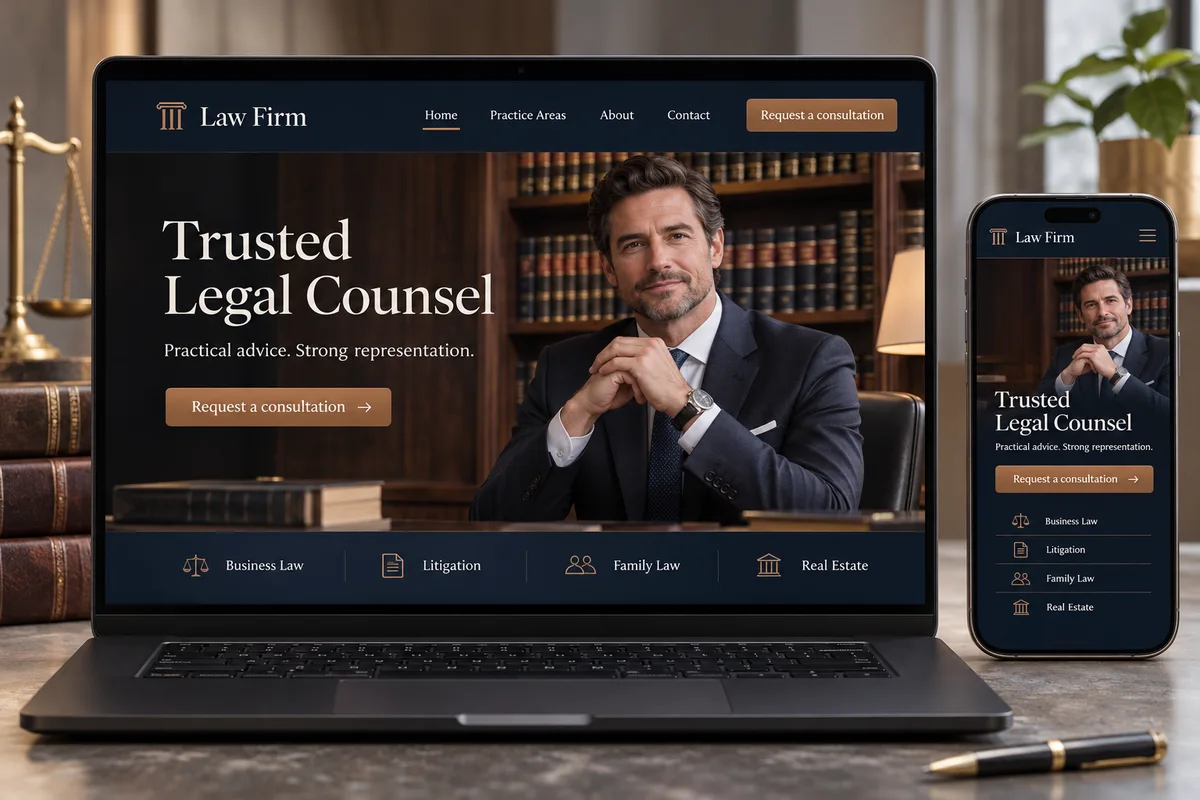
Separate private-client and business services, explaining the process without promising case outcomes.
Each practice area can have a dedicated page describing typical matters, engagement steps and the enquiry process.
Publish verified qualifications, areas of expertise, languages and contact information.
Present verified qualifications, practice areas and consultation languages without promising case outcomes.
Choose practice area, appointment time and format; optional online payment integration.
Scheduling can reflect a particular lawyer's availability, with forms collecting only essential initial contact details.
Assess separate document exchange with authentication, retention and access controls.
Confidential document exchange requires an agreed approach to access rights, retention and file security.
The basic website starts at €340 and includes: Practice areas, lawyer profiles, enquiry form and service pages. Quoted separately after assessing requirements: Protected document portal, contract workflows and CRM. Domain, hosting and paid third-party licences are not included. We confirm the scope and final quote before starting.
Build trust through precise information, clear navigation and confidentiality. Initial enquiry forms should not ask visitors to disclose confidential case details.
We build WordPress websites for businesses in Ukraine and internationally. We adapt structure, language, contact details, local payment options and integrations to your market. Before launch we test mobile layouts, forms and basic search optimisation, and prepare the owner handover.
Legal clients need to know whether a firm handles their issue: family matters, property, commercial disputes or contracts. Service pages should explain suitability, first-consultation process, possible documents and fee approach. Never imply a guaranteed legal outcome; distinguish general online information from advice on an individual case.
Legal services need practice-area and jurisdiction clarity without implying guaranteed case outcomes. Responsible professionals approve claims; confidential documents should not be collected through unsecured public enquiry forms.
A first enquiry form should avoid requesting confidential case details. Secure document exchange requires separate authentication, permissions, retention and deletion rules. Paid consultation booking is possible, but the practice must set confirmation, conflicts-of-interest screening and refund policies before automation.
Search pages should reflect real practice areas, jurisdictions and verifiable lawyer qualifications. Make clear where an informational article ends and legal representation begins. Test enquiry privacy, staff profiles, working contacts and mobile navigation; do not invent successful cases, client endorsements or professional credentials.
A law-firm visitor searches for help with a particular matter, so practice pages should state the service, jurisdiction, consultation route and how fees are assessed. Publish verified lawyer biographies, real office addresses and languages. Mention professional memberships only where supported and avoid implying guaranteed outcomes or authority to practise where none exists. A reader may need to know which documents are relevant, but sensitive case material should not be solicited through a public free-text box. Helpful content explains the process and its limits without pretending to replace individual legal advice.
An initial enquiry usually needs a matter category and safe contact route. A client portal with documents, contracts or case timelines requires permissions, audit logs, secure storage and retention policies. Check CRM and document-system APIs before promising integration. Test routing an enquiry to the appropriate team, confirmation, failed uploads and access restrictions between staff members. For SEO, publish substantive practice descriptions and accurately dated informational materials rather than fabricated court victories, unverified case statistics or duplicate pages targeting every city in which the firm has no office.
Prepare an accurate service or product list, real locations and contact details, up-to-date prices or quotation rules, rights-cleared media and someone to approve the facts. Confirm whether an existing CRM, calendar, stock system or other tool provides a documented API. Unknown integrations are assessed first, not included as an unsupported promise in a proposal.
Test mobile tasks, key-template performance, forms, notifications, contact routes, internal links, sitemaps, canonicals, language URLs and indexing readiness. Check exceptional conditions too: incomplete fields, unavailable slots or items, repeated requests, failed payment and external service outages. Analytics should capture meaningful enquiries and completed actions, not merely page views.
We agree the main pages and customer journeys first, then move through layout, content, integrations and end-to-end testing. The owner can update material in WordPress after handover. Timing depends on approved assets and checked integrations; we do not advertise an arbitrary universal three-day launch.
A starting guide for this category is €340. Basic scope: Practice areas, lawyer profiles, enquiry form and service pages. Scoped separately: Protected document portal, contract workflows and CRM. Domain, hosting and third-party paid services are agreed upfront; external accounts belong to the client.
A professional WordPress website for your business or practice, with up to five pages, easy editing and a clear enquiry journey.
Appointments, consultations or sessions with availability management.
Connect eligible payment providers to your online store.
Managed access for customers, students or partners based on project requirements.
Yes, subject to compatible booking, payment systems and practice requirements.
Yes, after agreeing a suitable secure architecture and access rules.
Yes. After handover you can update published content, services and contact details in WordPress. The owner retains the access credentials.
Tell us about your business and the functionality you need.
Message on WhatsApp ↗