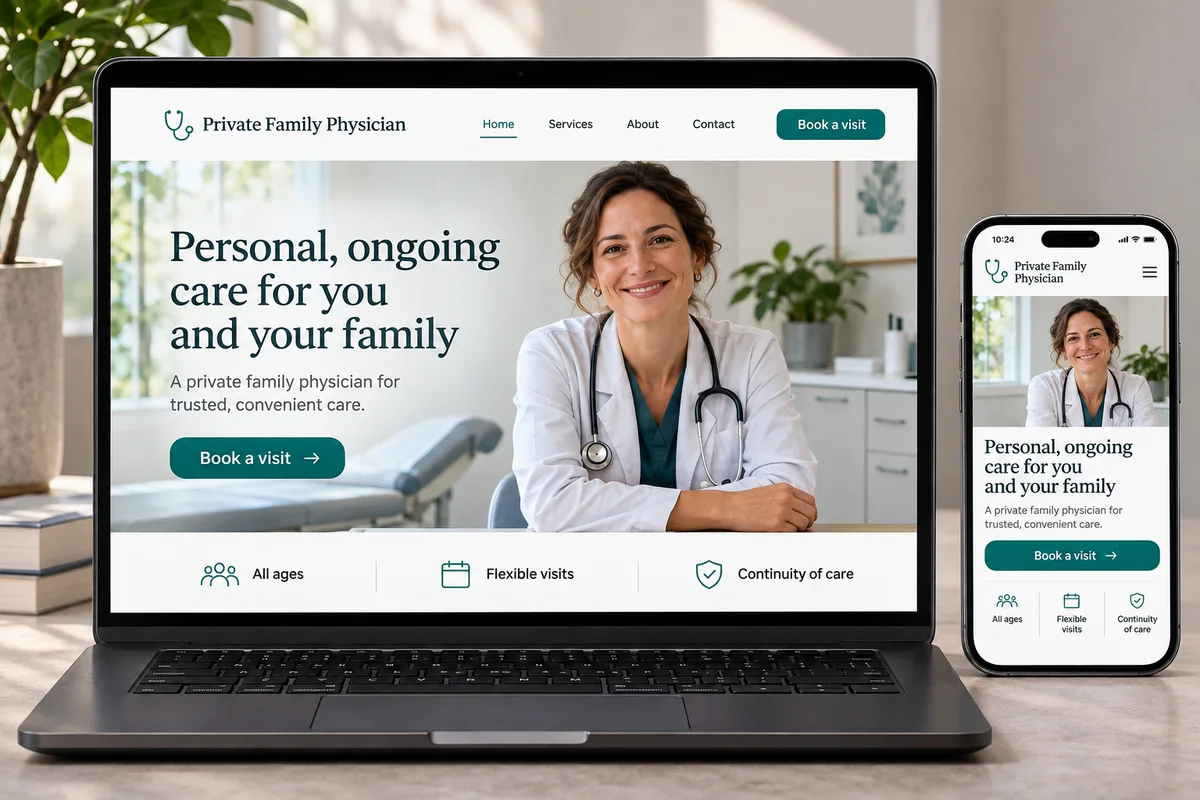
How the website supports real customer decisions
Patients need verified specialty, qualifications, practice location, fees and consultation options. Initial, follow-up and remote appointments may have different terms. Explain practical arrangements in plain language without substituting promotional claims for medical guidance. Qualifications, licences and services must be reviewed by the practitioner before publication.
A physician website must separate verified qualifications from marketing claims. The practitioner should approve services, consultation scope, locations, schedule and contact details before publication.
Implementation choices specific to this industry
Booking rules cover consultation duration, schedules at each practice, confirmation and rescheduling. A normal contact form should request minimal details, not patient histories. Any integration with a clinical system requires separate API and security assessment; sensitive records do not belong in an unverified booking widget or standard email notification.
Useful information for search visitors
Search pages should match actual practice areas, not claim to treat every condition. Publish factual credentials, current addresses and clear visit instructions. Test booking on phones, working contact routes and accessibility information; do not invent patient testimonials, qualifications or medical outcome guarantees.
A practical visitor journey
A private doctor's website should clarify speciality, consultation format and practice location, not promise treatment outcomes. Publish verified training and credentials, relevant licence information where appropriate, services, appointment conditions and real addresses. Explain the scope of consultations, duration, availability of telehealth and what is not included in a routine visit. Where several offices are used, schedules and contacts must match each site. The practitioner is responsible for verifying medical statements and professional details, while the developer ensures these facts have a clear and accessible structure.
Integration and acceptance details
A contact enquiry is very different from a patient-record portal. A simple form needs minimal contact details and preferred time; diagnoses, laboratory results and clinical documents should not be collected through generic WordPress fields. Live scheduling requires appointment lengths, accurate calendars, cancellation rules and notifications. Any medical-system link depends on checked API support and permissions. Before launch, test the mobile route from a speciality search to contact, unavailable appointment times and confidentiality of emails. No invented patient reviews, unverified qualifications or guarantees of successful care should be used to fill space.
What the business should prepare
Prepare an accurate service or product list, real locations and contact details, up-to-date prices or quotation rules, rights-cleared media and someone to approve the facts. Confirm whether an existing CRM, calendar, stock system or other tool provides a documented API. Unknown integrations are assessed first, not included as an unsupported promise in a proposal.
Decisions to settle in the brief
- Doctor profile: Which facts, limitations and policies require approval?
- Consultation services: What helps a visitor compare choices with confidence?
- Online appointments: Who confirms requests and keeps this information current?
- Practice information: What happens when data changes or a service fails?
Acceptance checks before handover
Test mobile tasks, key-template performance, forms, notifications, contact routes, internal links, sitemaps, canonicals, language URLs and indexing readiness. Check exceptional conditions too: incomplete fields, unavailable slots or items, repeated requests, failed payment and external service outages. Analytics should capture meaningful enquiries and completed actions, not merely page views.
Work stages and indicative cost
We agree the main pages and customer journeys first, then move through layout, content, integrations and end-to-end testing. The owner can update material in WordPress after handover. Timing depends on approved assets and checked integrations; we do not advertise an arbitrary universal three-day launch.
A starting guide for this category is €340. Basic scope: Doctor profile, specialties, verified qualifications, address and enquiry form. Scoped separately: Live booking, telehealth, medical systems and clinical data. Domain, hosting and third-party paid services are agreed upfront; external accounts belong to the client.
Services ↗ · Prices ↗ · Useful blog guides ↗