
Accounting packages
Compare agreed bookkeeping services and fees for sole traders, companies and specific tasks.
Compare packages by business type, transaction volume and reporting scope. An accountant confirms the final quotation.
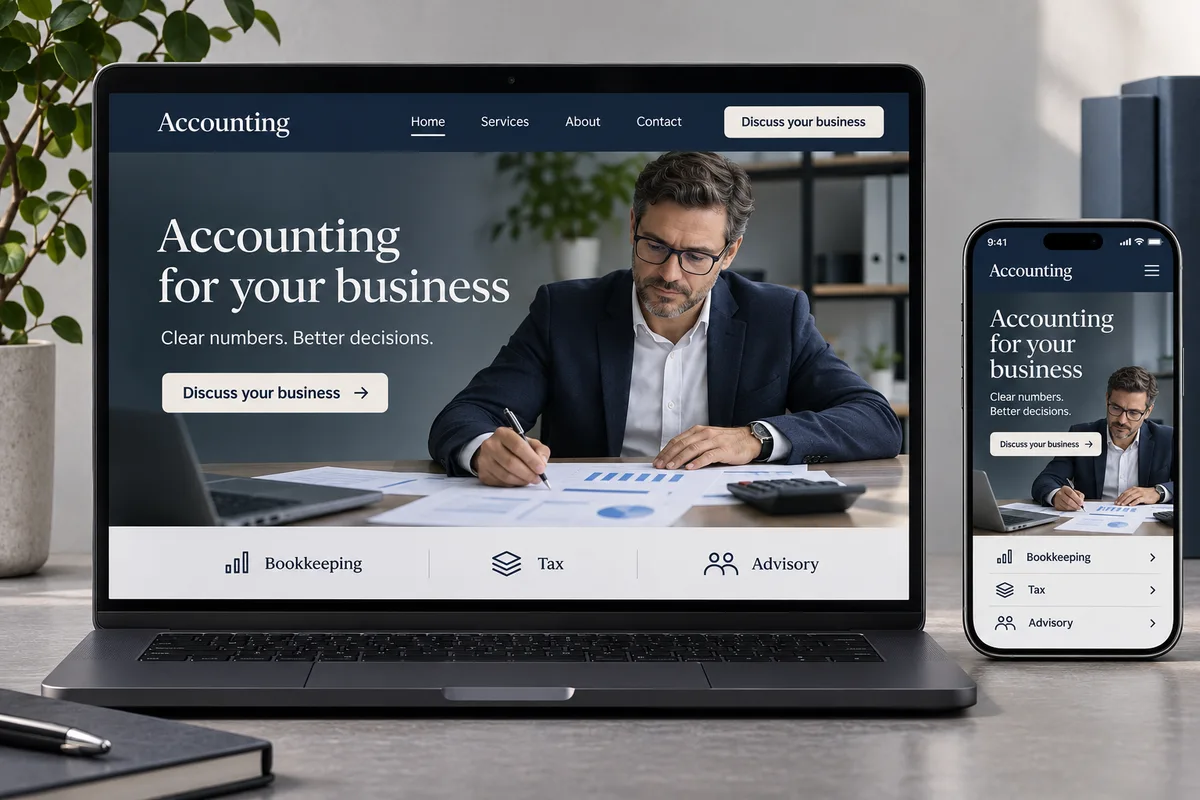
Compare agreed bookkeeping services and fees for sole traders, companies and specific tasks.
Compare packages by business type, transaction volume and reporting scope. An accountant confirms the final quotation.
Collect business type, approximate transaction volume and service requirements before a quote.
Collect company type, employee count and approximate document volume in a structured enquiry for the team.
Let prospective clients request a meeting or call with an accountant.
Book consultations by topic, specialist and available time, with agreed notification options.
A separately scoped secure area for agreed documents, statuses and communication.
For a client portal, agree roles, allowed document types, communication history and data protection requirements.
The basic website starts at €340 and includes: Accounting packages, client segments, pricing and enquiry form. Quoted separately after assessing requirements: Client portal, document workflows, CRM and estimators. Domain, hosting and paid third-party licences are not included. We confirm the scope and final quote before starting.
Explain service options and collect structured enquiries. Integrations with accounting software and financial document exchange are assessed separately.
We build WordPress websites for businesses in Ukraine and internationally. We adapt structure, language, contact details, local payment options and integrations to your market. Before launch we test mobile layouts, forms and basic search optimisation, and prepare the owner handover.
Accounting buyers search by business model: self-employment, small companies, payroll, reporting or cross-border transactions. The site should explain what a recurring service package covers, what is quoted separately and how onboarding works. Identify relevant jurisdictions and avoid presenting context-dependent tax information as universal advice.
Accountancy firms should explain supported business types, package boundaries and document exchange procedures. Tax files and financial statements should not be uploaded through an ordinary public enquiry form.
An initial form can request business type, approximate transaction volume and contact details without collecting financial databases or identity documents. Client portals need separately agreed authentication, permissions, logs, file transfer and retention policies. Check compatibility with accounting software before suggesting automatic data exchange is available.
Search architecture should reflect real service packages, regulated locations and common client questions. Publish verifiable qualifications and a clear method for preparing a quote. Test enquiry confidentiality, document handling and access revocation; never invent certifications or guaranteed tax savings.
Accounting firms may serve sole traders, small companies, international clients or a narrow sector. Service pages should say what bookkeeping, payroll, reporting and advice include, who supplies documents and what changes the fee. Do not promise freedom from tax risk or apply one country's rules to another without review. Demonstrate genuine expertise, supported languages, collaboration methods and important filing steps, while ensuring tax explanations are approved by an appropriately qualified professional. Clients should know what information they need to prepare before the first meeting, rather than face an unexplained quotation form.
A monthly-fee estimator may depend on legal form, transaction volume, payroll count and reporting complexity. When an exact amount requires document review, explain that boundary. Payroll records, tax reports and personal data should be exchanged through role-based secure workflows with retention rules, not unsecured public attachments. Verify accounting-system APIs and permissions before offering automated sync. Test the pricing enquiry, package selection, notification, failed file upload and separation between different client accounts. These practical controls matter more than inflated claims about effortless accounting automation.
Prepare an accurate service or product list, real locations and contact details, up-to-date prices or quotation rules, rights-cleared media and someone to approve the facts. Confirm whether an existing CRM, calendar, stock system or other tool provides a documented API. Unknown integrations are assessed first, not included as an unsupported promise in a proposal.
Test mobile tasks, key-template performance, forms, notifications, contact routes, internal links, sitemaps, canonicals, language URLs and indexing readiness. Check exceptional conditions too: incomplete fields, unavailable slots or items, repeated requests, failed payment and external service outages. Analytics should capture meaningful enquiries and completed actions, not merely page views.
We agree the main pages and customer journeys first, then move through layout, content, integrations and end-to-end testing. The owner can update material in WordPress after handover. Timing depends on approved assets and checked integrations; we do not advertise an arbitrary universal three-day launch.
A starting guide for this category is €340. Basic scope: Accounting packages, client segments, pricing and enquiry form. Scoped separately: Client portal, document workflows, CRM and estimators. Domain, hosting and third-party paid services are agreed upfront; external accounts belong to the client.
A professional WordPress website for your business or practice, with up to five pages, easy editing and a clear enquiry journey.
Managed access for customers, students or partners based on project requirements.
Connect your website to CRM and external systems to automate lead delivery, order processing and status updates.
Connect eligible payment providers to your online store.
Yes, using agreed pricing rules or ranges; the accountant confirms the final quote.
Yes, if a compatible API or supported connector is available.
Yes. After handover you can update published content, services and contact details in WordPress. The owner retains the access credentials.
Tell us about your business and the functionality you need.
Message on WhatsApp ↗